


Most traceability programs don't fail because the tooling is bad. They fail because someone picked a tool, ran a two-hour training session, sent a Slack announcement, and then wondered six weeks later why the trace links looked exactly like they did before — sparse, stale, and mostly invented during audit prep.
Traceability is an organizational behavior change, not a feature you turn on. The links between a requirement, its tests, its decisions, and its release evidence only exist because humans (and increasingly, automated hooks) create them at the right moment in their workflow. If the workflow doesn't reward that behavior — or worse, punishes it with extra clicks and no visible payoff — adoption dies quietly.
This is a playbook for actually landing that change. Not the "why traceability matters" pitch — you already believe it or you wouldn't be here. This is about who does what, when, how you measure whether it's sticking, and where the whole thing breaks as your org gets bigger. Think of this as the org-change layer that sits on top of a 90-day requirements maturity roadmap — the roadmap tells you what maturity to build, this tells you how to get people to do it.
Why adoption fails even when the tooling is right
There's a pattern that shows up repeatedly. A team buys or builds a traceability capability. Leadership is bought in. The BAs even like it. Three months later, coverage is at 40% and everyone's frustrated.
What went wrong is almost always one of these three things — and usually all three at once:
The change was announced, not onboarded. People were told the new expectation existed. Nobody walked them through what "good" looks like in their specific role on a real ticket they actually own. A developer and a business analyst have completely different moments where a trace link should get created, and a one-size training deck serves neither.
There was no incentive alignment. Traceability is a cost paid now for a benefit collected later — usually by someone else, during a regression cycle or an audit. If the person creating the link never feels the payoff, and their velocity metrics don't account for the extra work, they'll rationally deprioritize it. Classic tragedy-of-the-commons setup.
Nobody owned the adoption number. Coverage was "everyone's responsibility," which means it was no one's. No cadence for reviewing it, no governance checkpoint where a gap actually stopped something, no clear escalation when a team drifted.
The fix isn't more discipline or more nagging. It's designing the rollout as a system with clear roles, staged expectations, and measurable checkpoints — the same way you'd design any operational process that has to survive contact with a busy team.
Structure the rollout as ramps, not a launch
The single biggest mental shift: stop thinking "go-live date" and start thinking "ramp per role." Different roles need to reach competence at different times, and loading everyone in on day one guarantees that the roles who aren't ready yet will create bad data that poisons trust in the whole system.
Stop losing track of critical project requirements.
GoReqly helps you capture, organize, and track every requirement with precision and clarity.
- Centralized requirements repository
- Collaborative editing & commenting
- Traceability & version control
No credit card required
A workable sequence looks like this:
-
Weeks 1–2
Anchor roles ramp first.
BAs and product managers — the people who author requirements — go first, because they define the artifacts everything else links to. If the requirement isn't well-formed, no downstream link matters. -
Weeks 3–5
Delivery roles ramp.
Developers and QA start creating requirement-to-test and requirement-to-commit links on new work only. Not backfill. New work only. -
Weeks 6–8
Coordination and approval roles ramp.
Tech leads, release managers, and approvers start using the trace data for their signoffs and release gates — which is the moment the earlier roles finally see the payoff of their linking. -
Weeks 9–12
Backfill and hardening.
Now, and only now, you selectively backfill high-risk legacy areas and tighten the governance checkpoints.
The reason approvers ramp after delivery roles is deliberate. When a release manager can suddenly pull a clean evidence view because the developers linked their work, those developers get visible confirmation that the effort wasn't busywork. That feedback loop is what converts compliance into habit.
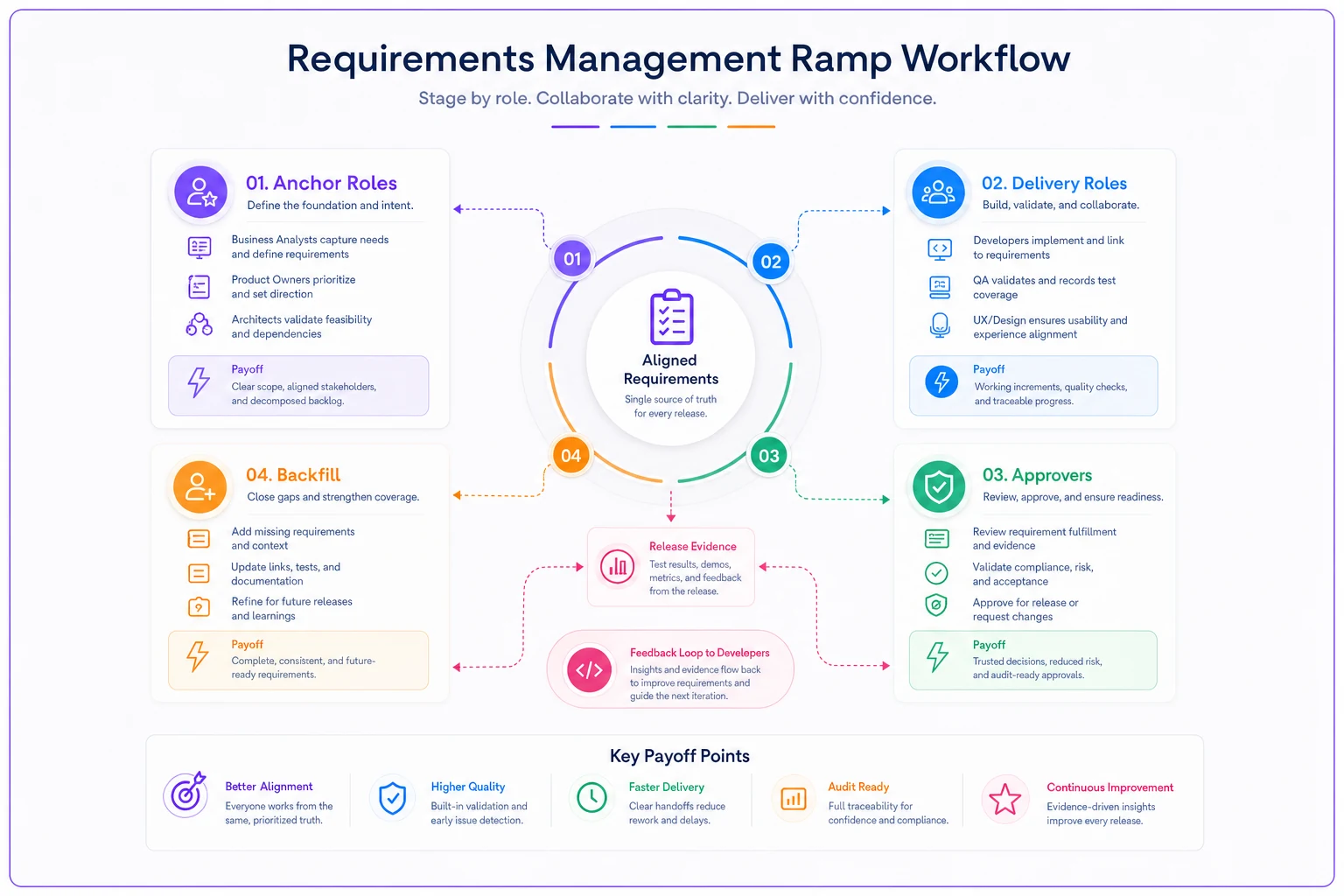
Here's a simple workflow view of the ramps and feedback loop.
Role ramp templates
A compact ramp template you can adapt per role. Each role gets a "by end of ramp" competence definition, a first-week focus, and one thing they explicitly do not have to worry about yet.
| Role | First-week focus | Competent by end of ramp when they... | Not responsible for (yet) |
|---|---|---|---|
| Business Analyst | Authoring requirements with stable IDs and clear acceptance criteria | Every new requirement has a unique ID, owner, and at least one downstream link intent | Backfilling old specs |
| Product Manager | Linking requirements to decisions and priorities | Priority changes reference the requirement ID; decisions are captured against requirements | Test-level linking |
| Developer | Linking commits/PRs to requirement IDs | New PRs reference the requirement they implement | NFR and analytics linking |
| QA / Test | Linking test cases to requirements | New test cases carry the requirement ID they verify | Legacy test mapping |
| Tech Lead | Reviewing link quality in PR review | Rejects PRs missing requirement references | Cross-team artifact contracts |
| Release Manager | Pulling evidence views per release | Can assemble a release's linked artifacts without manual chasing | Authoring anything |
The "not responsible for yet" column matters more than people expect. It prevents the overwhelm where someone feels they have to do everything perfectly on day one and instead does nothing.
Incentive design that doesn't backfire
This is where most playbooks get lazy and say "make it part of the culture." That's not an incentive, that's a wish.
Real incentive design for traceability has to account for the fact that you can accidentally reward the wrong behavior. Set a hard KPI of "100% link coverage" and you'll get 100% coverage — of garbage links, created to hit the number, pointing to the wrong things. Coverage without correctness is worse than no coverage, because it looks trustworthy and isn't.
-
Reward the moment of linking, not the aggregate. Recognize the developer whose PR came in with a clean requirement reference. Make it visible in review. Small, frequent recognition beats a quarterly coverage dashboard nobody reads.
-
Never tie an individual's velocity purely to coverage. Tie team health to it. Traceability is a shared asset; the incentive should be shared too, or you get gaming.
-
Give the payoff back to the creator. The strongest incentive is self-interest realized. When a QA engineer can instantly see which tests are affected by a changed requirement, they stop viewing linking as a tax and start viewing it as their own regression insurance.
-
Make the absence of links create friction, not the presence. Instead of rewarding people for linking, make it slightly harder to merge or release without a link. Friction placed at the right gate is the most durable incentive there is.
Prefer team-level incentives and small, visible recognition in code review rather than individual KPIs tied to coverage.
That last point is the quiet one. The best-adopted traceability programs rarely rely on carrots. They rely on well-placed, minimal friction — a PR template field, a release gate check — that makes the traced path the path of least resistance.
When incentives are a bad idea
Skip formal incentives entirely if your team is under eight people and everyone already sees the same board. At that scale, incentive schemes create more overhead than they solve. A single shared expectation plus visible payoff is enough. Incentive design earns its keep when you're coordinating across multiple squads who don't share daily context.
Training curricula that survive week three
Training fails when it's front-loaded and generic. Someone sits through a demo of the whole system, retains maybe 20% of it, and then hits their first real edge case with no support.
Structure training as short, role-specific, and spaced. The goal isn't comprehension in the room — it's competence on the third real ticket.
Session 1 (all roles, 45 min): The shared model. What an artifact is, what a link means, why stale links are dangerous. This is the only session everyone attends together, and it's short. Its whole job is to establish shared vocabulary so a "link" means the same thing to a BA and a developer.
Session 2 (role-specific, 30–45 min): Your workflow, your links. Done live, on a real ticket, per role group. BAs practice authoring with IDs. Developers practice referencing a requirement in a PR. Nobody watches a demo of a role that isn't theirs.
Session 3 (role-specific, 2 weeks later): The edge cases. By now people have hit real friction. This session is Q&A-driven, covering the messy stuff: split requirements, changed requirements mid-sprint, one commit touching three requirements. Spacing this two weeks out is deliberate — the questions are real by then.
Ongoing: Office hours, not more sessions. A weekly 30-minute drop-in for the first two months does more than any additional formal training. Adoption problems show up as specific, individual confusions, and those get solved in conversation, not slides.
One thing worth internalizing: the teams that ramp fastest are almost never the ones with the most training hours. They're the ones where the training was tied to work they were already doing that week. Abstract training decays. Applied training sticks.
Comms cadence: keep it alive without becoming noise
A rollout dies the same way a lot of internal initiatives die — the announcement lands, everyone nods, and then silence lets old habits reassert themselves. But over-communicating is just as fatal; people tune out a channel that fires constantly.
-
Weekly during weeks 1–6 a short, specific update. Not "adoption is going great" — that's noise. Instead: "This week, dev PR link coverage went from 30% to 55%. QA is next." Concrete numbers with a named next step.
-
Biweekly during weeks 7–12 shift from progress to payoff. Highlight a real moment the trace data saved time — a regression caught early, an audit request answered in minutes.
-
Monthly after that the number, the trend, one story.
Every comms message should either report a real metric movement or show a concrete payoff. The moment you send a message that's pure encouragement with no substance, you've trained people to skim the channel.
Adoption KPIs that actually reflect reality
Coverage is the metric everyone reaches for, and it's the most misleading one used alone. Here's a set that triangulates real adoption instead of one gameable number.
-
Link coverage on new work — percentage of requirements created this period that have downstream links. Tracking new work separately from total is critical, because total coverage hides whether current behavior is improving.
-
Link freshness — percentage of links verified or touched in the last N days. A high-coverage, low-freshness system is decaying.
-
Time-to-evidence — how long it takes a release manager to assemble linked evidence for a release. This is the payoff metric, and it's the one leadership actually cares about.
-
Link correctness (sampled) — a manual spot-check of around 20 random links per sprint. Correctness can't be automated fully, and sampling keeps you honest about whether coverage is real.
-
Gate friction rate — how often a merge or release is blocked for missing links, and whether that number is trending down over time (which means the behavior is becoming automatic).
For adoption specifically, these five are enough to know whether you're winning.
A simple adoption-measurement recipe
-
Snapshot new-work coverage and freshness at the start of each week.
-
Sample roughly 20 links for correctness once per sprint.
-
Measure time-to-evidence on every release.
-
Chart all three against the ramp schedule — you should see anchor roles improve first, then delivery, then time-to-evidence drop as approvers come online.
-
Any metric flat for two weeks becomes an agenda item at the governance checkpoint.
That last step is what separates a measured rollout from a hopeful one. A metric with no forum to discuss it is a metric that gets ignored.
Governance checkpoints on the 90-day path
Governance here doesn't mean a heavyweight review board. It means a few pre-agreed moments where you check the numbers and decide whether to proceed, hold, or intervene. The mistake is either having no checkpoints (drift) or having so many that governance itself becomes the bottleneck — the exact failure mode covered in the case for a lightweight requirements governance blueprint.
-
Day 30 — Anchor check. Are BAs and PMs authoring clean, linkable requirements? If not, do not proceed to loading delivery roles. Proceeding on a weak foundation is how you get garbage coverage.
-
Day 60 — Delivery check. Is new-work link coverage from dev and QA climbing steadily? Is correctness holding on the samples? This is where you decide whether the gate friction needs adjusting.
-
Day 90 — Payoff check. Has time-to-evidence dropped meaningfully? Can a release manager assemble evidence without chasing people? If yes, you shift from rollout mode to steady-state maintenance.
Each checkpoint has one binary decision baked in: proceed or hold. Governance that produces long documents but no decisions is theater.
A real scenario: mid-sized product org, three squads
A product company with three delivery squads — around 24 people total — had been doing traceability entirely manually, assembled in a panic before each quarterly compliance review. Assembling release evidence took roughly two days of a BA's time per release, and audit prep every quarter ate close to a full week across the team.
They ran a 90-day ramp roughly along the lines above. Anchor roles (four BAs, three PMs) went first. Delivery roles came online around week three, linking new work only — they explicitly did not try to backfill everything, which had been the trap in a previous failed attempt.
The numbers weren't dramatic in the first month, and that's the point. New-work coverage sat around 45% by day 30, which felt underwhelming but was honest. By day 60 it was in the 70s, and correctness sampling stayed high because they hadn't chased a vanity number. By day 90, assembling release evidence dropped from two days to a few hours, and the following quarter's audit prep took closer to a day and a half instead of a week.
What actually made it stick wasn't the tooling. It was the week-six moment when a release manager pulled a clean evidence view in front of the team, and the developers who'd been grumbling about the extra PR field saw where their effort had gone. Adoption stopped being pushed and started being pulled.
When this whole approach is overkill
Be honest about scale. If you're a single squad of six shipping a young product, a full role-by-role ramp with incentive design and three governance checkpoints is bureaucratic overkill. You'll spend more energy on the rollout than on the actual work. A single shared expectation, a PR template field, and one weekly glance at coverage is genuinely enough.
This playbook earns its complexity when you cross into multi-squad coordination, when handoffs between teams start dropping context, or when audit and compliance pressure makes evidence assembly a recurring fire drill. That's the point where informal expectations stop scaling — a transition explored in depth in the piece on when requirements artifacts fail to scale. Below that threshold, keep it light. Above it, the ramp structure is what keeps the whole thing from collapsing under its own coordination cost.
Where the system tends to break as you grow
A few failure points worth watching for, because they show up predictably as headcount climbs:
-
Anchor role dilution. As you hire more BAs, the requirement-authoring quality that everything else depends on gets uneven. New authors need the ramp too — you can't assume onboarding covers it.
-
Cross-squad link ambiguity. When one squad's work links to another squad's requirement, ownership of that link gets fuzzy. Define who owns cross-team links explicitly, or they rot.
-
Gate erosion. Under deadline pressure, someone quietly disables the merge gate "just for this release." It rarely comes back on. Protect the gate.
-
Metric fatigue. After 90 days, people stop looking. Fold the two or three metrics that matter into a meeting people already attend, rather than maintaining a separate dashboard nobody visits.
None of these are exotic. They're the ordinary entropy of any process under scaling pressure, and the ramp-plus-checkpoint structure exists specifically to catch them before they compound.
Traceability adoption isn't a training problem or a tooling problem — it's a sequencing and incentive problem. Ramp the anchor roles before the ones that depend on them. Place friction at the gate instead of nagging people. Give the payoff back to the person doing the work as fast as you can, so the behavior becomes self-reinforcing. Measure the few things that reveal whether it's real, and give those numbers a forum where they trigger actual decisions. Do that, and traceability stops being the thing you scramble to fake before an audit and becomes what it should be: a working part of how the team ships.
Ready to transform your product delivery?
Join 2,000+ teams using GoReqly to improve requirements accuracy, reduce rework, and accelerate time to market.