



Three months ago, a fintech startup called me in panic. Their product team had grown from 8 to 35 people in six months, and suddenly nobody could figure out what anyone was building. Sprint planning took four hours. Developers built features that didn't match what product envisioned. QA found bugs that weren't bugs—just misunderstood requirements.
The CTO showed me their setup. User stories lived in Jira. Technical specs scattered across Confluence pages, some updated, most abandoned. Design mockups in Figma had comments that contradicted the Jira tickets. API documentation existed in three places, each slightly different. Meeting notes with critical decisions sat in personal Google Docs that half the team couldn't access.
"We used to just talk," he said. "Now we spend more time documenting than building, and we still can't find anything."
This wasn't a tools problem or a process problem. Their requirements ecosystem—the living network of artifacts, ownership, and handoffs that makes product development possible—had hit its breaking point. Most teams never see it coming because requirements infrastructure stays invisible until it collapses.
The artifact explosion nobody plans for
Requirements ecosystems follow a predictable growth curve that catches every scaling team off guard. You start with user stories. Simple, clean, manageable. Then edge cases need documentation, so you add acceptance criteria. Technical constraints need capturing, so you create architecture decision records. Design needs specificity, so interaction specs appear. Before long, you're managing a dozen different artifact types, and nobody remembers why half of them exist.
Each artifact develops its own lifecycle, format, storage location, and informal ownership. A user story might live for a sprint. An API spec needs to survive as long as the code exists. Design mockups become irrelevant once implemented, but compliance needs them archived for two years.
Dependencies between artifacts? Nobody tracks them. When a product requirement changes, which technical specs need updating? When an API evolves, which user-facing documentation needs revision? When design pivots, which test cases become invalid?
Most teams discover these dependencies through failure. A developer builds to an outdated spec because nobody knew it connected to a recently updated requirement. QA tests against old acceptance criteria because the dependency chain broke three handoffs ago. Customer success promises features based on mockups that never made it to development.
Why traditional documentation completely misses the point
Every struggling team tries the same fix: better documentation standards. Templates. Reviews. Approval workflows. Documentation days. It never works, because documentation isn't the problem—the ecosystem is.
Stop losing track of critical project requirements.
GoReqly helps you capture, organize, and track every requirement with precision and clarity.
- Centralized requirements repository
- Collaborative editing & commenting
- Traceability & version control
No credit card required
Think about how requirements actually flow through your organization. A customer complaint triggers a feature request. Product research generates user interviews. Those interviews inform problem statements. Problem statements become user stories. User stories spawn technical investigations. Technical investigations reveal constraints that reshape user stories. Designs emerge that interpret user stories. Development implements designs while discovering new edge cases. QA validates against acceptance criteria while finding gaps. Each step generates artifacts, transforms information, and creates new dependencies.
Traditional documentation treats each artifact as a standalone document. Write it, review it, approve it, file it. But that's like trying to understand a river by collecting water samples. The ecosystem is the flow, not the documents.
Teams that scale successfully stop thinking about documentation and start thinking about information flow. How does customer feedback become code? Where does context get lost? Which transformations happen smoothly, and which create friction? What information needs to persist, and what should deliberately expire?
Once you see requirements as a living ecosystem rather than a documentation burden, the solutions become obvious. You need artifacts that know about each other. Ownership that follows natural boundaries. Lifecycles that match actual usage patterns. Handoffs designed as collaborations, not transactions.
Mapping the real workflow (not the one in your process docs)
Your actual requirements workflow looks nothing like your process documentation. Want proof? Track a single requirement from conception to deployment. Document every place it gets written down, every transformation it undergoes, every person who touches it, every tool it passes through.
I mapped this for an e-commerce team recently. Their official process showed requirements flowing neatly from product to design to development to QA. Clean, linear, logical.
The reality? Their requirements bounced between people across nearly a dozen tools with too many transformation points. Product managers wrote initial ideas in Notion. Those got discussed in Slack, refined in Zoom calls (with notes scattered everywhere), formalized in Jira, expanded in Confluence, interpreted in Figma, questioned in code reviews, clarified in more Slack threads, adjusted during development, validated in TestRail, and finally documented in release notes that bore little resemblance to the original requirement.
Each bounce introduced potential drift. Each transformation risked losing context. Each tool transition created a synchronization point that could fail.
Your first step toward a functional requirements ecosystem is mapping what actually happens, not what should happen. Spend a week following requirements through your system. Note where they live, who touches them, how they transform, where they get stuck.
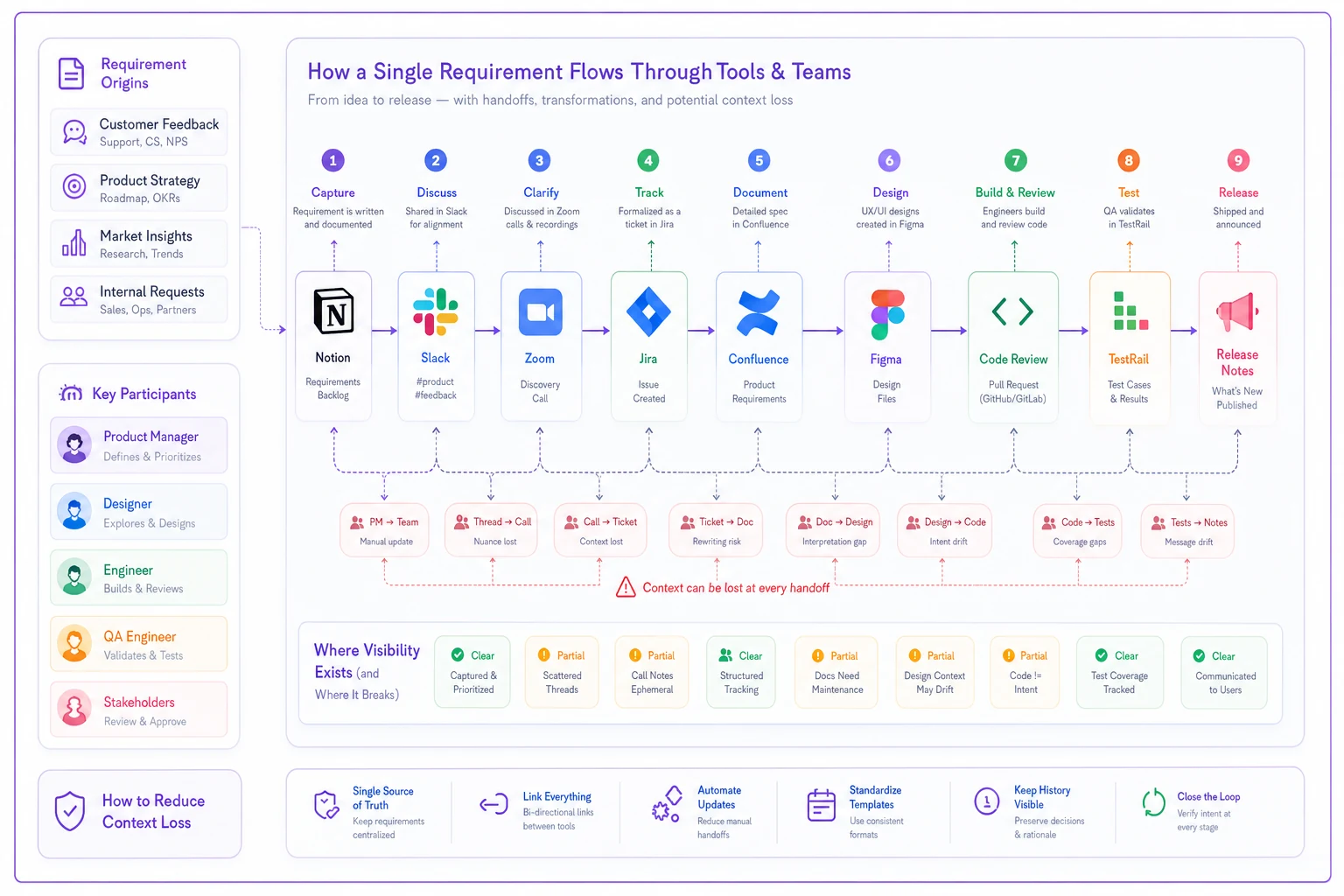
This visual represents the requirement's path through tools and teams and highlights transformation points where context can be lost.
You'll find shadow artifacts that teams create because official ones don't work. Zombie documents that everyone references but nobody updates. Critical information living in chat threads and email. Duplicate work where teams recreate existing documentation they can't find. Broken handoffs where information consistently gets lost.
This map becomes your blueprint for building an ecosystem that matches reality rather than forcing reality to match your process.
The ownership matrix everyone needs but nobody builds
Ownership sounds simple until you try to define it. Who owns a user story after development starts—product or engineering? Who owns test cases—QA who writes them or developers who need them? Who owns API documentation—the backend team who creates it or the frontend team who consumes it?
Most teams operate with implicit ownership that breaks down under pressure. Sarah always handled user stories, but now there are three product managers. Mike managed technical specs, but he's swamped and they're falling behind. Everyone assumes someone else owns edge case documentation, so nobody does.
A B2B SaaS team that successfully scaled from 20 to 80 people built an ownership matrix that actually works:
| Artifact | Creator | Active Owner | Reviewer | Archiver | Escalation |
|---|---|---|---|---|---|
| Problem Statements | Product | Product | Engineering Lead | Product | VP Product |
| User Stories | Product | Product → Dev (at sprint start) | Tech Lead | Scrum Master | Product Manager |
| Technical Specs | Tech Lead | Dev Team | Architect | Tech Lead | CTO |
| Test Plans | QA | QA | Dev + Product | QA Lead | QA Lead |
| Design Mockups | Design | Design → Dev (at handoff) | Product | Design | Head of Design |
| API Docs | Backend Dev | Backend Team | Consumer Teams | Tech Lead | Backend Lead |
| Release Notes | Product | Marketing | Support | Product | VP Product |
Notice the ownership transitions. User stories shift from product to development when sprint starts. Mockups transfer from design to development at handoff. This reflects reality—ownership needs to follow the work.
The escalation column matters more than you think. When ownership conflicts arise (and they will), you need a predetermined resolution path. Otherwise, you'll waste hours in meetings debating who should update what.
Ownership includes maintenance responsibility. If you own it, you keep it current or explicitly mark it obsolete. No orphaned artifacts. No zombie documents. No "someone should update that" syndrome.
Building handoffs that preserve context instead of losing it
Traditional handoffs are where requirements go to die. Product "completes" requirements and hands them to development. Development "finishes" code and hands it to QA. Each handoff loses context, which means by the third handoff, you're operating on assumptions rather than requirements.
The teams that scale successfully don't do handoffs—they do collaborative transitions. A mobile app company restructured their handoffs after losing months to requirement misunderstandings.
The Overlap Method
-
Product defines initial requirements (Days 1-3)
-
Engineering joins to discuss feasibility (Days 3-5)
-
Both teams refine requirements together (Days 5-7)
-
Engineering takes primary ownership (Day 7+)
-
Product stays engaged for clarification (Ongoing)
During the overlap, both teams have write access to requirements. Changes get discussed in real-time. Context transfers through conversation, not just documentation. By the time engineering takes ownership, they understand not just what to build but why.
The Three-Document Rule
-
What we're building (requirement)
-
How we're building it (approach)
-
What could go wrong (risks and assumptions)
That's it. No twenty-page specs. No endless documentation. Three focused artifacts that capture essential context without overwhelming anyone.
The Question Log
Every handoff includes a living question log. As the receiving team reviews requirements, they add questions. The sending team answers them in the document, creating a permanent record of clarifications. Future team members can see not just the requirements but the thinking behind them.
This sounds like more work, but it's actually less. You spend time upfront to save multiples of that time in clarification, rework, and fixes. Development time often drops significantly after implementing overlap handoffs, purely from reduced back-and-forth.
Lifecycle patterns that prevent artifact zombies
Dead documents pollute every requirements ecosystem. That user story from six months ago that might still be relevant. The technical spec that nobody's updated since version 1.0. The design mockup that doesn't match the current product but still shows up in searches.
Artifact zombies happen when you don't define explicit lifecycles. Every artifact needs birth criteria, active period, transition triggers, retirement conditions, and archive requirements.
A media company developed this lifecycle framework after their Confluence became a graveyard of outdated requirements:
Sprint-Cycle Artifacts (User stories, sprint goals, daily updates)
-
Born
Sprint planning
-
Active
Current sprint only
-
Transition
Sprint end
-
Retire
Sprint + 1
-
Archive
3 months searchable, then cold storage
Feature-Cycle Artifacts (Requirements docs, design specs, test plans)
-
Born
Feature kickoff
-
Active
Until feature ships
-
Transition
Feature launch
-
Retire
Launch + 3 months
-
Archive
1 year searchable, 7 years compliance storage
Permanent Artifacts (API docs, architecture decisions, compliance requirements)
-
Born
System design or regulatory requirement
-
Active
As long as system exists
-
Transition
Major version changes
-
Retire
System deprecation + 1 year
-
Archive
Permanent with version history
Different artifacts need different lifecycles. Trying to force everything into the same retention policy creates either information loss or zombie documents. Match the lifecycle to the artifact's purpose.
They also automated lifecycle transitions. When a sprint ends, stories automatically move to archive state. When features ship, requirements get tagged as historical. When APIs version, old docs get marked deprecated. No manual cleanup required.
The tools conversation everyone has backwards
Every team stuck in requirements hell thinks better tools will save them. They evaluate fifteen different platforms, spend months integrating systems, train everyone on new workflows... and six months later, they're back where they started, just with fancier tools.
Tools don't fix broken ecosystems. They amplify whatever system you already have. If your ownership is unclear, tools make that confusion faster. If your handoffs lose context, tools help you lose it more efficiently.
Get the ecosystem right first, then choose tools that support it. A spreadsheet with clear ownership beats Jira with chaos. Google Docs with defined lifecycles beats Confluence with zombie documents.
Certain tool characteristics make ecosystem management easier: version control that doesn't require manual intervention, linking that maintains references across artifacts, permissions that match your ownership model, search that understands artifact relationships, automation that enforces lifecycle transitions, and APIs that let you build custom integrations.
The most successful teams often use boring tools in smart ways rather than smart tools in boring ways. One team built their entire requirements ecosystem on top of GitHub—not because it's designed for requirements, but because developers already lived there, version control was automatic, and the PR model naturally created collaborative handoffs.
What AI automation actually helps with (and what it doesn't)
AI-powered operational software makes sense for requirements ecosystems, but not how most people expect. Everyone wants AI to write better requirements or automatically generate test cases. That's missing the point. AI excels at the coordination and synchronization work that makes ecosystems function.
-
Detecting when related artifacts drift out of sync
-
Identifying missing dependencies between requirements
-
Flagging terminology inconsistencies across documents
-
Generating notifications when artifacts need review
-
Suggesting which artifacts need updating when requirements change
-
Creating cross-artifact search that understands relationships
-
Maintaining audit trails without manual logging
-
Surfacing relevant historical context during requirement creation
Where AI doesn't help (yet): making product decisions, understanding customer needs, resolving requirement conflicts that need business judgment, creating genuinely new requirements from scratch, or determining what should be built.
The successful implementations treat AI as intelligent infrastructure. It watches for patterns, maintains connections, flags anomalies, and handles routine synchronization. This frees humans to focus on the creative and strategic work of defining what to build.
One team reduced their requirements synchronization overhead substantially after implementing AI-powered artifact monitoring. Not because AI wrote requirements, but because it eliminated the manual work of keeping everything connected and current.
The scalability cliff nobody warns you about
Between 40 and 60 people, every product team hits the same wall. The requirements ecosystem that worked through informal coordination suddenly collapses. It's predictable enough that you can watch it happen in real-time.
Week 1: "Why are there so many meetings about requirements?" Week 4: "Can we add a requirements review to the sprint ceremony?" Week 8: "We need better templates for our user stories" Week 12: "Let's try this new requirements management tool" Week 16: "Maybe we need a dedicated business analyst role" Week 20: Complete breakdown, emergency reorganization
The pattern is so consistent across companies that it feels like a natural law. But it's not inevitable—it's what happens when you try to scale informal systems past their breaking point.
Teams that navigate this successfully start preparing around 25 people, well before the crisis. They map their current ecosystem while it's still simple, establish ownership before conflicts arise, define lifecycles while everyone still agrees, build automation before manual work overwhelms them, and create handoff processes while trust is high.
The difference between teams that scale smoothly and teams that hit the wall? About six months of preparation. The ones who wait until they feel the pain are already too late.
Starting where you are (not where you wish you were)
The biggest mistake teams make is trying to build the perfect requirements ecosystem from scratch. They spend months designing ideal processes, comprehensive templates, elaborate governance structures... and nobody uses any of it because it doesn't match how work actually happens.
Start with one painful handoff. Maybe it's product to engineering, where requirements constantly get misunderstood. Map that single handoff. Document what information flows through it. Identify where context gets lost. Create one simple improvement—maybe a question log or an overlap period. Test it for a sprint. Adjust based on what actually happens.
Once that handoff works better, move to the next painful point. Maybe it's engineering to QA, where test cases don't match implementation. Apply the same process. Small improvement, test, adjust, solidify.
This incremental approach feels slow, but it builds an ecosystem that matches your team's reality. More importantly, it brings everyone along gradually rather than forcing massive change all at once.
A gaming company transformed their requirements ecosystem this way over six months:
-
Month 1
Fixed product-to-engineering handoff with overlap periods
-
Month 2
Established ownership for five critical artifact types
-
Month 3
Defined lifecycles for sprint-based artifacts
-
Month 4
Built automated archival for expired documents
-
Month 5
Created cross-artifact linking system
-
Month 6
Implemented AI-powered synchronization monitoring
By month six, their requirements flow had completely transformed, but no single change felt disruptive. The ecosystem evolved naturally rather than being imposed.
The ecosystem health metrics that actually matter
Most teams measure requirements through completion metrics—how many stories have acceptance criteria, what percentage of requirements are "approved," how many documents are up-to-date. These metrics tell you nothing about ecosystem health.
Healthy requirements ecosystems show different signals. Flow efficiency—how long does it take for a requirement change to propagate through all dependent artifacts? In healthy ecosystems, updates cascade quickly. In broken ones, you find outdated information months later.
Context preservation matters too. When requirements move through three handoffs, how much original context survives? Healthy ecosystems preserve why decisions were made, not just what was decided.
Discovery time reveals ecosystem problems. How long does it take a new team member to find and understand requirements for a feature? Healthy ecosystems make information discoverable in minutes, not hours.
Conflict rate shows synchronization health. How often do different artifacts contradict each other? Healthy ecosystems maintain consistency automatically.
Rework attribution connects directly to business impact. What percentage of rework stems from requirement misunderstandings versus technical challenges? Healthy ecosystems minimize requirement-based rework.
One team tracks a single metric: "requirement clarification requests per sprint." When developers need to ask fewer questions, the ecosystem is working. When questions spike, something's broken. Simple, direct, actionable.
Building systems that grow with your team
Requirements ecosystems aren't built—they evolve. The patterns that work at 15 people fail at 50. The processes that work at 50 people become bureaucratic overhead at 150. Planning for evolution from the start prevents major reconstruction later.
Building operational software that can adapt alongside your requirements ecosystem makes this evolution smoother. AI-powered platforms excel at maintaining connections between artifacts as they multiply, automating routine coordination as handoffs become more complex, and preserving context as information flows through more people and systems. The software
The software
Ready to transform your product delivery?
Join 2,000+ teams using GoReqly to improve requirements accuracy, reduce rework, and accelerate time to market.