



Three months ago, a product team at a mid-sized insurtech showed me their requirements governance setup. Seventeen approval gates. Four different RACI matrices. Weekly steering committee meetings that dragged on for three hours. Their average feature went from concept to release in 14 weeks.
The kicker? They called themselves "agile."
This isn't rare. Most agile requirements governance frameworks aren't actually governing anything meaningful—they're just adding friction. Teams end up spending more time navigating approval processes than building features. The governance becomes the bottleneck, not the safeguard.
Why lightweight governance gets harder as teams grow
When you're five people in a room, governance happens naturally. Everyone knows what's happening. Decisions get made over coffee. Requirements change based on quick conversations.
Watch what happens around the 15-person mark though. Communication lines multiply exponentially. That casual "hey, we're changing this requirement" becomes a game of telephone. Someone builds the wrong thing. Suddenly, you need "process."
Teams overcorrect. They go from no governance to enterprise-level bureaucracy overnight. They implement every governance practice they've read about, creating what amounts to organizational scar tissue—layers of process built from past failures that now slow everything down.
A fintech startup hit this wall at 22 people. Their response? They copied a governance framework from a 5,000-person bank. Requirements needed sign-off from product, engineering, compliance, and operations. Every. Single. Requirement. Their velocity dropped 40% in two sprints.
They didn't need governance. They needed the right amount of governance for their current scale.
The sprint-aligned governance model
Most governance frameworks ignore your actual development cadence. They operate on their own timeline—quarterly reviews, monthly approvals, weekly committees—completely disconnected from how work actually flows through your teams.
Stop losing track of critical project requirements.
GoReqly helps you capture, organize, and track every requirement with precision and clarity.
- Centralized requirements repository
- Collaborative editing & commenting
- Traceability & version control
No credit card required
Align governance checkpoints to your sprint boundaries.
Pre-Sprint Gate (Day -1) Instead of continuous approval requests, batch requirement decisions to happen right before sprint planning. This creates a natural rhythm where stakeholders know when decisions need to be made.
One product team switched to this model and saw their requirement approval time drop from an average of 8 days to 1.5 days. Not because they rushed decisions, but because they eliminated the waiting time between request and review.
Mid-Sprint Checkpoint (Day 5-7) A lightweight check, not a gate. No approvals needed. Just a quick sync to catch scope creep early. This is where you catch the "oh, we also need it to do X" additions that derail sprints.
Sprint Review Integration Your existing sprint review becomes your governance checkpoint. Stakeholders see what got built, provide feedback, and make decisions about next steps. No separate governance meeting needed.
Here's a simple visual of that sprint-aligned governance flow.
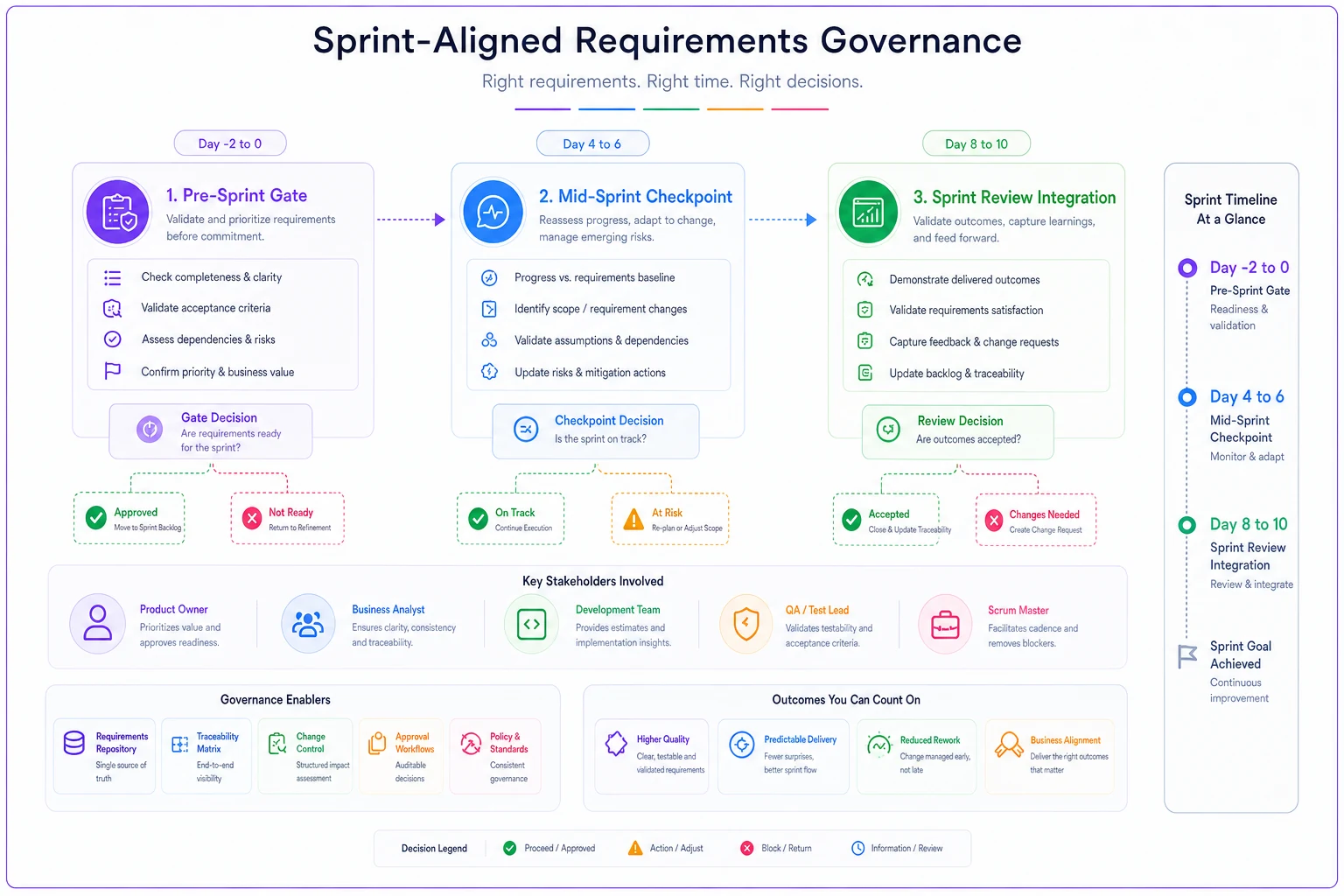
A simple visual like this makes checkpoints obvious to stakeholders.
Role responsibilities without the matrix madness
RACI matrices are where good intentions go to die. I've never seen a team actually reference their RACI during daily work. They create them, file them away, and then figure out who does what through trial and error anyway.
Think in terms of decision rights tied to specific scenarios:
Product Owner owns:
-
Requirement priority within the sprint
-
Acceptance criteria definition
-
Trade-off decisions during the sprint
Tech Lead owns:
-
Technical approach to meet requirements
-
Identifying technical dependencies
-
Flagging feasibility issues
Stakeholder representative owns:
-
Business value validation
-
End-user impact assessment
-
Regulatory/compliance flags
Notice what's missing? Consulted and Informed columns for everything. Those create noise. If someone needs to know, they join the sprint review. If they need input, they provide it during pre-sprint planning.
A B2B SaaS company had 47 people listed across various RACI matrices. After simplifying to this three-role model, their average decision time went from 6 days to same-day resolution. The other 44 people? They got weekly summary updates and could dig deeper if needed.
Exception handling that doesn't break everything
Most governance frameworks assume everything follows the happy path. But real work is messy. Requirements change mid-sprint. Stakeholders have emergencies. Technical surprises appear.
You need exception flows that don't require calling an emergency meeting of twelve people.
The 24-hour rule For mid-sprint requirement changes, implement a simple escalation: the product owner has 24 hours to either accept the change (and explicitly state what gets dropped) or defer it to the next sprint. No committees. No approval chains.
The complexity trigger Not all requirements are equal. Define clear thresholds that trigger additional governance:
-
Changes affecting more than 3 systems
technical architecture review required
-
Changes affecting regulated data
compliance check required
-
Changes over 5 story points
stakeholder validation required
Below these thresholds? Standard flow applies.
Emergency override protocol Sometimes stuff really is on fire. Define exactly two people who can override normal governance: typically the product lead and engineering lead together. Not separately—together. This prevents both business panic and technical perfectionism from derailing everything.
The medical device company we worked with used this sparingly—three times in eight months. Each time, it saved them weeks of committee meetings during actual crises. The key is that overrides get reviewed at the next retrospective. No blame, just learning.
Lightweight audit trails that actually get maintained
Traditional audit trails read like court transcripts. Every decision, every conversation, every thought documented in exhaustive detail. Nobody maintains them. Nobody reads them.
What teams actually need is a decision log. Not a process log—a decision log.
| Date | Decision | Made By | Impact | Reversal Cost |
|---|---|---|---|---|
| Sprint 23, Day 1 | Defer payment integration | Product Owner | 2-week delay on checkout flow | Low - not started |
| Sprint 23, Day 4 | Add field validation to form | Tech Lead | Additional 3 story points | Medium - refactor needed |
| Sprint 24, Day 0 | Priority shift to compliance features | Stakeholder Rep | Full sprint replanning | High - work in progress |
Five columns. Takes 30 seconds to update. Gives you everything you need for both retrospectives and compliance audits.
One team tracked decisions this way for six months. When they needed to understand why their roadmap had shifted, they had the answer in minutes, not days of archaeological digging through Slack and email.
Escalation rules that prevent bottlenecks
Escalation usually means "wait for someone senior to make a decision." That's broken. Escalation should mean "get unblocked fast."
Build escalation around response times, not seniority:
Level 1: Immediate team resolution (within 2 hours)
-
Requirement clarification
-
Minor scope adjustments
-
Technical approach decisions
Level 2: Extended team resolution (within 24 hours)
-
Cross-team dependencies
-
Scope changes affecting sprint commitment
-
Resource allocation questions
Level 3: Leadership resolution (within 48 hours)
-
Strategic priority changes
-
Budget impact decisions
-
Compliance/regulatory issues
But here's the critical part: if someone doesn't respond within the timeframe, the decision defaults to the requesting team's recommendation. No response equals approval.
This changes the entire dynamic. Instead of escalation creating delays, it creates urgency for decision-makers to engage or accept the team's judgment.
The "good enough" governance test
A medical device software team asked me to review their governance framework. 134 pages. I asked them one question: "When did you last update this?"
Eight months ago. Their actual process had evolved completely since then. The documentation was fiction.
The maintenance test: Can you update your governance docs in under 10 minutes after a process change?
The onboarding test: Can a new team member understand the governance model in their first sprint?
The exception test: Did you handle your last exception without calling an emergency meeting?
The value test: Did governance catch a real issue in the last month, or just create delays?
If you're failing these tests, you're probably over-governed.
Real scenario: From 6-week features to 2-week delivery
An edtech company with around 35 people was struggling. Every feature took 6+ weeks from requirement to production. Not because development was slow—coding took maybe 1-2 weeks. The rest was governance overhead.
Their process required:
-
Business case documentation (3-5 days)
-
Technical design review (weekly meeting, up to 7-day wait)
-
Stakeholder approval (monthly meeting, up to 30-day wait)
-
Compliance review (48-72 hours)
-
Final sign-off (2-3 days)
We rebuilt their governance around their 2-week sprints:
Sprint -1: Lightweight business case (1 page max) submitted by Wednesday, reviewed by Friday. Technical feasibility assessed in parallel, not sequentially.
Sprint 0: Requirements refined during sprint planning. Compliance concerns flagged, not formally reviewed unless triggered by complexity thresholds.
Sprint 1-2: Development proceeds with embedded checkpoints, not external gates.
Results after three months:
-
Average feature delivery
2.3 weeks
-
Requirements churn
dropped from roughly 35% to 12%
-
Team satisfaction scores improved (they stopped mentioning "process friction" in retrospectives)
-
Compliance issues caught
same as before
The governance didn't disappear. It just stopped being the bottleneck.
Templates that teams will actually use
Nobody uses 20-page requirement templates. What teams actually maintain:
``\nFeature: [Name]\nProblem: [1-2 sentences]\nUsers Affected: [Specific segments]\nSuccess Metric: [One measurable outcome]\nDependencies: [Technical/Team/External]\nCompliance Flags: [Yes/No, specifics if Yes]\nEstimated Effort: [S/M/L/XL]\nDecision Needed By: [Date]\n``
``\nWhat's Changing: \nWhy Now:\nImpact if Delayed:\nTrade-off Proposal:\nDecided By: [Name] on [Date]\n``
``\nBlocked On: [Specific decision needed]\nAttempted Resolution: [What you tried]\nRecommendation: [Your proposed solution]\n``
These templates work because they're faster to fill out than scheduling a meeting to discuss whether you need to fill them out.
When to break your own governance rules
Good governance knows when to break itself. If you're never bypassing your governance, it's probably too loose. If you're always bypassing it, it's definitely too rigid.
Legitimate bypass scenarios:
-
Production incidents requiring immediate requirement changes
-
Regulatory changes with fixed deadlines
-
Critical customer issues affecting revenue
-
Security vulnerabilities needing immediate patches
Bypasses get reviewed in the next sprint retrospective. Not to punish anyone, but to understand if the bypass revealed a governance gap or was truly exceptional.
The coordination problem governance actually needs to solve
Most teams think governance is about control. It's not. It's about coordination.
When governance works, teams know:
-
What they're building without constant clarification
-
When decisions will be made without chasing stakeholders
-
How to handle changes without everything grinding to halt
-
Who makes which decisions without political navigation
When it doesn't work, you see:
-
The same requirement interpreted three different ways
-
Features built that stakeholders reject at review
-
Critical dependencies discovered mid-sprint
-
Constant emergency meetings and "quick syncs"
The best agile requirements governance is nearly invisible during smooth sprints and immediately helpful during rough ones. It's there when you need it, absent when you don't.
Building governance that scales with your team
Your governance needs will change. The framework that works at 10 people breaks at 30. What works at 30 becomes bureaucratic at 100.
Build evolution triggers into your governance:
Team size triggers
-
Under 10 people
verbal governance, documented decisions only
-
10-25 people
lightweight written process, single approval gate
-
25-50 people
formal roles, defined escalation paths
-
50+ people
consider splitting into smaller, autonomous teams with their own governance
Incident triggers After any major requirement failure, ask: would different governance have caught this? If yes, add the minimum process to catch it next time. If no, don't add process just to feel like you're doing something.
Velocity triggers If your team velocity drops 20% or more over two sprints, audit your governance overhead. You might be governing yourself into paralysis.
Making it stick without making it stick
The best governance frameworks embed themselves into existing workflows. They don't create new meetings, new documents, or new approval chains. They piggyback on what you're already doing.
AI-powered operational software can help here by automating the routine parts—tracking decisions, flagging exceptions, maintaining audit trails—while keeping humans in control of actual governance decisions. When requirement changes get automatically logged, when stakeholders get notified based on smart triggers instead of blanket communications, when audit trails build themselves from your existing tools, governance stops feeling like overhead.
Whether you use sophisticated tools or simple spreadsheets, the principle remains: governance should enable delivery, not control it. Every gate, every role, every escalation path should have a clear answer to "how does this help us ship better features faster?"
Most teams have it backwards. They implement governance to prevent problems, then wonder why their velocity tanks. Start with the minimum viable governance, then add only what pain forces you to add. You'll end up with something that actually works, not just something that looks good in a process document nobody reads.
The teams that get this right share one characteristic: their governance evolves with them. It's not carved in stone. It's not perfect. It just works well enough to keep them moving without letting things fall apart.
That's all governance really needs to do.
Ready to transform your product delivery?
Join 2,000+ teams using GoReqly to improve requirements accuracy, reduce rework, and accelerate time to market.