


Most teams don't have a requirements problem. They have a "we can't tell which problem is worse" problem. Traceability is broken, but so is prioritization, and nobody trusts the acceptance criteria, and the backlog looks fine until release week when three teams discover they built against different assumptions.
When everything feels broken, the instinct is to fix everything. That's the mistake. You end up rolling out a heavyweight tooling change, a new template, and a governance process all at once — and none of it sticks because the team was never at the maturity level those things assume.
A requirements maturity assessment is really just a way to stop guessing. You figure out honestly what stage you're at, then you pick the two or three moves that actually matter at that stage. Not the moves that matter at the stage you wish you were at.
This is the roadmap I'd hand a product manager or BA lead who has 90 days and wants traceability working by the end of it — without burning the team out on process theater.
First, a blunt diagnostic
Forget the five-level capability maturity model stuff for a second. In practice, requirements maturity clusters into four rough buckets. You can usually place a team in about 20 minutes by asking pointed questions and watching people squirm.
| Signal | Level 1: Ad hoc | Level 2: Documented | Level 3: Traceable | Level 4: Governed |
|---|---|---|---|---|
| Where requirements live | Tickets, Slack, someone's head | A tool, but inconsistently filled | Linked to stories + tests | Linked and versioned with owners |
| Can you trace a feature to a test? | No | Sometimes, manually | Yes, most of the time | Yes, and it's audited |
| Change impact when a req changes | Surprise in QA | Found in review | Flagged by links | Flagged + reviewed by owner |
| Acceptance criteria quality | Vague or missing | Present, uneven | Test-ready mostly | Standardized + enforced |
| Who owns a given requirement | Unclear | Loosely assigned | Named owner | Named owner + escalation path |
| How you find a past decision | Ask around | Search a doc | Linked decision record | Searchable + tied to req |
Most teams that think they're at Level 3 are actually a strong Level 2 with a couple of Level 3 habits. That gap is where all the pain lives.
The single most useful question in this whole diagnostic: "Pick a feature that shipped last quarter. Can you show me the requirement, the story it became, and the test that proves it works — in under five minutes?" If the answer involves opening four tools and a "hang on, let me ask Priya," you're not at Level 3, no matter what the tool says.
Why teams misplace their own maturity
Teams overrate themselves because they judge maturity by tooling adoption instead of behavior. Buying a requirements tool and configuring trace links feels like reaching Level 3. But traceability isn't a feature you turn on — it's a habit that survives a busy sprint.
Stop losing track of critical project requirements.
GoReqly helps you capture, organize, and track every requirement with precision and clarity.
- Centralized requirements repository
- Collaborative editing & commenting
- Traceability & version control
No credit card required
The tell is what happens under pressure. A team at genuine Level 3 keeps links updated when they're slammed because it's cheaper than the alternative. A team at fake Level 3 lets links rot the moment a deadline hits, then spends release week reconstructing the trail by hand. The tool is identical. The maturity isn't.
Another common misread: confusing volume of documentation with maturity. Some of the least mature teams have gorgeous 40-page spec documents that nobody reads, nobody updates, and where actual behavior gets driven by hallway conversations. Heavy docs can mask a Level 1 practice wearing a Level 3 costume.
The real cost of skipping the diagnostic
Here's what happens when you skip straight to "let's implement traceability" without honestly assessing where you are.
A mid-sized product team — around 18 people across three squads — decided they needed full traceability after a release where two squads shipped conflicting changes to the same billing flow. Reasonable reaction. So they mandated trace links on every requirement, rolled out a new template, and added a review gate.
Six weeks later, link coverage sat around 30% and dropping. Why? They were a Level 2 team. Acceptance criteria were still vague, ownership was still fuzzy, and half the requirements were duplicated across squads. Asking people to link that mess to tests just added a chore on top of chaos. The gate became something people clicked through, not something that caught problems.
The rework — retraining, cleaning up half-populated links, re-running the whole rollout — cost them roughly a quarter of a sprint across three squads. A few weeks of engineering time thrown at a process that never had a foundation under it.
The fix wasn't more traceability. It was fixing ownership and acceptance criteria first, so the links had something solid to attach to. Which is exactly what a staged approach forces you to do.
Staged playbooks: what to actually do at each level
The right next move is different depending on where you are. Trying to do Level 4 governance from Level 2 is how you get the disaster above.
If you're at Level 1 (Ad hoc)
-
Pick one system of record. Not two, not "the tool plus the wiki." One.
-
Write requirements as testable statements, even rough ones. "User can export report as CSV" beats "improve reporting."
-
Assign a loose owner to every requirement — even if it's just "whoever wrote it."
-
Stop capturing requirements in chat. Chat is where requirements go to die.
Don't touch trace links yet. You'll just be linking to garbage.
If you're at Level 2 (Documented)
-
Standardize acceptance criteria into a test-ready shape. If QA can't turn a criterion into a test case without asking questions, it's not done.
-
Deduplicate. At Level 2 you almost always have the same requirement written three different ways across squads.
-
Establish clear, named ownership with a real escalation path.
-
Start linking requirements to stories — just stories, not tests yet. Get that habit stable first.
If you're at Level 3 (Traceable)
-
Wire trace links to tests so a failing test points back to the requirement it violates.
-
Add change-impact checks
when a requirement changes, the linked stories and tests get flagged automatically.
-
Track a small set of operational metrics that actually change behavior. Most requirements KPIs are vanity numbers — this piece on operational metrics that drive action is worth reading before you pick yours, because "% of requirements with links" is not the metric you think it is.
If you're at Level 4 (Governed)
You're mostly maintaining and scaling now. The risk at this stage is over-governance strangling delivery.
-
Audit trace integrity periodically instead of gating every change.
-
Formalize cross-team artifact handoffs so scaling doesn't reintroduce Level 2 chaos. When multiple teams share requirements, the coordination model matters more than the individual practice — the operational ecosystem map for scaling requirements covers how those handoffs break down.
-
Keep decision records linked so the why is as traceable as the what.
Fix ownership and acceptance criteria before forcing trace links; links need something solid to attach to.
Keep decision records linked so the why is as traceable as the what.
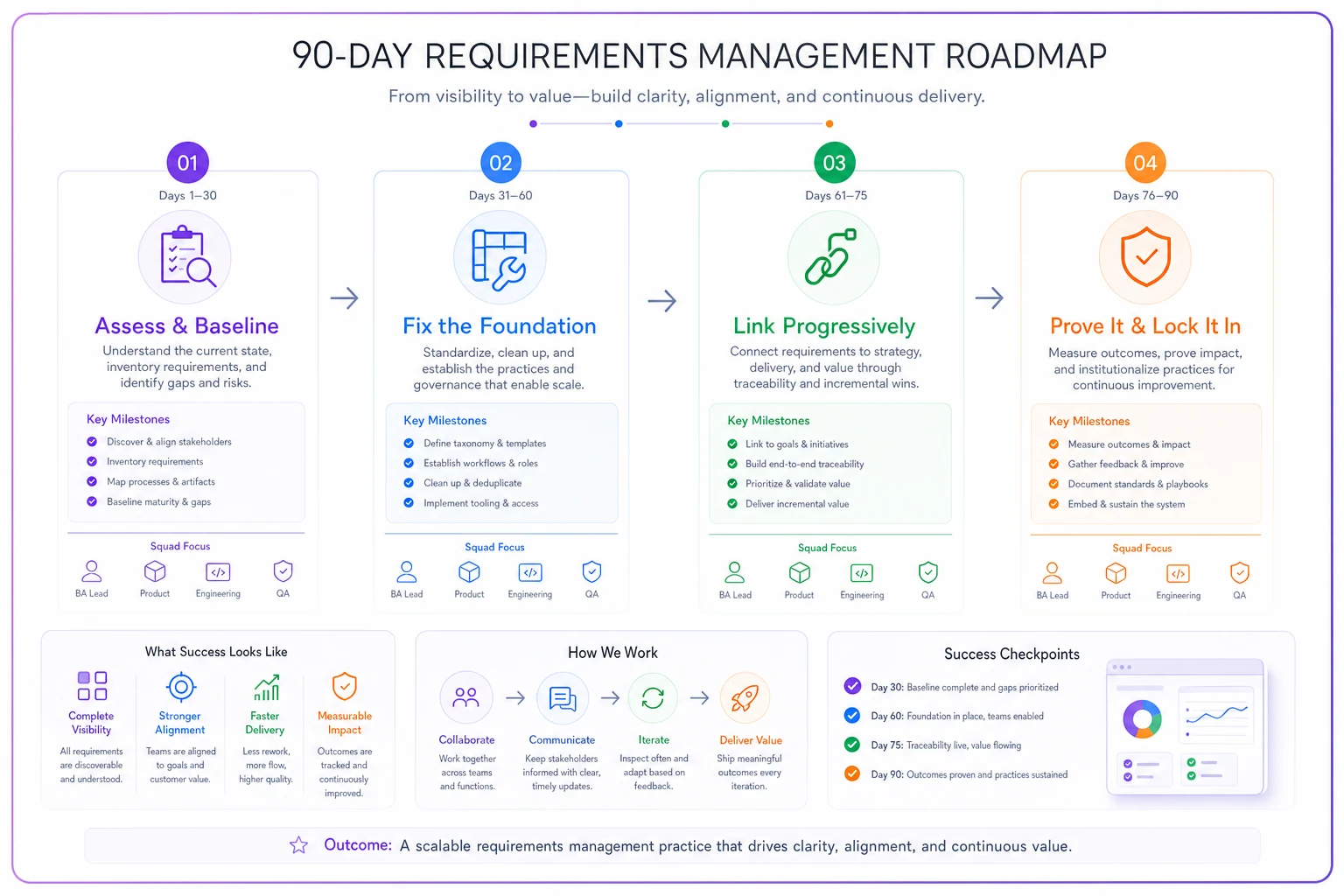
A sample 90-day roadmap
This assumes you start somewhere around Level 2, which is where most product and agile teams actually live. Adjust based on your diagnostic — a Level 1 team spends month one on consolidation, not cleanup.
Days 1–15: Assess and baseline
-
Run the diagnostic across every squad. Do it per-squad, not org-wide — maturity varies wildly between teams.
-
Pull a baseline
pick 10 recent features and time how long it takes to trace each one to a test. Write the numbers down.
-
Pick your system of record and freeze it. No parallel tools.
Days 16–40: Fix the foundation
-
Standardize acceptance criteria. Rewrite the worst 20% first — that's where most QA rework originates.
-
Deduplicate requirements across squads. Expect more overlap than you'd like.
-
Assign named owners with escalation paths.
Days 41–65: Link progressively
-
Link requirements to stories. Get to consistent coverage before moving on.
-
Once story links hold under a normal sprint, link to tests.
-
Turn on change-impact flagging so edits surface downstream effects.
Days 66–90: Prove it and lock it in
-
Re-run the baseline test from step 2. Same 10 features (or their descendants). Measure trace time again.
-
Pick two or three operational metrics and wire them into your normal review cadence.
-
Document the one rule that matters most
links get updated before the sprint closes, not after.
Visualizing the sequence can help teams keep the phases in order and avoid skipping the foundational steps.
The measurable milestone that matters isn't "100% link coverage." It's that trace time on a typical feature drops from "half a morning of archaeology" to "a couple of minutes." If that number improves, the practice is working. If coverage is high but trace time is still awful, your links are decorative.
When this actually makes sense
Run this roadmap when you've had a release-week surprise caused by requirements drift, when audits or compliance reviews are getting painful,
or when new team members take weeks just to understand why things were built the way they were.
When it's a bad idea
If you're a single squad of four people shipping a fast-moving early product with no compliance pressure, don't bother. Heavy traceability at that stage is pure overhead. You'll spend more time maintaining links than the links will ever save you. Stay at a clean Level 1 or 2 deliberately and revisit when you scale past two or three squads.
Also skip it if leadership won't protect the time. A maturity climb done in stolen 15-minute increments between "real work" produces half-populated links and cynicism — which is worse than where you started.
A quick real scenario
A team building B2B logistics software — three squads, roughly 22 people — kept getting burned in integration testing. Requirements existed, but they were a solid Level 2: documented, uneven, no real trace links. Trace time on a random feature ran around 40–50 minutes because someone had to reconstruct the trail from memory and old tickets.
They didn't jump to full governance. They spent the first month just fixing acceptance criteria and killing duplicate requirements across squads. Only then did they start linking — stories first, tests second.
By day 90, trace time on a typical feature dropped to under five minutes, and integration surprises during release week noticeably decreased. Not zero — but the "wait, who built this and against what?" scrambles mostly stopped. The interesting part: link coverage was only around 70%, not 100%. They'd chosen to trace the requirements that actually mattered and skip the trivial ones, which is probably why the practice survived instead of collapsing under its own weight.
The one thing to take away
Maturity climbs fail when teams reach for the practice above their level. A Level 2 team mandating Level 4 governance doesn't become mature — it becomes resentful and produces fake compliance. Assess honestly, fix the layer you're actually standing on, and let traceability emerge from a foundation that can hold it. Ninety days is plenty of time to move up one real level. It's not enough to fake three.
Ready to transform your product delivery?
Join 2,000+ teams using GoReqly to improve requirements accuracy, reduce rework, and accelerate time to market.