

Most teams treat security like a checkpoint. Something you pass through near release. A pen test report gets uploaded, a compliance spreadsheet gets filled in, someone from security signs off, and the release goes out. Then three months later an incident happens, and everyone realizes the control that should have caught it was never a requirement anybody owned, tested, or tracked.
That gap — between "we know we need this" and "this is a tracked artifact with an owner and a gate" — is where security requirements quietly rot. And it doesn't rot because people are lazy. It rots because security artifacts live in a completely different universe than the rest of your requirements. Threat models sit in a wiki. SLOs live in a monitoring dashboard. Security tests live in a separate pipeline that half the product team can't even see. Nothing connects.
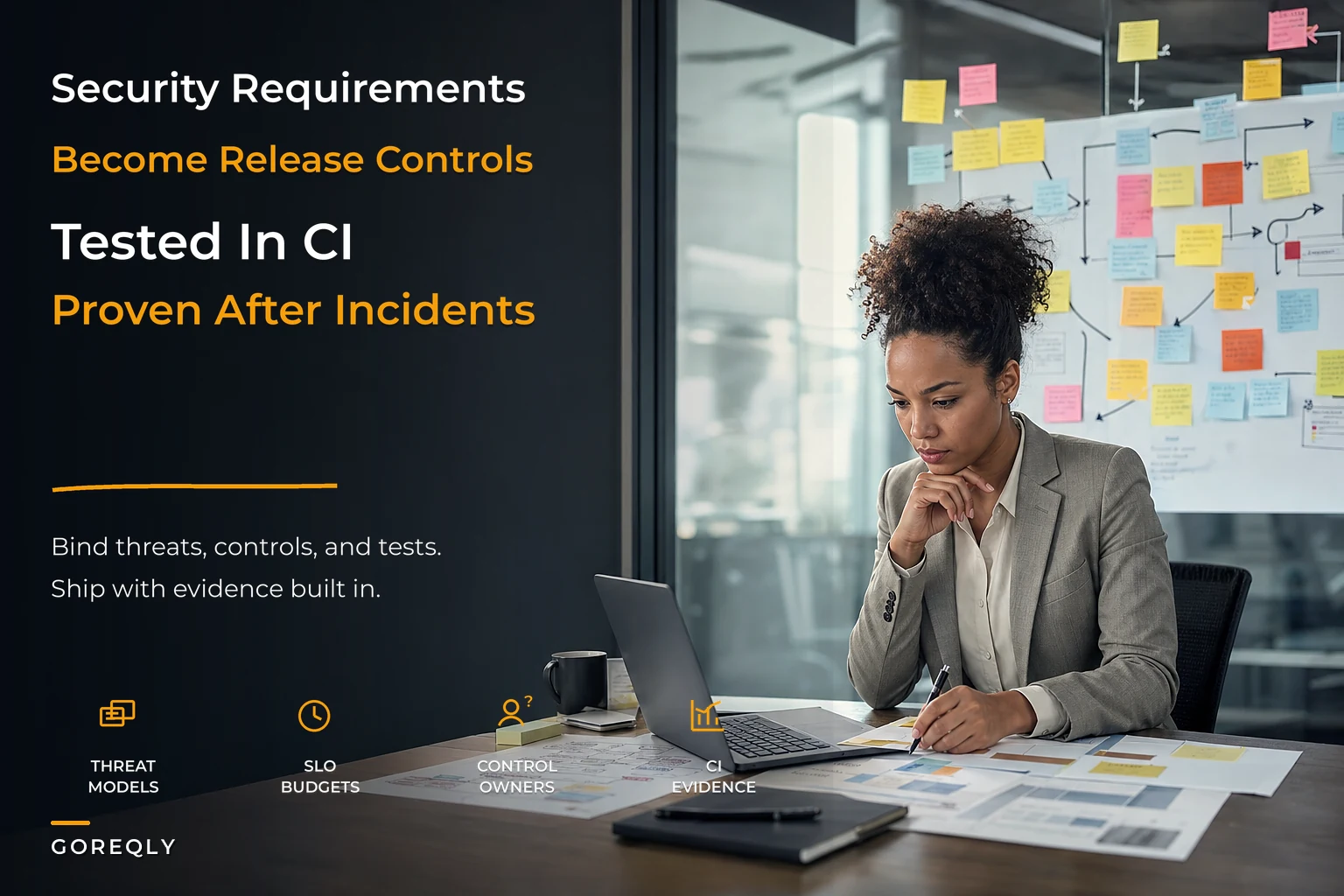
This post is about wiring those pieces into one operating model — where threat-model outputs, service-level objectives, security controls, and security tests behave like first-class requirements with owners, gating rules, CI hooks, and a feedback loop that turns incidents back into requirements. Not as a compliance ritual, but as something your delivery system actually runs on.
Why security requirements drift out of the delivery system
Here's the pattern that shows up across product orgs of almost any size. Functional requirements have a home. They're in the backlog, they have acceptance criteria, they get linked to tests, they show up in sprint reviews. There's a whole social and tooling machine keeping them alive. Security requirements have no such machine. They enter the org through side doors:
-
A threat model gets run during design, produces a list of risks, and then the doc is never opened again.
-
A compliance framework (SOC 2, ISO, PCI) says "you must have X control," and that becomes a checkbox in an audit tool, disconnected from any actual code.
-
A pen test finds five issues, they get patched, and the reason they existed never becomes a permanent requirement.
The result is that security lives as evidence scattered after the fact, not as requirements that shape the work up front. When an auditor asks "show me the requirement, the owner, the test that proves it, and the date it last passed," teams scramble. They have the security work. They just can't prove it's connected to anything.
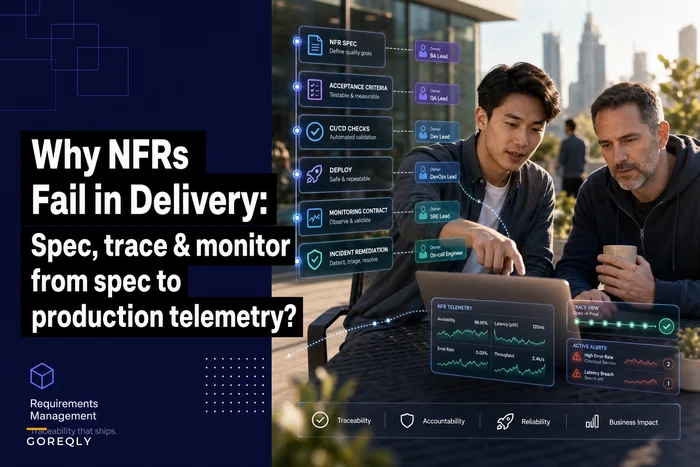
Teams who pass audits smoothly aren't necessarily more secure — they've just made their security requirements traceable in the same way their functional requirements are. That's the whole trick. This connects directly to the broader problem of why non-functional requirements fail in delivery, because security is the most abandoned NFR category of them all.
What actually breaks as you scale
At five engineers, none of this matters much. One person holds the whole threat model in their head. Security decisions get made in Slack. It works because coordination cost is basically zero.
Stop losing track of critical project requirements.
GoReqly helps you capture, organize, and track every requirement with precision and clarity.
- Centralized requirements repository
- Collaborative editing & commenting
- Traceability & version control
No credit card required
The breakage starts around the point where you have multiple squads shipping to shared services. Here's roughly the order things fall apart:
Ownership evaporates. A control like "all PII fields encrypted at rest" was owned by the original platform team. That team reorganized. Now three squads touch that data path and none of them consider the control theirs. The requirement exists; the owner doesn't.
Gates become theater. You add a "security review" gate to your release process. At first it's real. Then release pressure builds, the security reviewer is on vacation, and someone waves it through "just this once." Six months later the gate is a formality everyone knows how to bypass.
Tests and requirements decouple. A security test exists in CI. The requirement it was written for got reworded, or split into two stories, or deprecated. The test keeps passing against a requirement that no longer means what it used to. Green pipeline, false confidence.
Incidents teach nothing. You have an incident, you write a postmortem, the postmortem has great action items — and those action items live in the postmortem doc forever. They never become tracked requirements with owners and tests. So the next similar incident happens 14 months later and the postmortem reads almost identical to the last one.
A typical example: a mid-size SaaS company with around 40 engineers had roughly 60 documented security controls across their compliance framework. When they actually audited the linkage, only about 18 had a named current owner, and fewer than 10 had an automated test running on every build. The other 40-something were "true on paper." That's not a security team failing. That's a system failing to keep security requirements alive as the org grew.
Treating security artifacts as first-class requirements
The core shift is simple to say and annoying to implement: every security artifact needs the same lifecycle metadata your best functional requirements have. An ID, an owner, an acceptance definition, a linked test, a status, and a review date.
Here's what "first-class" actually means for each artifact type:
| Artifact | What makes it first-class | Owner type | How it gates |
|---|---|---|---|
| Threat-model output | Each identified threat becomes a tracked requirement with a mitigation and a linked control | Product + security lead | Design gate — can't exit design without mitigations assigned |
| Security control | Has a stated intent, an owner, and at least one automated or scheduled test | Engineering squad owning the service | CI gate — control test must pass to merge |
| SLO (security-relevant) | Defined threshold, alert wiring, and an owner who gets paged | SRE / service owner | Release gate — error budget burn blocks risky deploys |
| Security test | Linked to the exact requirement it verifies, versioned with it | QA / security engineering | CI gate — failing test blocks the pipeline |
| Incident finding | Converted into a new or updated requirement, not just a postmortem line | Incident commander → requirement owner | Post-incident gate — release blocked until finding is triaged into a requirement |
The important column is the last one. A requirement that doesn't gate anything is documentation, not a requirement. The moment a security artifact can block a merge or a release, people start keeping it accurate — because inaccurate gates create pain and someone fixes them fast.
One mistake teams make: they try to gate everything on day one. That backfires. If your gates block half your releases in week one, engineers route around them and you've lost the whole thing. Gate the highest-severity items first, prove the mechanism works, then expand.
Wiring the CI test hooks so requirements stay honest
The connection between a requirement and its proof has to be automated, or it will drift. This is the same principle that applies to functional requirement-to-test traceability, just applied to security.
A workable process for wiring it:
-
Give every gating control a machine-readable ID. Not "encryption requirement" — something like
SEC-DATA-014. This ID lives in the requirement record and in the test itself. -
Tag the test with the requirement ID. Whether it's a SAST rule, a dependency scan policy, an integration test that checks auth behavior, or an infra policy check — the test carries the requirement ID in metadata or a naming convention.
-
Emit a linkage record on every run. When CI runs, it produces a record: requirement ID, test result, commit, timestamp. This is the raw material for audit evidence.
-
Fail the build on a missing link, not just a failing test. If
SEC-DATA-014is marked as a gating control but no test emitted a result for it this run, that's a failure too. Silent absence is more dangerous than a red test. -
Roll linkage records into a status view. Someone should be able to look at one page and see: which security requirements are gating, which have current passing tests, which are stale, and which have no test at all.
That fourth step is the one that catches quiet decay. A test that used to run and got disabled during a flaky-test cleanup will show up as "no result for a gating control" — which is exactly the signal you want.
Use a consistent ID prefix per domain to make requirement→test queries trivial.
For teams that struggle with stale links between requirements and their proof, the mechanics here overlap heavily with building a proper traceability model. If you're starting from scratch on the evidence side, building a lightweight compliance-ready traceability model gives you the scaffolding to hang security requirements on.
The incident → requirement feedback loop
This is the part almost nobody operationalizes, and it's the highest-leverage piece of the whole model.
An incident is the most expensive information your organization will ever generate. You paid for it in downtime, in trust, sometimes in real money. The only thing that makes that cost worthwhile is if the incident permanently changes your requirements so the same class of failure can't recur silently.
During the postmortem, alongside the usual timeline and root cause, you explicitly ask: "What requirement, if it had existed and been tested, would have prevented or caught this earlier?" That question forces the finding into requirement-shaped language.
That finding then gets converted into either a new requirement or a modification to an existing one. It gets an ID, an owner, and — this is the part that matters — a gating test that would have failed under the incident conditions. Not a vague "improve monitoring" action item. A specific, testable requirement. Then the release that ships the fix is blocked until that requirement-and-test pair exists. The incident isn't "closed" when the fix deploys. It's closed when the requirement exists and its test is green.
A realistic example: a payments team had an incident where a rate-limiting control silently stopped working after a config change, and it took roughly a day to notice. The old process would have added "monitor rate limiter" to a backlog. The new process created a requirement — "rate limiter must reject over-threshold traffic in a synthetic test that runs every deploy" — with an owner and a CI test that literally hammers the endpoint and asserts rejection. That same failure now can't ship silently. The postmortem stopped being a document and became a permanent part of the delivery system.
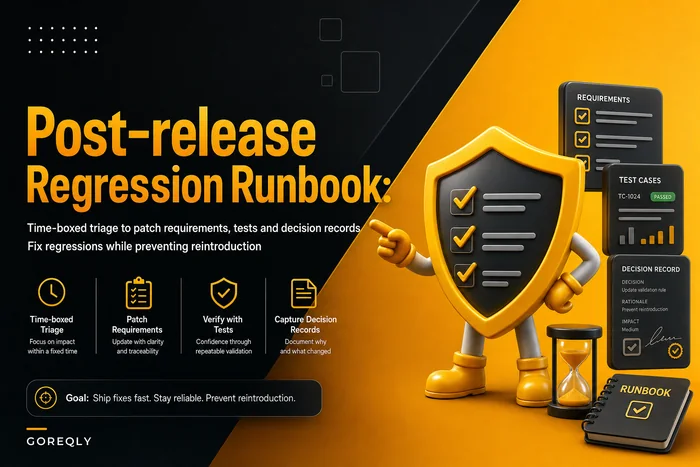
For the mechanics of triaging and patching without reintroducing problems, the post-release regressions runbook covers the discipline of updating artifacts as part of the fix — which is the exact habit that makes this loop stick.
A workflow, end to end
Here's how the whole thing flows for a single feature, so the pieces connect.
Feature scoped ↓ Lightweight threat model (45-min structured session) ↓ Threats → tracked requirements, mitigations assigned ↓ Design gate: all mitigations mapped before "ready for dev" ↓ Dev: inherited controls link to existing tests / new controls get new tests ↓ CI: gating requirement IDs checked → missing result = build failure ↓ Release: SLO budget checked, evidence record emitted automatically ↓ Incident (if any) → postmortem → new requirement + test → next release carries it
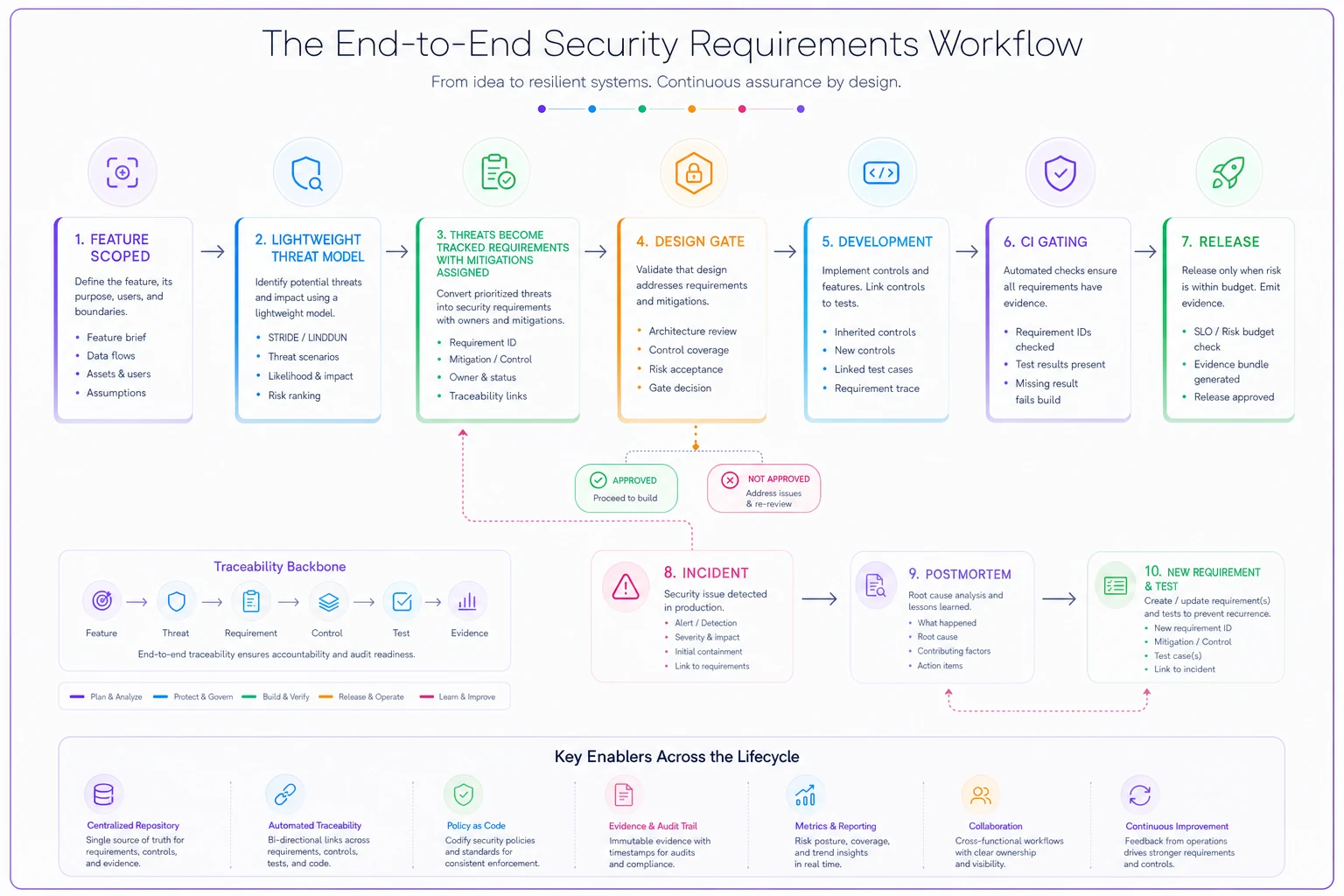
A squad picks up a feature that touches customer data. During design, they run a lightweight threat model — not a two-day workshop, more like a 45-minute structured session. It surfaces three threats. Each threat becomes a tracked requirement with a proposed mitigation and an assigned owner. The design gate won't let the story move to "ready for dev" until all three have mitigations mapped to controls.
During development, two of those controls already exist as shared platform controls with existing CI tests, so they're inherited and their tests already run. The third is new, so the squad writes the requirement, tags it with an ID, and writes the gating test alongside the code. The merge is blocked until that test exists and passes.
At release, the pipeline checks that every gating security requirement touched by this change has a current passing test result. It also checks the relevant security SLOs aren't in a burned-budget state. If both are clear, release proceeds and an evidence record is emitted automatically — requirement IDs, test results, timestamps, owners.
Three weeks later, a minor incident touches the same data path. The postmortem produces one new requirement. It gets an owner and a test. The next release carries it. The threat model for that feature gets updated to reflect what the incident taught. Notice there's no separate "security phase." Security requirements moved through the exact same pipeline as everything else, gated at the exact same points. Security stops being a parallel track and becomes part of how work flows.
When this makes sense — and when it doesn't
This model isn't free. Worth being honest about fit.
When it clearly makes sense:
-
You're in or heading toward a regulated space (payments, health, anything with real compliance obligations).
-
You have multiple squads touching shared services, so tribal knowledge no longer covers ownership.
-
You've had at least one incident where "we thought that control existed."
-
Audits currently cause a scramble because the linkage is manual.
When it's premature:
-
You're a handful of engineers on one codebase. Formalizing gates here just adds friction that one architecture conversation would solve better.
-
You don't yet have functional requirement traceability working at all. Security traceability built on top of chaos will just add more chaos. Get the base model working first.
Who should not do this the heavy way: early-stage teams still finding product-market fit. You still need basic security hygiene, but building the full gating-and-feedback machine before you have stable services is optimizing something that's about to change shape entirely. Track your top handful of controls with owners, and grow the machine as the org grows.
A short checklist to see where you actually stand
Run through this honestly. It's not about scoring high — it's about seeing the gaps.
-
- [ ] Every gating security control has a named current owner, not a team that reorganized away.
-
- [ ] Every gating control has an automated test, and that test's absence would fail the build.
-
- [ ] Threat-model outputs become tracked requirements, not a doc nobody reopens.
-
- [ ] Security-relevant SLOs can block a risky deploy, not just fire an alert.
-
- [ ] Postmortem findings are converted into requirements-with-tests before the incident is closed.
-
- [ ] You can produce, in minutes, the requirement→test→result linkage for any control an auditor names.
-
- [ ] Your gates are real — nobody has a routine "just wave it through" path.
Most teams find they can check two or three of these. That's normal. The value isn't checking all seven tomorrow; it's knowing which unchecked box is currently costing you the most and closing that one first.
The real shift
The deepest change here isn't tooling. It's that security stops being something that happens to the delivery system from the outside — an audit, a review, a gate someone imposes — and becomes something the system carries natively, the same way it carries functional requirements.
When a threat model produces tracked requirements, when controls have owners who feel the pain of a failing gate, when incidents permanently reshape what the system tests for, security requirements stop being paperwork you assemble for auditors and start being the reason your product doesn't break the same way twice.
The audit evidence becomes a byproduct of a system that's actually working, rather than a document you build under deadline pressure. That's the difference between an org that has security artifacts and one that runs on them. The first passes audits by scrambling. The second passes them almost by accident, because everything an auditor could ask for is already living, owned, and tested inside the normal flow of work.
The audit evidence becomes a byproduct of a system that's actually working, rather than a document you build under deadline pressure. That's the difference between an org that has security artifacts and one that runs on them. The first passes audits by scrambling. The second passes them almost by accident, because everything an auditor could ask for is already living, owned, and tested inside the normal flow of work.
Ready to transform your product delivery?
Join 2,000+ teams using GoReqly to improve requirements accuracy, reduce rework, and accelerate time to market.