

Most teams have a decent handle on catching bugs. Where they fall apart is what happens after the fix ships. A regression gets patched, everyone moves on, and four months later the exact same failure reappears — usually because the requirement, the acceptance test, and the decision behind it were never touched. The code got fixed. The artifacts describing the code stayed wrong.
This is the quiet failure mode that a post-release requirement remediation runbook is built to prevent. Not the fix itself — teams are fine at fixes. The problem is closing the loop across every artifact that will otherwise reintroduce the same defect.
Here's how this actually goes sideways, and the time-boxed triage flow that keeps it from repeating.
The specific way regressions come back from the dead
There's a pattern that shows up over and over in real remediation work.
A payment flow ships. Two weeks in, support tickets start coming in: customers on annual plans are getting charged the monthly proration on upgrade. Someone traces it to a rounding assumption in the billing service, patches it in an afternoon, and pushes. Tickets stop. Everyone exhales.
Three months later, a new engineer picks up an unrelated billing story. They read the requirement doc — which still says "prorate upgrades based on remaining monthly cycle" because nobody updated it — and they "correct" the code to match the spec. The regression is back. Same bug, new author, and this time it took longer to catch because the original patch had no test guarding it.
The root cause isn't the engineer. It's that the fix lived in exactly one place — the code — while three other artifacts still described the broken behavior as correct:
-
- The requirement still specified the wrong proration logic.
-
- There was no acceptance test locking in the corrected behavior.
-
- The decision record explaining why it was changed didn't exist, so the change looked arbitrary.
When a fix only exists in code, the surrounding artifacts act as a slow-motion time bomb. Anyone who trusts the documentation over the running system will eventually undo your work.
Why "just fix the bug" isn't enough — and why teams skip the rest
Skipping artifact updates isn't laziness. It's incentive structure.
Stop losing track of critical project requirements.
GoReqly helps you capture, organize, and track every requirement with precision and clarity.
- Centralized requirements repository
- Collaborative editing & commenting
- Traceability & version control
No credit card required
During an incident, the clock is the only thing anyone cares about. Getting the fix out reduces the bleeding, so the fix gets full attention. Updating a requirement doc, writing a regression test, and logging a decision record feel like paperwork you can do "later." Later never arrives because the incident is closed and the pressure evaporates.
There's also a knowledge problem. The person patching the code often isn't the person who owns the requirement. The engineer fixes billing logic; the BA who wrote the proration requirement isn't in the channel. So even if someone wanted to update the artifact, the ownership handoff never happens.
Worth naming this directly: the further an artifact sits from the code, the less likely it gets updated during remediation. Tests sometimes get added because they live in the repo. Requirement docs and decision records — which usually live somewhere else entirely — almost never do. That distance is exactly why regressions come back.
The time-boxed triage principle
The core idea here is deliberately constraining how long remediation takes, so that updating artifacts becomes part of the fix instead of an optional afterthought.
Open-ended remediation always expands to fill the code and starve everything else. When you time-box it, you force a decision: within this window, what's the minimum set of changes — across all artifacts — that closes this out completely?
| Box | Time budget | What must be done | What's explicitly out of scope |
|---|---|---|---|
| Contain | First 2–4 hours | Stop the bleeding. Hotfix, flag, or rollback. No artifact work yet. | Root cause analysis, "proper" fix |
| Remediate | 1–2 days | Real fix + regression test + requirement update + decision record | Refactors, adjacent improvements |
| Verify & close | Half a day | Confirm test guards the behavior, artifacts reconcile, ticket links everything | New feature work |
The important rule: you cannot close the Remediate box with the code fixed but the artifacts untouched. That's the whole point. The time-box makes artifact updates non-negotiable rather than aspirational.
The remediation sequence that actually holds
Below is the numbered flow teams can run during the Remediate box. The order matters — do it out of sequence and you'll patch code against a requirement you haven't corrected yet.
-
Reproduce and capture the correct behavior in words first. Before touching code, write one or two sentences describing what the system should do. This becomes the corrected requirement text. In the billing example: "Annual-plan upgrades prorate against the remaining annual cycle, not the monthly cycle."
-
Write the failing test before the fix. The test should fail against current behavior and describe the corrected expectation. This is your regression guard — the single most important artifact, because it's the one that lives closest to the code and actively blocks reintroduction.
-
Apply the code fix. Now the test goes green. Standard work, but it's step three, not step one, on purpose.
-
Update the requirement artifact to match reality. Change the actual requirement — not a comment, not a Slack message. If the spec still says the old thing, someone will trust it later.
-
Write a short decision record. Two or three sentences
what changed, why, and what the previous behavior was. This is what stops a future engineer from "fixing" your fix. Linking decision rationale directly to the requirement is a discipline worth building into your normal flow — we've written about the mechanics of that in linking decision records to requirements.
-
Cross-link all four. Ticket → requirement → test → decision record. If someone opens any one of them, they can reach the other three. Broken links here are how the loop stays open.
The single biggest mistake is teams doing steps 3, 3, and 3 — three separate code fixes over three months — because steps 1, 2, 4, 5, and 6 never happened the first time.
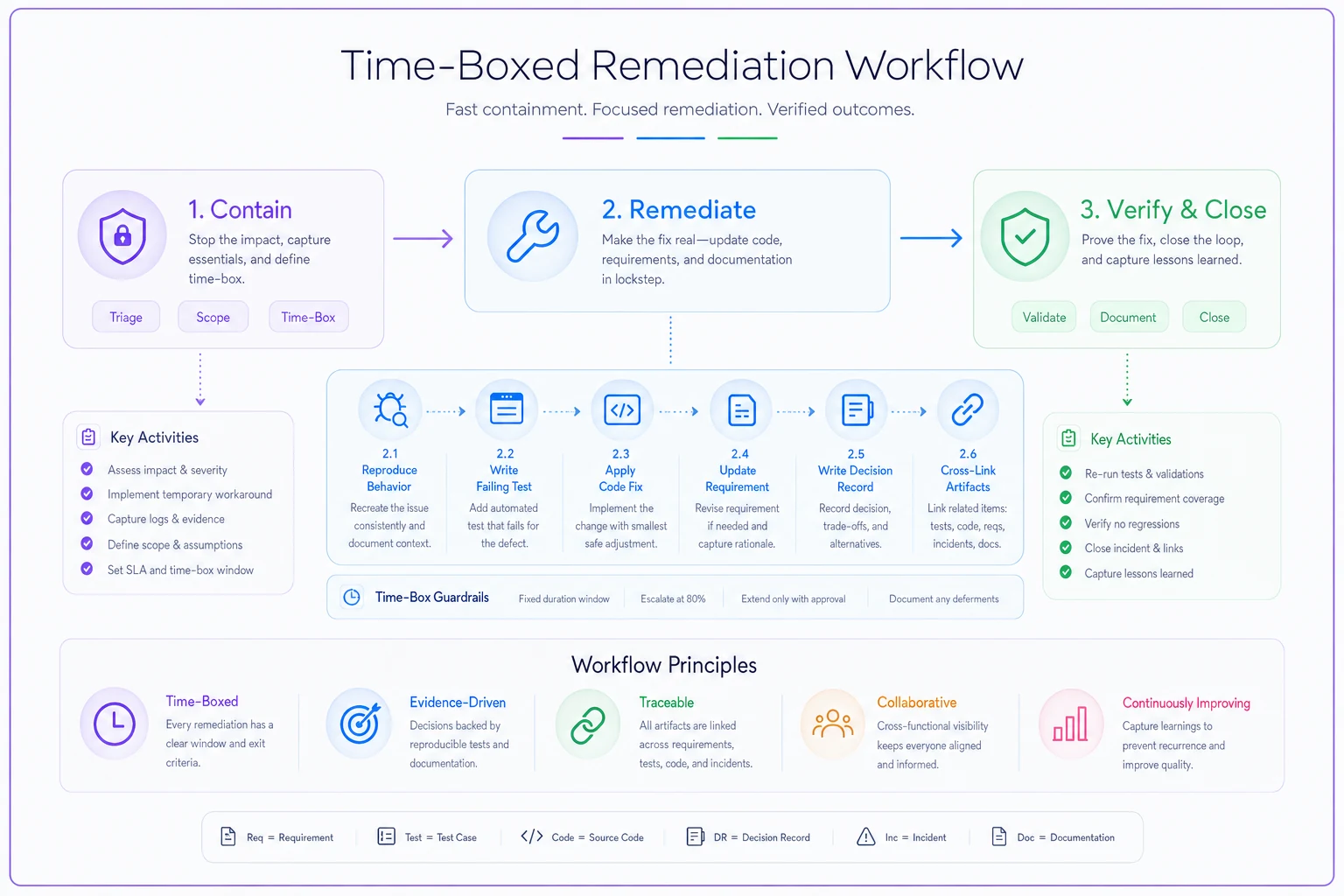
A simple diagram like this helps teams visualize the required sequence and the artifacts to update during remediation.
A real scenario: the SaaS billing team that stopped re-shipping the same bug
A mid-sized B2B SaaS company — roughly 40 people, subscription billing at the core of the product — kept hitting the same category of failure. Over about eight months, they'd shipped three separate regressions in proration and plan-change logic. Two of them were literally the same defect reintroduced by different engineers.
When they dug into it, the pattern was exactly what you'd expect: requirement docs described billing behavior that hadn't been true since the previous year. Engineers coding against those docs were re-creating old bugs. Each regression cost roughly a day of investigation, a day of fixing, and a handful of support tickets — plus one or two uncomfortable conversations with annual customers who'd been mischarged.
They put in a time-boxed remediation rule: no billing regression closes until the requirement is updated, a regression test exists, and a one-paragraph decision record is linked. Nothing fancy. The whole "process" fit on half a page.
Over the following two quarters, reintroduced billing regressions dropped to zero. New regressions still happened — that's normal — but they didn't come back. The team estimated they recovered somewhere around 5–7 engineering days per quarter that used to disappear into re-investigating already-solved problems. Plus the harder-to-measure win of not mischarging annual customers twice for the same reason.
The fix wasn't better engineers. It was refusing to close a ticket while the artifacts still lied about how the system worked.
When this makes sense — and when it's overkill
When it makes sense:
-
Requirements are load-bearing — billing, compliance, permissions, anything where the spec is a source of truth people code against.
-
You've already seen at least one reintroduced regression. That's the signal the loop is open.
-
Multiple people touch the same subsystem, so the person fixing rarely owns the requirement.
When it's a bad idea:
-
Prototype or pre-PMF products where requirements change weekly anyway. Maintaining decision records for behavior you'll throw out next sprint is pure ceremony.
-
Cosmetic or throwaway fixes with no requirement behind them. Not every bug maps to an artifact, and forcing one wastes everyone's time.
Who should NOT do this: solo builders or two-person teams where the fixer is the requirement owner and holds the full context in their head. The runbook exists to survive handoffs. No handoffs, no reason for it.
The verification step people skip — and pay for
Open the requirement doc as if you'd never seen the ticket. Does it now describe the fixed behavior clearly enough that a new engineer coding against it would produce the correct result?
If the answer is no — if the doc is technically updated but still ambiguous — you haven't actually closed the loop. The regression will come back through a different door.
A quick close-out checklist that catches most gaps:
-
- [ ] Regression test exists and fails against the old behavior
-
- [ ] Requirement text describes the corrected behavior, not the old assumption
-
- [ ] Decision record explains the change in plain language
-
- [ ] Ticket, test, requirement, and decision record are cross-linked
-
- [ ] Someone who wasn't in the incident can follow the trail end to end
That last item is the real test. If the trail only makes sense to the people who were there, it won't survive the next team member.
Keeping artifacts in sync without drowning in process
All of this only works if updating requirements is cheap. If changing a requirement means editing a doc in one system, a test in another, and a decision log in a third — with no links between them — people will skip it under pressure every single time. The friction is the failure.
This is where treating requirements with the same rigor as code pays off. When requirements are versioned, linkable, and change alongside the work they describe, updating them during remediation stops feeling like separate paperwork and starts feeling like part of the fix. The mechanics of that — branching, tagging, keeping artifact history intact — are worth reading up on in treating requirements like code. Platforms that keep requirements, tests, and decision records in one traceable place remove most of the friction that causes teams to skip the loop, but the discipline matters more than the tooling — a half-page rule enforced consistently beats an elaborate system nobody follows.
A regression that comes back isn't a testing failure. It's an artifact failure. The code got fixed while the requirement, the test, and the reasoning stayed broken — and one of those three quietly told a future engineer to undo your work. Time-boxing remediation forces the whole loop closed inside a fixed window: fix the code, yes, but also correct the requirement, add the guard test, and log the why. Do that consistently on the subsystems that actually matter, and the same bug stops resurrecting itself. You spend a little more per incident and stop paying for the same incident three times.
Ready to transform your product delivery?
Join 2,000+ teams using GoReqly to improve requirements accuracy, reduce rework, and accelerate time to market.