



Three months into a platform migration, a fintech team discovered their payment gateway specs referenced an API version deprecated 18 months earlier. The actual implementation had moved forward through undocumented patches and workarounds, but nobody updated the requirements. When a new developer tried implementing a feature based on those specs, they built against the wrong integration points entirely. Two weeks of work, scrapped.
This happens constantly. Requirements written months or years ago slowly drift from reality as teams make changes, fix bugs, and adapt to production issues. Unlike technical debt that shows up in your codebase, requirement debt hides in your documentation, silently corrupting every decision based on those outdated specs.
Building a requirement debt register isn't about creating another tracking spreadsheet. It's about systematically identifying which requirements have decayed, scoring their business impact, and fixing them before they derail your next sprint.
Discovery heuristics that actually catch requirement rot
Most teams only discover requirement debt when something breaks. By then, multiple features might already be built on incorrect assumptions. The operational challenge isn't finding obviously broken requirements — those surface quickly. The real problem is catching the subtle decay that happens when requirements technically remain valid but no longer reflect how the system actually works.
Start with timestamp analysis. Any requirement older than 6 months without a review flag automatically enters your debt register. But age alone doesn't determine rot. A login requirement from two years ago might still be perfectly valid, while a data processing spec from last quarter could already be obsolete due to regulatory changes.
Cross-reference requirements against deployment logs. When production deployments happen without corresponding requirement updates, you've found debt. One e-commerce team discovered 40% of their checkout flow requirements hadn't been updated despite 23 production changes to that exact flow over eight months.
Check for orphaned dependencies. Requirements that reference deprecated services, sunset APIs, or decommissioned systems are obvious debt. Less obvious: requirements depending on other requirements that have changed. A reporting requirement might still look valid, but if the data model it references has evolved, that requirement is now misleading.
Monitor implementation variance. Compare what requirements specify against what actually got built. Small variances compound over time. A requirement specifying "email notification within 2 hours" might have been adjusted to "within 24 hours" during implementation due to rate limits. If the requirement wasn't updated, future features built on that assumption will fail user expectations.
The most insidious form of requirement debt comes from context loss. Requirements written with specific business conditions in mind become dangerous when those conditions change. A requirement for "premium users get priority support" becomes debt the moment your company restructures its pricing tiers, even though the requirement text remains unchanged.
Classification patterns that drive action
Not all requirement debt needs immediate attention. Some outdated requirements affect critical user flows, while others document rarely-used admin features. Without proper classification, teams waste sprints fixing low-impact debt while critical issues compound.
Stop losing track of critical project requirements.
GoReqly helps you capture, organize, and track every requirement with precision and clarity.
- Centralized requirements repository
- Collaborative editing & commenting
- Traceability & version control
No credit card required
Operational Impact Classification
Critical Path Debt: Requirements affecting primary user journeys or revenue-generating features. A payment processing requirement with outdated error codes falls here. Fix within current sprint.
Integration Debt: Requirements defining connections between systems. These create cascading failures when wrong. An inventory sync requirement referencing old field mappings can break your entire fulfillment flow. Fix within 2 sprints.
Compliance Debt: Requirements tied to regulatory or security standards. GDPR requirements written pre-amendment, PCI requirements using old standards. Non-negotiable timeline based on audit schedules.
Experience Debt: Requirements affecting user experience but not core functionality. Outdated tooltip text, deprecated UI patterns. Schedule for next UX sprint.
Documentary Debt: Requirements that are wrong but don't affect current development. Old feature requirements for sunset products. Archive or delete, don't fix.
Blast Radius Scoring
Beyond classification, you need to understand impact scope. A single outdated requirement might affect:
-
Direct implementations
Features built directly from this requirement
-
Dependent requirements
Other requirements referencing this one
-
Test coverage
Test cases derived from the requirement
-
Team knowledge
Developers who learned the system from these requirements
Score each requirement's blast radius on a simple 1-5 scale. Multiply by the operational impact classification weight. This gives you a priority score that actually reflects business risk, not just technical incorrectness.
Sprint remediation templates that prevent requirement regression
Fixing requirement debt isn't like fixing code debt. You can't just update the document and move on. The fix needs to propagate through your entire requirements ecosystem, update dependent artifacts, and ensure teams understand what changed and why.
The Three-Phase Remediation Template
Phase 1: Forensic Documentation Before changing anything, document the delta between requirement and reality. Create a simple table:
| Requirement Aspect | Documented State | Actual State | Business Impact |
|---|---|---|---|
| API endpoint | /api/v1/users | /api/v3/users | Breaks new integrations |
| Response time | <500ms | <2000ms | Affects SLA calculations |
| Retry logic | 3 attempts | 5 attempts | Changes error handling |
This forensic record serves two purposes: it helps you understand how the debt formed, and it provides context for developers who might have built features based on the outdated requirement.
Phase 2: Cascade Update Requirements don't exist in isolation. When you fix one, you need to update:
-
[ ] Parent requirement updated
-
[ ] 3 child requirements reviewed
-
[ ] 8 test cases modified
-
[ ] Integration guide section flagged
-
[ ] Team notification sent
Phase 3: Regression Prevention The requirement will rot again unless you address root causes. For each remediated requirement, add:
-
- Review triggers (deployment, API updates, regulation changes)
-
- Ownership assignment (who validates this stays current)
-
- Expiry date (when to re-review regardless of triggers)
A logistics software team reduced re-regression by 60% simply by adding "expires-on" dates to requirements based on their volatility. Payment requirements expire quarterly, UI requirements annually, security requirements with each compliance audit.
Here's a simple remediation workflow visualization.
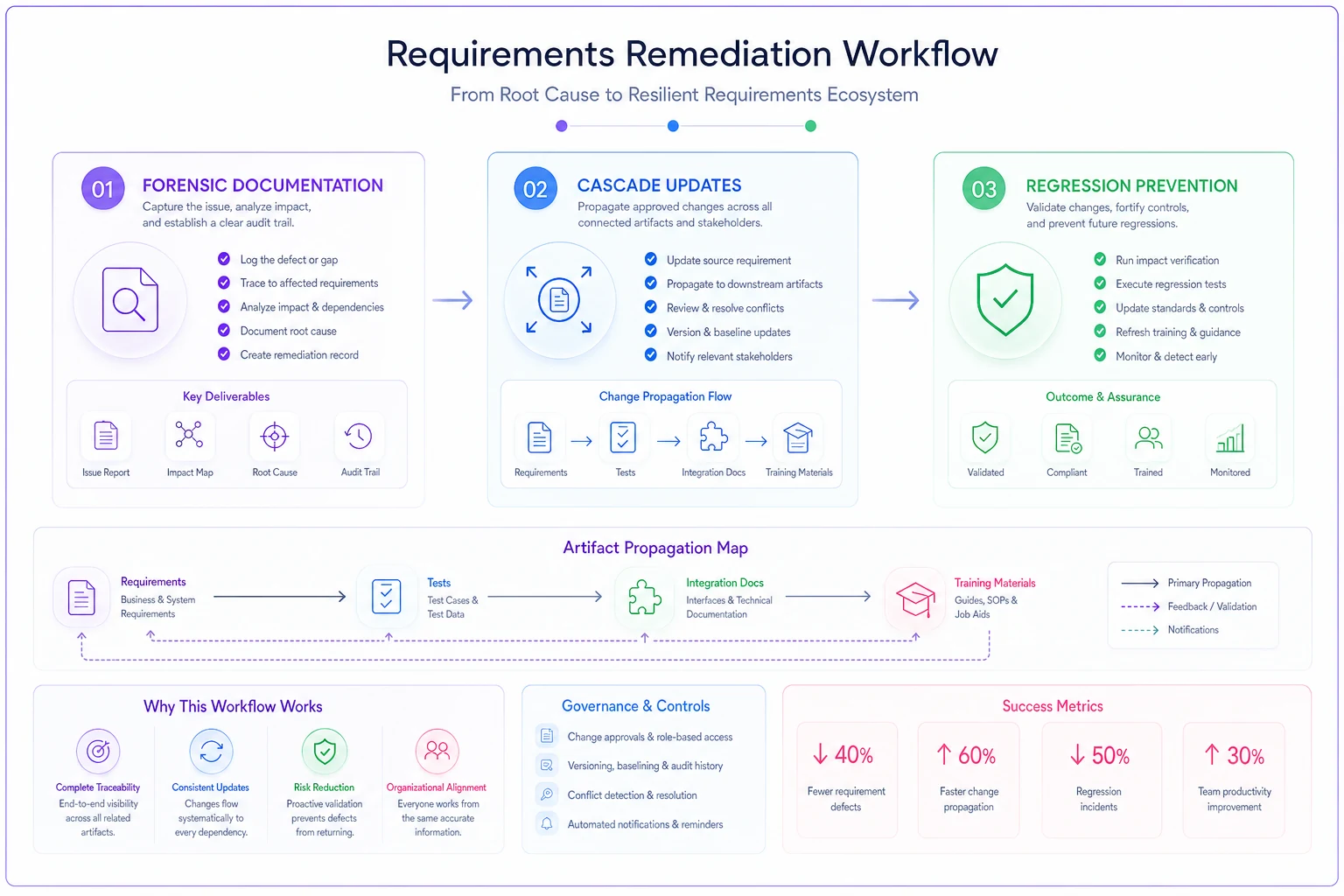
Place ownership, triggers, and expiry dates at the end of the workflow so validation happens automatically post-deployment.
Metrics that show actual debt reduction over time
Traditional requirement metrics count things like "requirements documented" or "requirements approved." These tell you nothing about debt reduction. You need operational metrics that show whether your requirement debt register actually improves development velocity and reduces rework.
Rework Correlation Score
Track how often work items get reopened due to requirement issues. Before implementing their debt register, a healthtech team averaged 18% rework rate on stories. After three months of systematic debt remediation, rework from requirement issues dropped to 7%. The correlation is direct — fix the requirements, reduce the rework.
Implementation Variance Rate
Measure the gap between what requirements specify and what gets built. This should decrease as you remediate debt. One team tracked this through PR comments. Before debt remediation: 3.2 requirement clarification comments per PR. After: 0.8 comments per PR.
Requirement Half-Life
How long before a requirement becomes misleading? This metric helps you identify which areas of your system create debt fastest. Payment requirements might have a 3-month half-life due to processor changes, while login requirements might last 18 months. Use this to set review cycles.
Cascade Impact Tracking
When you fix a requirement, how many dependent artifacts need updating? This number should decrease over time as you establish better governance patterns. High cascade impact indicates architectural coupling in your requirements structure.
Before and after: operational transformation examples
A B2B SaaS company managing supply chain software discovered their integration requirements hadn't been updated in 14 months despite switching message queue providers twice. Their requirement debt register revealed:
Before state:
-
67 integration requirements referencing RabbitMQ configurations
-
23 data transformation specs using outdated schemas
-
45% of new integration work required "clarification meetings"
-
Average integration story
8 story points
Remediation approach: They classified debt by integration partner criticality. Top-tier partners got immediate fixes. Lower-tier partners got batched updates. They created a simple template: current state, required changes, implementation notes, validation steps.
After state (4 sprints later):
-
All critical path integrations updated to Kafka specifications
-
Schema registry linked directly to requirements
-
Clarification meetings dropped to 15% of stories
-
Average integration story
5 story points
The real win wasn't just cleaner documentation. Developers stopped building defensive code to handle ambiguity. QA stopped writing redundant test cases to cover undocumented behaviors. Product managers stopped scheduling buffer time for requirement confusion.
Another example: An insurtech platform dealing with claims processing discovered their business rules requirements contained 89 conflicts with actual implemented logic. These conflicts had accumulated over 18 months of regulatory updates and product pivots.
Their register identified requirements by regulatory impact and claims volume. High-volume, high-compliance requirements got a dedicated remediation sprint. They discovered that 30% of their "bugs" were actually features working as implemented but not as documented.
The systematic approach meant they could finally convert those old specs into actionable stories rather than treating them as unreliable reference material. Post-remediation, their claims processing accuracy improved by 12% — not from code changes, but from everyone finally working from the same playbook.
The compound effect of requirement debt
Unlike technical debt that usually affects single components, requirement debt compounds across your entire development ecosystem. One outdated API requirement doesn't just affect the team implementing it. It impacts QA writing tests against wrong assumptions, DevOps configuring monitors for incorrect thresholds, support documenting workflows that don't exist, and product planning features on capabilities you don't actually have.
Teams that successfully manage requirement debt treat it like they treat code. Version control for requirements, deprecation notices for outdated specs, migration paths for evolving requirements. They build operational software that tracks requirement health alongside system health, automating the detection of drift between documented and actual behavior.
Your requirement debt register isn't a one-time cleanup exercise. It's an operational practice that prevents small documentation drifts from becoming sprint-destroying discoveries. The cost of maintaining this register — maybe 2-3 hours per sprint — is nothing compared to the weeks of rework caused by building on rotten requirements.
Start with your highest-velocity areas. Requirements that change frequently rot faster. Payment flows, integration points, regulatory features — these create debt quickly. Build your register there first, prove the value through reduced rework, then expand systematically.
The alternative is continuing to build on a foundation that gets less stable with each sprint. Your velocity might look fine on paper, but you're spending increasing time on rework, clarification, and defensive coding. The requirement debt register makes that hidden cost visible and actionable.
Most importantly, it transforms requirements from static documents into operational assets. When requirements accurately reflect your system's reality, every development decision gets easier, every estimate gets more accurate, and every sprint delivers what it actually promised.
Ready to transform your product delivery?
Join 2,000+ teams using GoReqly to improve requirements accuracy, reduce rework, and accelerate time to market.