


You know that sinking feeling when auditors ask for evidence that doesn't exist? Or when they want to see how requirement X maps to test Y and you're digging through Confluence pages from 2019?
Most product teams treat compliance requirements traceability like documentation — something to scramble together right before the audit. Then they wonder why audit prep takes three months and still fails on basic traceability gaps.
The problem isn't that compliance is hard. The problem is that teams build it backwards — starting from what auditors want instead of how the team actually works. They create massive traceability matrices nobody updates, evidence folders nobody maintains, and signoff processes that block every sprint.
Why traditional compliance models break agile teams
Traditional compliance assumes waterfall. Big requirements documents upfront. Formal signoffs at each phase. Clear handoffs. Evidence in neat folders. Everything traceable in a straight line from requirement to test to deployment.
That's not how product teams actually work.
Requirements live in Jira tickets, Slack threads, and recorded Zoom calls. Evidence is scattered across pull requests, test runs, and deployment logs. Signoffs happen in sprint reviews, not formal gate meetings. Requirements change every two weeks based on user feedback.
When audit time comes, you're trying to reconstruct six months of agile reality into a waterfall narrative that never existed. Product managers spend weeks building traceability matrices by hand. Engineers dig through Git history looking for evidence. QA rebuilds test documentation from memory.
A fintech team I watched spent four months preparing for SOC 2 certification. They passed — barely — but the product roadmap stopped completely during prep. The product manager told me they spent more on audit prep contractors than on actual product development that quarter.
The operational reality of compliance in product teams
Here's what actually happens in most product organizations trying to maintain compliance requirements traceability.
Stop losing track of critical project requirements.
GoReqly helps you capture, organize, and track every requirement with precision and clarity.
- Centralized requirements repository
- Collaborative editing & commenting
- Traceability & version control
No credit card required
The compliance team creates a requirements register — usually a massive Excel file with hundreds of controls. Each control needs to map to specific product requirements. Those requirements need test cases. Test cases need execution evidence. Everything needs an approval trail.
Meanwhile, the product team works in two-week sprints. Requirements come from customer feedback, not compliance matrices. Stories get refined during backlog grooming. Tests run automatically in CI/CD pipelines.
These two worlds never connect until audit season. Then it's panic mode.
The business analyst spends weeks mapping user stories back to compliance controls. But half the stories have changed since implementation. The original requirements are buried in comments. Acceptance criteria evolved through multiple sprints.
QA tries to extract evidence from their test automation suite. But the tests were written for functionality, not compliance. They cover the happy path, not the control objectives. Test names don't map to requirement IDs because nobody thought about traceability when writing them.
Engineering looks for deployment evidence and change approvals. The deployment pipeline runs automatically. Approvals happen through pull request reviews, not formal change boards. The evidence technically exists but it's scattered across GitHub, Jenkins, and AWS CloudTrail.
By the time you compile everything, you've spent 400+ hours creating documentation that's already outdated. And you'll do it all again next year.
Building evidence collection into your actual workflow
Teams that handle compliance well don't treat it as a separate process. They build evidence collection directly into their existing agile workflow.
Start with your sprint ceremonies. Recording refinement sessions and tagging them properly makes every requirement discussion traceable by default. Sprint planning naturally documents prioritization. Sprint reviews capture stakeholder acceptance.
But recording everything creates a different problem — too much evidence, not enough structure. You need to know what to actually collect.
For each regulation type, a simple checklist of evidence types is enough:
SOC 2 evidence pattern:
-
Requirement source (ticket, email, meeting recording)
-
Implementation decision (ADR, design doc, PR description)
-
Test coverage (automated test links, manual test recordings)
-
Review approval (PR approval, sprint review clip)
-
Deployment record (pipeline run, change ticket)
HIPAA evidence pattern:
-
PHI data flow documentation
-
Access control implementation
-
Encryption verification
-
Audit log configuration
-
Incident response test
PCI DSS evidence pattern:
-
Cardholder data mapping
-
Network segmentation proof
-
Security scan results
-
Change management approvals
-
Vendor compliance attestations
These aren't massive documents. They're links to things you're already creating. The key is making them findable later.
The integration points that matter
Evidence collection needs to hook into four critical points in your development workflow.
Requirements intake is where traceability starts. Whether requirements come from compliance, customers, or internal stakeholders, they need consistent tagging from day one. Not complex taxonomies — just enough metadata to find them later.
A medical device company used three simple tags: regulatory (FDA, ISO, etc.), functional area (patient data, device control, reporting), and risk level (critical, major, minor). Those three tags made audit prep roughly 70% faster because they could quickly filter to what mattered.
Sprint execution is where evidence naturally generates. Every code commit, every test run, every deployment creates potential evidence. The trick is capturing it without slowing down delivery.
Instead of asking developers to document everything, instrument your pipeline to collect evidence automatically. Tag commits with story IDs. Link test runs to requirements. Archive deployment logs with sprint markers. The collection happens in the background while teams keep shipping.
Review cycles create your approval trail. But instead of formal signoff documents, use your existing review mechanisms. Pull request approvals become technical reviews. Sprint reviews become business acceptance. Security scans become compliance verification.
The difference is making these reviews searchable and traceable. A simple comment like "Approved - meets HIPAA encryption requirement" in a PR transforms it from a code review into compliance evidence.
Release management closes the loop. Every release should automatically generate a compliance package — not a massive document, but a collection of links to all the evidence generated during development. Requirements addressed, tests executed, reviews completed, deployments verified.
Here's a rough picture of how this maps end-to-end:
[Requirements Intake] → [Sprint Execution] → [Review Cycles] → [Release Management] ↓ ↓ ↓ ↓ Tag tickets Instrument CI/CD Link PRs to Generate evidence with controls to archive runs controls package on release
This simple flow shows how the four integration points connect in practice.
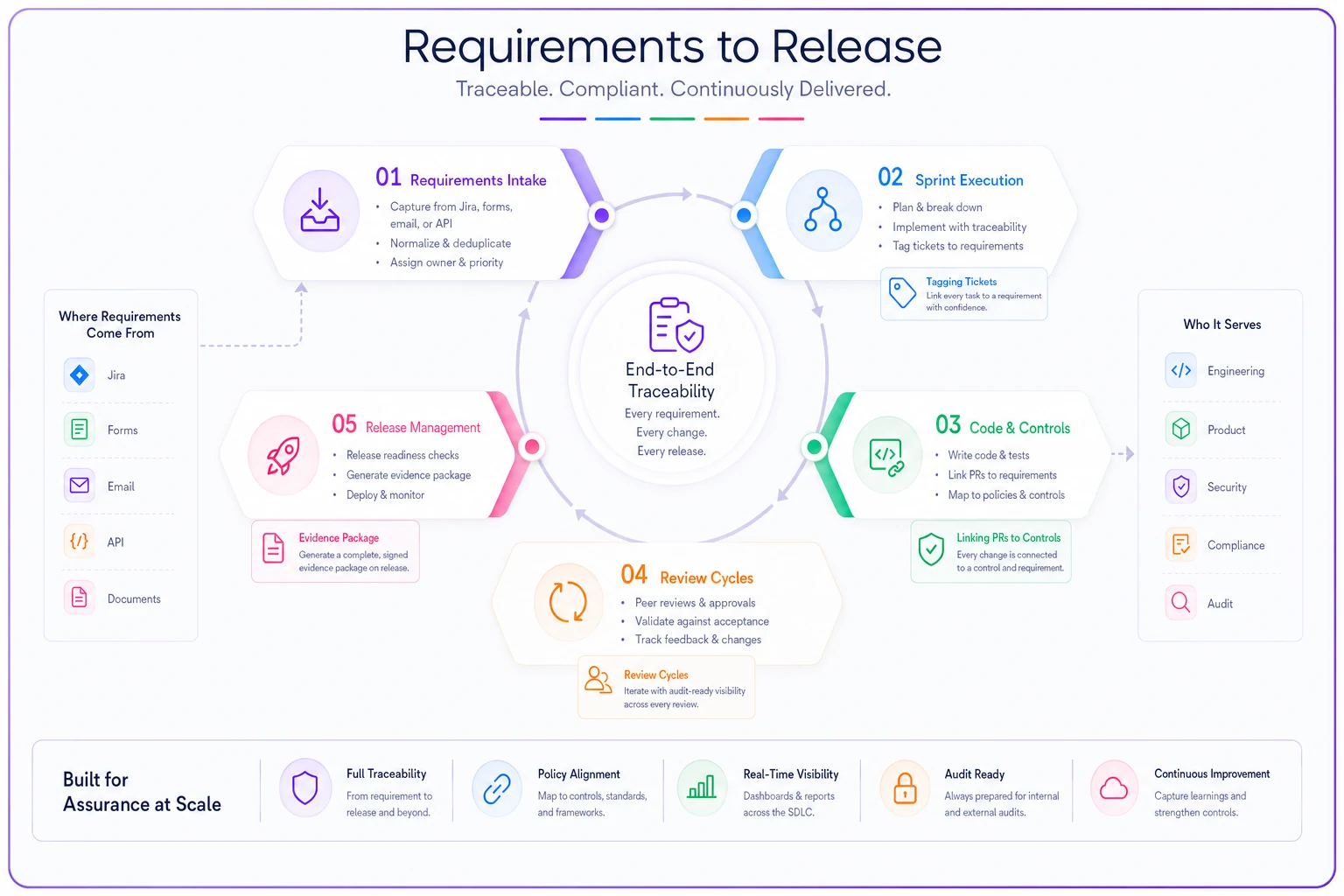
The goal is that every artifact produced during these steps becomes a searchable piece of evidence without adding manual work.
Creating templates without creating bureaucracy
Templates accelerate compliance without adding friction — if you design them right.
Bad templates force teams to fill out forms. Good templates give teams a starting point they can adapt.
Your user story template might include a compliance section:
Compliance Considerations:
-
Regulatory requirements
[link to controls]
-
Data classification
[public/internal/confidential/regulated]
-
Audit evidence needed
[list or "none"]
Most stories will have "none" for audit evidence. That's fine. But for the ones that matter, there's a natural place to capture it.
Your definition of done becomes your evidence checklist:
-
Code reviewed and approved
-
Tests pass (unit, integration, security)
-
Documentation updated (if needed)
-
Compliance evidence linked (if needed)
-
Deployed to staging
-
Product owner accepted
Not every story needs compliance evidence. But when it does, there's a clear place for it in your existing process.
Your test cases already document expected behavior. Add one field for compliance mapping:
-
Test
User login with MFA
-
Purpose
Functional verification
-
Compliance
SOC2-CC6.1 (logical access controls)
-
Evidence
Test execution logs + MFA configuration screenshot
Now your existing tests double as compliance evidence without writing separate compliance tests.
Signoff patterns for different team structures
How you handle signoffs depends on how your team actually works.
Small product teams (under 10 people) usually have informal signoffs. The product owner approves in sprint review. Engineers approve in PR reviews. QA approves by moving tickets to done.
For these teams, compliance signoffs should piggyback on existing approvals. Add a compliance checkbox to your PR template. Include a compliance column in your sprint review notes. Document verbal approvals with a quick video clip or screenshot.
Scaled agile teams (multiple squads, shared platforms) need more structure but still can't block on formal signoffs. These teams usually have architecture reviews, security reviews, and release committees.
Embed compliance into existing governance. Architecture reviews include compliance impact assessment. Security reviews verify control implementation. Release committees confirm evidence collection. The signoffs happen naturally as part of scaling coordination.
Regulated enterprise teams (healthcare, finance, government) already have formal controls but often duplicate them for compliance. Instead of separate signoffs, map your existing controls to regulatory requirements.
Your change advisory board approval covers change management requirements. Your security review covers data protection requirements. Your test sign-off covers validation requirements. You're not adding signoffs — you're documenting the ones you already do.
The pattern that never works? Creating a separate compliance approval gate that blocks deployment. Teams either bypass it in emergencies, destroying your audit trail, or it slows delivery until people start finding creative workarounds. Both outcomes are bad.
When lightweight compliance actually isn't enough
Some situations genuinely need heavyweight processes.
If you're building medical devices that could harm someone, you need formal V&V. If you're processing millions of credit cards, you need rigorous security controls. If you're handling classified data, you need strict access controls.
But even then, you can be lightweight where it doesn't matter. Not every requirement needs the same level of rigor.
A pharma software company dealing with FDA Part 11 requirements handled this well. Critical drug interaction checks needed full validation — requirements traceability, formal testing, multiple signoffs. UI color changes? Standard code review was enough.
| Risk Level | Example | Process |
|---|---|---|
| Critical | Could cause patient harm | Full validation |
| Major | Affects clinical decisions | Streamlined validation |
| Minor | Usability / performance | Standard agile process |
This let them move fast on low-risk changes while maintaining compliance where it actually mattered.
Common failure patterns in compliance traceability
The Excel maze happens when teams try to maintain traceability in spreadsheets. It starts simple — requirements in column A, tests in column B. Then you add columns for status, approvals, evidence links, notes. Soon you have a 50-column monster that nobody can navigate.
These spreadsheets become write-only. People add data but never read it. By audit time, half the links are broken and nobody remembers what the abbreviations mean.
The documentation debt spiral occurs when teams defer evidence collection. "We'll document it after release." But after release there's the next sprint. Six months later, you're trying to remember why you made that architectural decision.
The perfect process trap hits teams who try to design the ideal compliance process before starting. They spend months creating procedures and templates. Meanwhile the product team keeps shipping without any evidence collection. By the time the perfect process launches, there's six months of undocumented work to remediate.
The tool multiplication problem happens when each compliance requirement gets its own tool. Jira for stories, Confluence for requirements, TestRail for tests, SharePoint for evidence, Excel for traceability.
Data scattered across five tools means five times the work to maintain traceability. When audit comes, you're copying and pasting between systems, introducing errors and breaking links.
Building your compliance operating model
A working compliance requirements traceability model has five components.
-
Requirement classification scheme — Keep it simple. Three to five categories maximum. Link to regulations, don't copy them. Focus on what affects implementation.
-
Evidence collection points — Identify where evidence naturally exists. Don't create new artifacts — link to existing ones. Automate collection where possible.
-
Traceability mechanism — Pick one source of truth. Everything links back to it. Usually your work tracking system (Jira, Azure DevOps, etc.). Avoid separate traceability tools unless you have dedicated staff to maintain them.
-
Review and signoff pattern — Map existing reviews to compliance needs. Embed compliance checks in current meetings. Document decisions, not process.
-
Audit preparation workflow — Create a repeatable process for assembling evidence. Start with a checklist. Build the package incrementally. Test it with internal audits.
Each of these components should reinforce the others. If your classification scheme is a mess, your evidence collection points won't map cleanly. If your traceability mechanism lives in a separate tool nobody checks, your audit preparation workflow falls apart. They work together or they don't really work at all.
A healthcare SaaS platform's compliance transformation
A healthcare platform serving 200+ clinics was drowning in compliance overhead. Three different regulations (HIPAA, SOC 2, state requirements). Four product teams. Monthly releases. Quarterly audits.
Their old process: a compliance manager manually tracked requirements in Excel. Product managers updated status weekly when they remembered. Engineers searched for evidence during audits. Preparation took six to eight weeks per audit.
The transformation started by mapping their actual workflow. Requirements lived in Jira. Code reviews happened in GitHub. Tests ran in CircleCI. Deployments went through AWS.
Instead of creating new processes, they instrumented the existing ones:
-
Jira tickets got a "Compliance" field linking to regulatory requirements
-
GitHub PRs included a compliance checklist in the template
-
CircleCI archived test results with Jira ticket IDs
-
AWS deployment logs got tagged with release versions
They created one source of truth — a simple database that pulled data from all these systems. Not real-time syncing, just nightly extracts of metadata. Jira ticket → GitHub commits → CircleCI tests → AWS deployments.
For evidence, they stopped creating documents. Everything linked back to source systems. Test evidence? Link to the CircleCI run. Code review? Link to the GitHub PR. Deployment approval? Link to the AWS change set.
Signoffs embedded into existing ceremonies. Sprint planning included compliance review for upcoming stories. Sprint review included compliance verification for completed stories. Release planning included evidence verification.
The first audit after implementation took two weeks to prepare instead of six. More importantly, they found gaps during sprints, not during audits. Missing tests got added immediately. Unclear requirements got clarified in real-time.
The product teams barely noticed the change. They added one field to tickets, one section to PRs, and spent an extra five minutes in sprint planning. Compliance overhead dropped from around 20% of team capacity to under 5%.
The compound effect of operational compliance
When compliance requirements traceability becomes operational rather than administrative, teams start catching problems earlier.
A missing test gets flagged during code review, not during an audit. An unclear requirement gets questioned during refinement, not months later. A configuration drift gets detected during deployment, not during assessment.
This early detection reduces both compliance risk and technical debt. You're not just passing audits — you're building better software.
The real efficiency comes from reuse. Evidence collected for SOC 2 often covers ISO 27001 requirements. Traceability built for HIPAA helps with state regulations too. Each audit gets easier because you're building on existing evidence rather than starting from scratch.
But the biggest shift is cultural. When compliance integrates into daily work, it stops being "that thing we do for auditors" and becomes part of how the team builds. Engineers understand why requirements matter. Product managers see the connection between stories and controls. QA knows their tests provide audit evidence.
Making it sustainable with smart automation
The manual parts of compliance requirements traceability will always break down eventually. Someone forgets to tag a ticket. Someone skips the checklist. Someone doesn't update the matrix.
Targeted automation makes the difference. Not trying to automate judgment calls — just the repetitive operational pieces that connect your existing tools.
A few key automation points worth prioritizing:
-
Auto-tag tickets based on keywords or components
-
Extract test coverage from code analysis tools
-
Generate traceability reports from ticket metadata
-
Alert on missing evidence before sprint close
-
Build evidence packages from system queries
The teams doing this well aren't trying to automate everything. They're automating the repetitive parts while keeping human judgment where it matters. Humans decide if a requirement is complete. Automation tracks that decision and links the evidence.
This combination — lightweight governance plus smart automation — is what makes compliance sustainable for product teams. You're not choosing between agility and compliance. You're building compliance into agility.
Start with your next sprint
Don't wait for the perfect compliance process. Don't try to fix six months of missing evidence all at once. Start with your next sprint.
Pick your highest-risk features. Add compliance tags to those tickets. Link your PRs to tickets. Save your test results. Document your reviews. Build the habit before you build the system.
Once the team sees how lightweight compliance actually feels in practice, expanding coverage becomes natural. The operational metrics that matter will improve — not because you're tracking compliance harder, but because you're building better software with clear requirements and proper evidence.
Auditors don't want perfect documentation. They want evidence that you're in control of your development process. A lightweight, integrated compliance model shows exactly that — you know what you're building, why you're building it, and how you verify it works.
If you're sitting on a pile of legacy specs that never got this treatment, there's a practical workflow for converting them without blowing up your current sprint cadence.
That's not just compliance. That's good engineering.
Ready to transform your product delivery?
Join 2,000+ teams using GoReqly to improve requirements accuracy, reduce rework, and accelerate time to market.