


You know that moment when the mobile team discovers the API team changed their response format three sprints ago? Or when QA finds out the backend team never implemented that critical validation rule the frontend team assumed existed? That's not a communication problem—it's what happens when teams operate without a proper requirements operating model at the program level.
I spent the last month helping a fintech startup untangle their payments platform after a botched release. Eight teams, one product, zero ownership of the handoff points. The CTO kept saying "we just need better standups" but standups don't fix structural gaps in your operating model. Their real problem? They'd scaled from two teams to eight without ever defining how requirements flow between teams, who owns the boundaries, and what happens when Team A's output becomes Team B's input.
The hidden complexity tax of multi-team programs
Most companies nail their single-team requirements process first. They get their ecosystem map working smoothly, establish clear story templates, define acceptance criteria patterns. Then they add a second team. Then a third. Suddenly you've got five teams building pieces of the same feature and your beautiful single-team process falls apart at the seams.
The complexity isn't linear—it's exponential. Two teams means one handoff point. Three teams means three potential handoffs. Five teams? Ten handoff points, each one a potential failure mode. And that's just counting direct dependencies.
What really breaks is the assumption model. In a single team, assumptions get challenged in real-time during grooming. But when Team A makes an assumption about Team B's component, that assumption might not surface until integration testing. Or worse, until production.
That fintech startup was a perfect example. Their mobile team spent three weeks building a payment flow based on an API contract from Q2. The API team had updated that contract twice since then, but those updates lived in their team's Confluence space. The mobile team was still referencing a PDF someone exported months ago. Classic artifact drift, multiplied across every team boundary in the program.
Artifact contracts: the missing piece between team boundaries
Most organizations miss this entirely: you need explicit artifact contracts between teams, not just API contracts between services. An artifact contract defines:
Stop losing track of critical project requirements.
GoReqly helps you capture, organize, and track every requirement with precision and clarity.
- Centralized requirements repository
- Collaborative editing & commenting
- Traceability & version control
No credit card required
-
What requirements artifacts Team A produces
-
What format those artifacts follow
-
When those artifacts get delivered
-
Who validates them
-
What happens when they change
Companies keep trying to solve this with "alignment meetings" and "cross-team syncs" but meetings don't scale. What scales is operational clarity about who produces what, when, and in what format.
A medical device company had this figured out. Their hardware team produced detailed interface specifications every two sprints—strict template, signal definitions, timing requirements, error conditions, validation rules. The firmware team knew exactly what they'd receive and when. More importantly, they had a formal acceptance process where the firmware lead had to sign off before the hardware team could close their sprint.
That's an artifact contract in action. Not a handshake agreement or a Slack message, but an operational contract with clear deliverables and acceptance criteria.
Cross-team handoff patterns that actually work
Three handoff patterns worth knowing:
Pattern 1: The Gateway Model
One team owns the integration point and acts as the gateway, translating requirements from multiple upstream teams into a single coherent interface for downstream teams.
An ecommerce platform used this for their checkout flow. The payments team acted as the gateway, taking requirements from the cart team, promotions team, and inventory team, then producing a single checkout API specification. Downstream teams—mobile, web, analytics—only had to integrate with one consistent interface.
Pattern 2: The Contract-First Model
Teams agree on contracts before any implementation begins. The contract becomes the requirement, not the implementation.
This works well for API-driven architectures. A logistics company made every team produce OpenAPI specs before writing code. Those specs went through architecture review, security review, and consumer team review. Only after approval could implementation begin. Their defect rate at integration dropped by roughly 60% after implementing this.
Pattern 3: The Cascade Model
Requirements flow in one direction through a defined sequence of teams. Each team enriches the requirements before passing them downstream.
A healthcare startup used this for their patient portal. Product team created user stories → UX team added wireframes and flows → Backend team added technical specifications → Frontend team added component specifications → QA team added test scenarios. Each team had 48 hours to enrich and pass forward. No backflow allowed until the full cascade completed.
Release boundaries and the ownership vacuum
Release boundaries are where things get messy. When five teams contribute to one release, who owns the release criteria? Who decides if a dependency is blocking or nice-to-have? Who makes the call to ship with known issues?
Most companies default to "senior manager decides." That's not an operating model—it's the absence of one. You're hoping the right person is in the right meeting at the right moment.
The fix: establish release boundaries as first-class artifacts in your requirements operating model. A release boundary includes:
Acceptance criteria at the program level:
-
Integration test coverage thresholds
-
Performance benchmarks across components
-
Security review completeness
-
Documentation requirements
Ownership matrix:
-
Who owns go/no-go for each component
-
Escalation paths for conflicts
-
Override authority and conditions
Dependency contracts:
-
Hard dependencies (blocker)
-
Soft dependencies (degraded functionality)
-
Optional dependencies (enhanced functionality)
A retail platform learned this the hard way. They shipped a Black Friday update where the inventory service worked perfectly, the cart service worked perfectly, but nobody had tested them together under load. The integration point failed at 10x normal traffic. They had team-level acceptance criteria but nothing at the program level covering integration points.
The escalation ladder nobody wants to build
Escalation paths are like insurance—you hope you never need them, but when you do, you really need them to work. Most companies treat escalation as "we'll figure it out when it happens."
A proper escalation model for multi-team programs needs three levels:
Level 1: Technical escalation
When Team A and Team B disagree on implementation approach, who breaks the tie? Not the loudest voice in the room, but a designated technical authority for that boundary. Could be an architect, a principal engineer, or rotating technical leadership. The key: it's decided before the conflict, not during.
Level 2: Priority escalation
When teams compete for the same sprint capacity or disagree on priority, who decides? This can't always bubble to product leadership—they'll become a bottleneck. Establish priority frameworks teams can self-apply first. If that fails, escalate to a defined role.
Level 3: Risk escalation
When a team identifies a risk affecting multiple teams, who coordinates the response? Who decides if it's acceptable? Who owns the mitigation?
A manufacturing software company established a simple but effective rule: risks escalate based on blast radius. Single team risk = team lead decides. Two-team risk = program technical lead decides. Three or more teams = program manager decides. Revenue impact over $100k = VP involvement required.
Building a requirements operating model that scales
The biggest mistake is designing your multi-team operating model for your current size. Five teams now, so you design for five teams. Six months later you have seven. A year later, maybe twelve.
Your requirements operating model needs to scale without wholesale restructuring. A few principles that actually hold up:
Start with boundaries, not processes. Define what each team owns, produces, and consumes. These boundaries should stay stable even as teams grow or shrink.
Treat requirements like code with proper versioning and branching strategies. When Team A updates their requirements, Team B should know immediately if they're affected. Version your contracts, version your interfaces, version your dependencies.
Instrument your handoffs. You measure API latency—why not requirement latency? How long does it take for a requirement change in Team A to propagate to Team B? How often do integration tests fail due to requirement misalignment? These metrics show you exactly where your operating model is breaking down.
Create feedback loops that cross team boundaries. Single-team retrospectives won't catch cross-team issues. You need program-level feedback mechanisms—integration retrospectives, boundary reviews, contract effectiveness assessments.
The coordination cost nobody tracks
Coordination between teams isn't free. Every handoff has a cost—every sync meeting, every alignment session, every contract negotiation adds overhead.
A software consultancy tracked this for six months and found that developers in multi-team programs spent roughly 23% of their time on coordination activities. That's more than a full day per week just managing handoffs and dependencies.
The instinct is to minimize handoffs, but that leads to monolithic teams that can't scale. The better approach: make handoffs efficient and asynchronous.
This is where AI automation becomes genuinely useful—not for replacing human judgment, but for eliminating coordination friction. Automated contract validation, dependency tracking, impact analysis when requirements change. These tools don't make decisions; they surface information so humans can make better decisions faster.
An enterprise software company implemented automated contract validation between their teams. When Team A updated their API contract, an automated system immediately validated it against the existing schema, identified all consuming teams, ran compatibility tests, generated impact reports, and created review tasks for affected teams. What used to take three days of emails and meetings now happened in about thirty minutes. The teams still made every decision—they just weren't drowning in coordination overhead to get there.
From chaos to clarity: making it operational
A logistics platform with eight development teams went through this transformation. Six months prior, releases were chaotic—features half-built, dependencies discovered during deployment, post-mortems full of finger-pointing. Their head of engineering was spending 15 hours a week refereeing disputes between teams.
They implemented a formal requirements operating model:
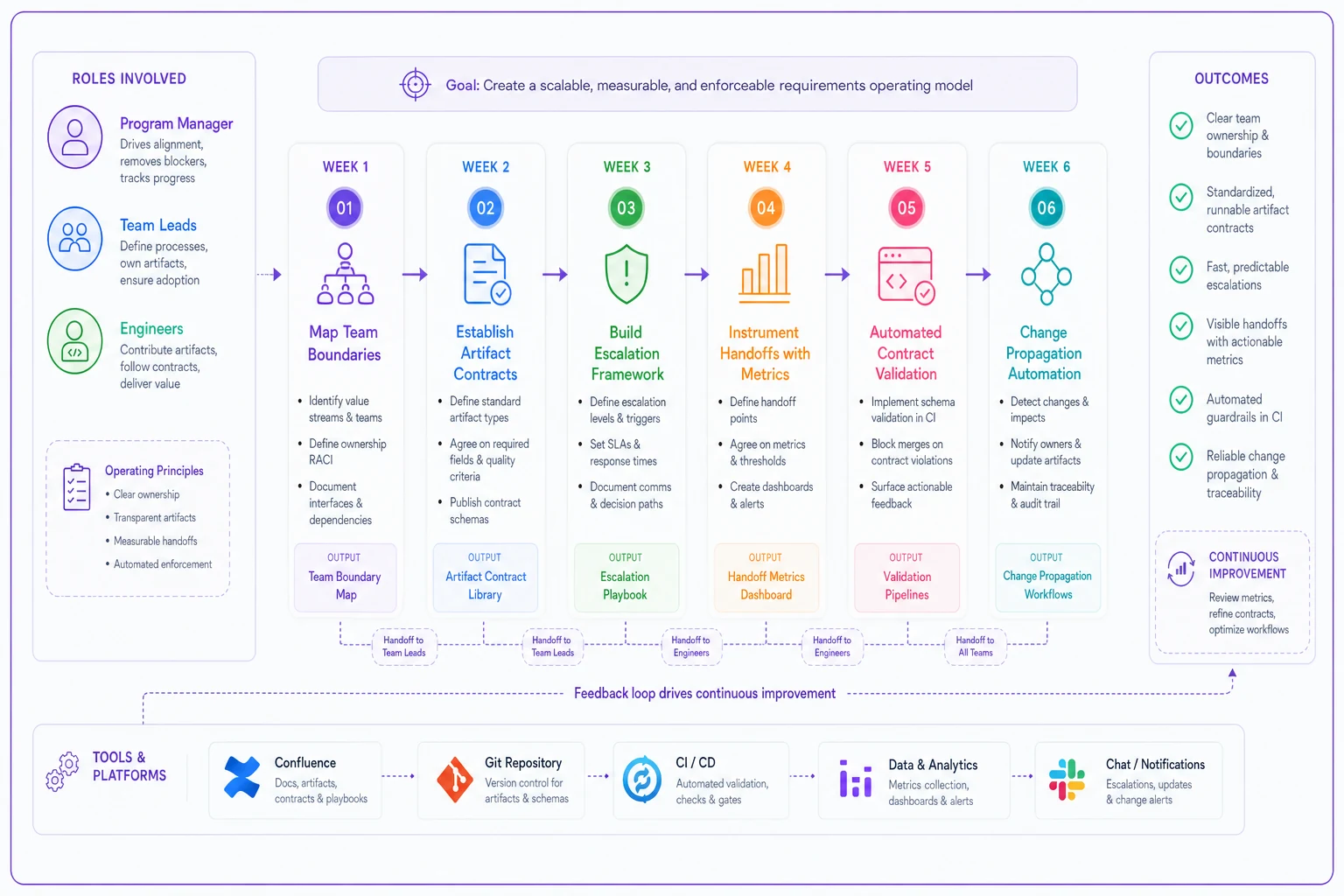
| Phase | Activities |
|---|---|
| Week 1-2 | Mapped all team boundaries and current handoffs. Found 23 unofficial handoff points that weren't documented anywhere. |
| Week 3-4 | Established artifact contracts for the five most critical handoffs. Started simple—just defining what gets delivered and when. |
| Week 5-8 | Built their escalation framework. Clear ownership, clear paths, clear decision rights. |
| Week 9-12 | Instrumented their handoffs with metrics. Started tracking handoff latency, contract violations, escalation frequency. |
| Week 13-16 | Implemented automated contract validation and change propagation. Nothing fancy—webhook-triggered validation scripts and automated Jira ticket creation. |
A visual of the implementation workflow helps make the sequence clear.
Integration defects dropped from around 40 per release to 12. Release planning went from three-day marathons to half-day sessions. The head of engineering got her evenings back.
But the real change was cultural. Teams stopped treating boundaries as no-man's land. Every boundary had an owner. Every handoff had a contract. Every escalation had a path.
When to implement (and when to wait)
Not every organization needs a formal multi-team requirements operating model. Two or three teams with stable boundaries and low change velocity can get by with lightweight governance.
But you need one if:
-
You have more than four teams working on the same product
-
Your integration defect rate is above 20%
-
Teams regularly discover dependencies during sprint execution
-
Your releases require "war rooms" to coordinate
-
Different teams have conflicting understandings of the same requirement
-
You're planning to add more teams in the next six months
The worst time to build this? During a critical release. The best time? Right after a painful one, when everyone still remembers why it hurt.
The path forward
Building a program-level requirements operating model isn't about adding process for its own sake. It's about creating clarity at scale. When every team knows what they own, what they produce, and how their work fits the larger system, coordination becomes operational rather than political.
Start small. Pick your two most problematic team boundaries and establish artifact contracts between them. Define clear handoff criteria. Build simple escalation paths. Measure what's actually happening at those boundaries.
Then expand. More boundaries, more contracts, more instrumentation. Use automation to reduce coordination overhead, not to replace human judgment. Make your operating model explicit, visible, and measurable.
The companies that get this right don't have fewer problems—they have clearer ways to solve them. Teams spend less time in alignment meetings. Releases are predictable because dependencies are known. Escalations are quick because the paths already exist.
Your requirements don't live in isolation. They flow between teams, across boundaries, through releases. The question isn't whether you have a requirements operating model—you do, even if it's implicit and messy. The question is whether that model serves your teams or quietly works against them.
Stop treating cross-team coordination as a communication challenge. It's an operational system that needs design, instrumentation, and ongoing improvement. Your teams—and your releases—will be better for it.
Stop treating cross-team coordination as a communication challenge. It's an operational system that needs design, instrumentation, and ongoing improvement. Your teams—and your releases—will be better for it.
Ready to transform your product delivery?
Join 2,000+ teams using GoReqly to improve requirements accuracy, reduce rework, and accelerate time to market.