


Most portfolios don't have a taxonomy problem on day one. They have it on day 400, when three teams have independently invented four names for the same thing, two systems disagree about whether an artifact is "approved" or "accepted," and nobody can run a clean report across the portfolio because every team's artifact IDs follow different rules.
What usually gets missed is that a taxonomy isn't a naming convention. It's the contract that lets a hundred different artifacts — requirements, test cases, decision records, release notes, risk entries — behave predictably when they cross team boundaries. Without it, every handoff becomes a translation exercise and every rollup report becomes a guessing game.
This is a systems article. The goal isn't to hand you a glossary. It's to show you where artifact taxonomies actually break at scale, what the connective tissue between artifact types looks like, and how to build governance that prevents drift without smothering your teams in bureaucratic overhead.
Why the taxonomy breaks before anyone notices
The pattern that shows up across portfolios: the taxonomy is implicit for a long time, and it works fine. One team, maybe two. Everyone knows that REQ- means a requirement and TC- means a test case, and "done" means the same thing to everyone because everyone's in the same standup.
Then the portfolio grows. A new team gets spun up and copies the old team's tools but not their conventions. A vendor integration drops artifacts into your system with a completely different ID scheme. Someone decides "user story" and "requirement" are different enough to warrant separate types, and now you have two artifact types that are 90% identical with different fields and different lifecycle states.
-
Team A uses
FR-1023for functional requirements. -
Team B uses
REQ-FUNC-2024-0045. -
A migrated legacy set uses
SpecSection4.2.1. -
An imported vendor set uses UUIDs.
None of these are wrong on their own. Together, they make it impossible to answer a simple question: how many open functional requirements does the portfolio have right now? That question should take thirty seconds. In a drifted portfolio it takes a person half a day and a spreadsheet.
The deeper issue is that naming drift is a symptom. The actual problem is that there's no canonical definition of what each artifact type is, what metadata it must carry, and what states it's allowed to be in. Once those three things are undefined, drift is inevitable — not because people are careless, but because every reasonable person fills the gap with their own reasonable choice.
This connects directly to when requirements artifacts fail to scale and the operational ecosystem that holds them together — taxonomy is the layer underneath that ecosystem. If the ecosystem is the plumbing, the taxonomy is the spec that says which pipes connect to which.
The three layers every artifact taxonomy actually needs
A taxonomy that survives scale has three layers, and most teams only build one.
Stop losing track of critical project requirements.
GoReqly helps you capture, organize, and track every requirement with precision and clarity.
- Centralized requirements repository
- Collaborative editing & commenting
- Traceability & version control
No credit card required
Layer 1 — Canonical metadata fields. The fields every artifact carries regardless of type. This is what makes cross-artifact reporting possible. If a requirement, a test case, and a risk entry all share a consistent owner, status, lastmodified, and portfolioid, you can build a portfolio view that treats them as one dataset. If they don't, you can't.
Layer 2 — Lifecycle states per artifact type. Different artifact types have genuinely different lives. A requirement goes through drafting, review, and acceptance. A risk gets identified, mitigated, accepted, or closed. Forcing them into one shared lifecycle creates nonsense states like a "deployed risk." The lifecycle layer is where you define the legal states and the legal transitions between them — per type.
Layer 3 — Governance and enforcement. The rules that keep Layers 1 and 2 honest over time. Naming rules, validators, and the migration logic that catches drift before it spreads. This is the layer almost nobody builds until after the first painful audit or the first failed portfolio rollup.
Teams usually build Layer 2 first because it feels most urgent and most visible. But Layer 1 is the one that pays off at the portfolio level, and Layer 3 is the one that keeps the whole thing from decaying. Build them out of order and you end up with beautifully specified lifecycles that nobody can query across teams.
Canonical metadata fields
These are the fields every artifact in a portfolio should carry. Not as a bureaucratic checklist — as the minimum set that makes an artifact findable, ownable, and auditable.
| Field | Purpose | Why it matters at scale |
|---|---|---|
artifact_id | Globally unique, type-prefixed identifier | Prevents collisions across teams and tools |
artifact_type | Canonical type (requirement, test_case, risk, etc.) | Enables type-specific lifecycle and rules |
title | Human-readable short name | Searchability; the first thing humans scan |
owner | Accountable individual or role | Kills the "who owns this?" delay |
status | Current lifecycle state | Cross-portfolio status rollups |
portfolioid / programid | Where it lives organizationally | Scoping reports and governance rules |
createdat / lastmodified | Timestamps | Staleness detection, audit trails |
version | Revision marker | Change tracking and merge logic |
links | Typed relationships to other artifacts | Traceability — the whole point |
source | Where it originated (manual, import, vendor) | Migration and provenance |
The field that gets skipped most often is source. It feels redundant until you're six months into a migration and can't tell which artifacts came from the legacy system, which were hand-created, and which arrived from a vendor feed. When something's malformed, source is the first thing you'll reach for.
The second most-skipped is a typed links field. Plenty of systems let you link artifacts, but the links are untyped — you know A connects to B, but not whether B verifies A, depends on A, or supersedes A. Untyped links are almost useless for governance because you can't write a rule like "every requirement in 'accepted' state must have at least one link of type verified_by."
Lifecycle matrices: where the real coordination lives
Lifecycle states are where cross-team coordination succeeds or fails. The common mistake is treating lifecycle as a per-artifact concern. It isn't. A lifecycle state is a promise to everyone downstream. When a requirement moves to "accepted," a QA team somewhere expects it to be stable enough to write tests against. When it slides back to "in revision" without anyone noticing, those tests silently rot.
So the lifecycle matrix needs to define not just the states, but the legal transitions and what each transition means to other artifacts.
Here's a sample lifecycle matrix for three common artifact types:
| Artifact type | States | Legal transitions | Terminal states |
|---|---|---|---|
| Requirement | draft → in_review → accepted → implemented → retired | draft↔inreview, inreview→accepted, accepted→implemented, any→retired | retired |
| Test case | draft → ready → passing → failing → deprecated | draft→ready, ready↔passing, ready↔failing, any→deprecated | deprecated |
| Risk | identified → assessed → mitigating → accepted/closed | identified→assessed, assessed→mitigating, mitigating→accepted, any→closed | accepted, closed |
| Decision record | proposed → accepted → superseded | proposed→accepted, accepted→superseded | superseded |
Two things worth noticing here.
First, every type needs a real terminal state. Portfolios accumulate artifacts forever if there's no sanctioned way to end them. "Retired," "deprecated," "closed," "superseded" — these matter because they let you filter the living portfolio from the historical one. Without them, every report drowns in dead artifacts and every new team inherits a graveyard.
Second, illegal transitions should be impossible, not just discouraged. A requirement jumping straight from draft to implemented skips review entirely. If your system allows it, someone will eventually do it under deadline pressure, and your traceability will have a hole nobody finds until audit season. The lifecycle matrix is only as good as the enforcement behind it.
This is also where lifecycle and version control intersect. If you're treating requirement artifacts with branching and tagging discipline — which is worth doing and covered in detail in treating requirements like code with branching, tagging, and merge patterns — then your lifecycle states need to map cleanly onto your merge model. An "accepted" state on a branch that hasn't merged is a different promise than "accepted" on main.
Governance rules that prevent naming drift
Governance is where most taxonomy efforts either become useful or become theater. The theater version is a 40-page standards document nobody reads. The useful version is a small set of rules that are enforced automatically at the moment artifacts are created or changed.
A rule that isn't validated isn't a rule, it's a suggestion. And suggestions drift.
Here's a practical governance ruleset that stays lightweight:
-
ID format is enforced at creation. Every artifact ID follows
{TYPE_PREFIX}-{PORTFOLIO}-{SEQUENCE}. The system rejects anything that doesn't match. NoFR-1023on one team andREQ-FUNC-2024-0045on another — the format is the format. -
Type prefixes are a closed list. New artifact types require a governance decision, not a free-text field. This single rule prevents the slow proliferation of near-duplicate types.
-
Status values are drawn from the lifecycle matrix only. A requirement cannot be in a status that isn't in its defined lifecycle. "In progress," "TBD," and "pending-ish" don't become statuses just because someone typed them.
-
Owner is mandatory and must resolve to a real person or role. No orphaned artifacts. An unowned artifact is an invisible one.
-
Required links depend on state. An "accepted" requirement with no
verified_bylink is flagged. The governance rule is tied to the lifecycle state, not applied blindly.
The pattern worth internalizing: good governance rules are contextual, not uniform. A draft requirement shouldn't be forced to have test links — it's a draft. An accepted one absolutely should. Blanket rules annoy people into working around them. State-aware rules feel reasonable because they match how the work actually flows.
Migration validators and enforcement
This is the part that separates a taxonomy that survives from one that quietly rots. You can define perfect canonical fields and lifecycle matrices, but the moment you onboard a legacy artifact set or a vendor feed, all of it collides with reality. Validators are how you absorb that collision without corrupting the portfolio.
A migration validator does three jobs: it checks incoming artifacts against the canonical schema, it attempts automatic normalization where it safely can, and it quarantines what it can't fix so a human decides.
Here's what a validation pass looks like in practice:
-
Ingest the incoming artifact set, tagging every record with
sourceso provenance is preserved. -
Schema check — does each artifact have every canonical field? Missing fields go to a report.
-
ID normalization — map legacy IDs to the canonical format, keeping the original ID in a
legacy_idfield so nothing is lost. -
Type mapping — map legacy types onto the closed list of canonical types. Ambiguous mappings (is
Spec_Sectiona requirement or a decision record?) get quarantined. -
Status mapping — map legacy statuses onto valid lifecycle states. A legacy "signed off" becomes "accepted"; an unmappable status gets quarantined.
-
Link validation — check that linked targets exist. Broken links get flagged, not silently dropped.
-
Quarantine review — everything that couldn't be normalized automatically lands in a review queue with the specific reason attached.
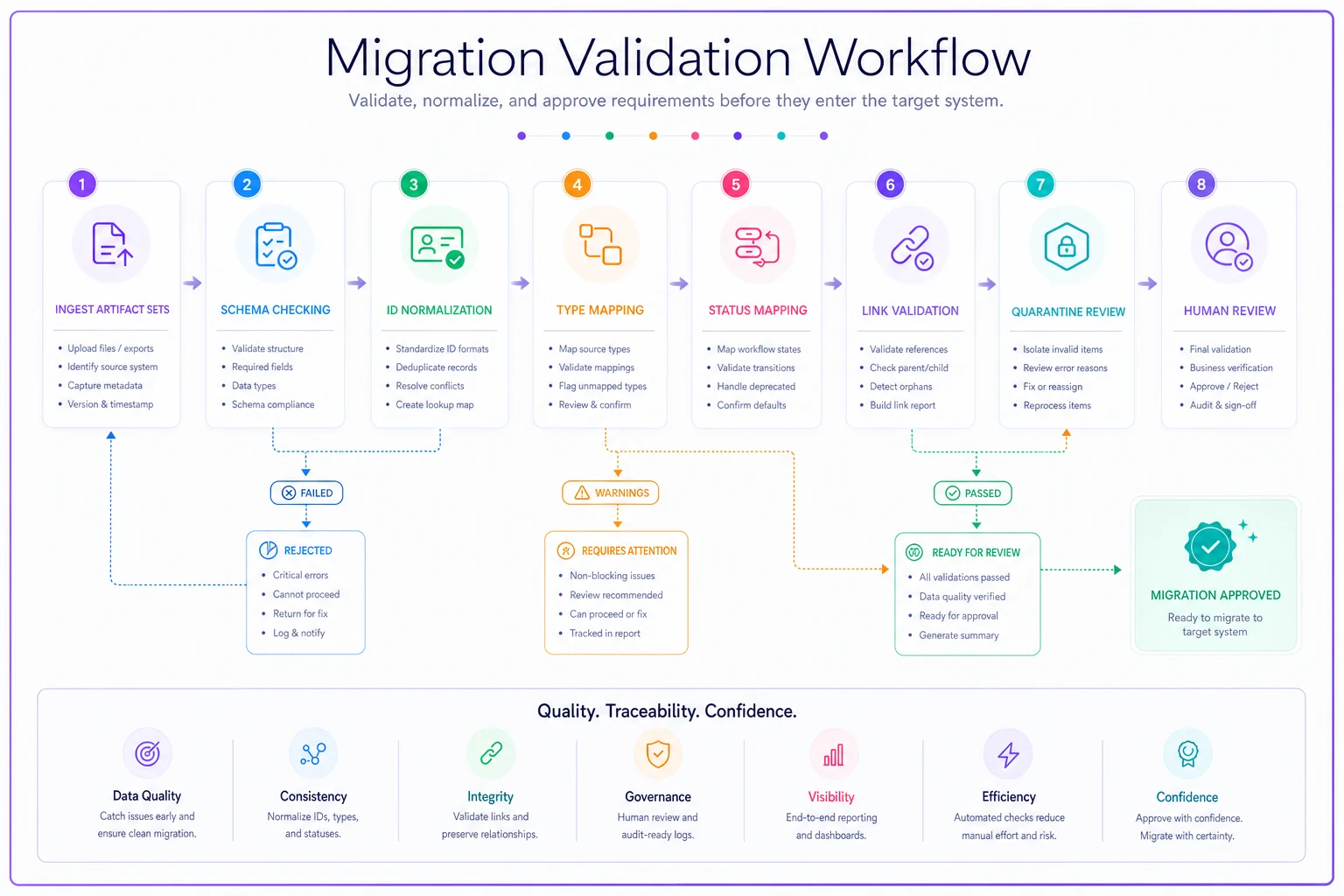
A visual of the migration validation flow can help teams align on the steps.
Here's a sample validator check in plain pseudo-logic:
for artifact in incomingset: if artifact.type not in CANONICALTYPES: quarantine(artifact, reason="unknowntype") if artifact.status not in LIFECYCLE[artifact.type].states: quarantine(artifact, reason="invalidstatus") if not matchesidformat(artifact.id): artifact.legacyid = artifact.id artifact.id = generatecanonicalid(artifact.type, artifact.portfolio) if not artifact.owner: quarantine(artifact, reason="missingowner") for link in artifact.links: if not targetexists(link.target): flag(artifact, reason="brokenlink", detail=link)
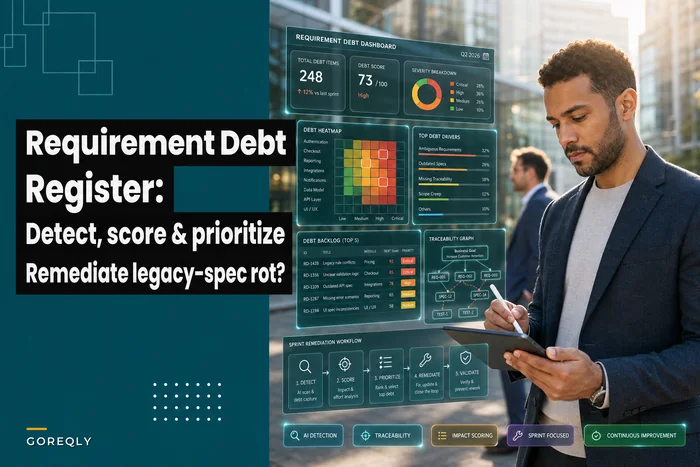
The non-obvious lesson from running migrations: quarantine is a feature, not a failure. Teams new to this instinctively want the migration to "just work" and push everything through. But the artifacts that can't be cleanly mapped are exactly the ones carrying hidden taxonomy debt. Force them through with a default guess and you've imported the debt into your clean system. Quarantining them makes the debt visible and assignable — which connects directly to the idea of a requirement debt register that detects, scores, and remediates legacy-spec rot. The quarantine queue is a debt register for taxonomy.
A real scenario: what drift costs and what fixing it looks like
Consider a mid-sized product org running three programs under one portfolio — roughly 4,000 active artifacts across requirements, test cases, risks, and decision records. They'd grown by acquisition, so two of the three programs arrived with their own tools and their own naming habits.
The symptom that triggered action wasn't audit failure. It was a quarterly portfolio review where leadership asked how many high-priority requirements were blocked, and it took the team the better part of three days to produce a number they trusted — because "blocked" was a status in one program, a tag in another, and a free-text note in the third.
The fix wasn't exciting, which is kind of the point. They defined ten canonical fields, locked lifecycle matrices for four artifact types, enforced ID formats at creation, and ran a migration validator across the legacy sets. The validator quarantined around 600 artifacts on the first pass — mostly missing owners and unmappable statuses. That quarantine queue felt like a failure for about a week, until they realized those 600 artifacts were precisely the ones that had been causing the review chaos.
After the taxonomy stabilized, that quarterly "how many blocked" question went from a three-day scramble to a saved filter. Not a revolution — just a question that finally had a reliable answer. The quieter payoff: new teams onboarding into the portfolio inherited the rules automatically instead of inventing their own, so drift stopped reproducing.
When this level of rigor makes sense — and when it doesn't
A full artifact taxonomy with validators and enforcement is real work. Worth being honest about when it pays off.
When it makes sense:
-
You have multiple teams or programs producing overlapping artifact types.
-
You run portfolio-level reporting and the numbers don't reconcile.
-
You've absorbed artifacts through acquisition, vendor feeds, or legacy migration.
-
You face audits where artifact provenance and lifecycle state have to be provable.
When it's overkill:
-
A single team, a single tool, and everyone shares context daily. A lightweight naming convention is plenty.
-
Early-stage products where the artifact types themselves are still shifting weekly. Lock the taxonomy too early and you'll be re-migrating constantly.
Who should hold off: teams that haven't stabilized their artifact types. If you're still arguing about whether user stories and requirements are the same thing, you're not ready to enforce a lifecycle matrix on either. Settle the types first. Enforcement layered on top of unsettled definitions just locks in the confusion and makes it harder to course-correct later.
The system view
A taxonomy isn't documentation — it's infrastructure. Canonical fields make the portfolio queryable. Lifecycle matrices make handoffs predictable. Governance rules keep both honest as teams multiply. And validators are what let you absorb the messy reality of migrations and vendor feeds without importing their chaos into your clean system.
The portfolios that stay legible at scale aren't the ones with the strictest rules. They're the ones where the rules are few, enforced automatically, and tied to how the work actually flows — state-aware governance instead of blanket mandates, quarantine instead of forced defaults, closed type lists instead of free-text sprawl.
Get those few things right early, and the taxonomy becomes invisible in the best way: nobody thinks about it, because it just works.
Ready to transform your product delivery?
Join 2,000+ teams using GoReqly to improve requirements accuracy, reduce rework, and accelerate time to market.