


The product manager opens Jira. Three sprints ago, someone changed a critical requirement from "must support offline mode" to "requires constant connection." No explanation. No discussion thread. Just... changed. Now the mobile team's halfway through implementing offline caching that nobody needs.
This plays out constantly across product teams. Requirements evolve — that's fine, expected even. But the reasoning behind those changes? Gone. Buried in Slack threads, email chains, or someone's head who left the company six months back.
Most teams treat decision records and requirements like they're separate creatures. Requirements live in Jira or Azure DevOps. Decision records float around in Confluence pages nobody reads. The connections between them? Maybe a stale hyperlink if you're lucky.
The rationale graveyard problem
Requirements without rationale become technical debt generators. A developer sees "user session timeout: 30 minutes" in the spec. Makes sense, implements it. What they don't see: the security team originally pushed for 15 minutes, product compromised at 30 after analyzing user workflows, and legal wanted 10 minutes for compliance but got overruled.
Six months later, during a security audit, that 30-minute timeout becomes a blocking issue. The original decision-makers have moved on. The new security lead demands 10 minutes. Product fights back without understanding the original context. Three weeks of meetings later, they land exactly where the original team started — if only someone had captured that journey.
The operational cost compounds. Teams revisit settled decisions. Engineers implement then re-implement based on shifting interpretations. QA writes test cases against requirements they don't fully understand because the "why" disappeared.
A fintech startup tracked this waste over 18 months and found that roughly 23% of their requirement changes were re-litigating old decisions where the rationale had been lost. That's not iteration — that's amnesia.
Why traditional linking fails at scale
Most organizations try solving this with hyperlinks and "see also" sections. The BA adds a link from the requirement to a decision record in Confluence. Problem solved, right?
Stop losing track of critical project requirements.
GoReqly helps you capture, organize, and track every requirement with precision and clarity.
- Centralized requirements repository
- Collaborative editing & commenting
- Traceability & version control
No credit card required
Except links break. Confluence pages move. Jira tickets get cloned without their attachments. Requirements get bulk-imported to new systems during tool migrations. The carefully constructed web of connections becomes a maze of 404 errors.
-
Initial scoping decisions
-
Technical feasibility assessments
-
Compliance reviews
-
Performance trade-offs
-
Security implications
-
Cost-benefit analyses
Traditional documentation captures maybe the final decision. The journey — where the real value lives — vanishes. Then there's the search problem. A new team member joins and needs to understand why the payment flow works a certain way. They search "payment processing decisions" and find nothing. Because the actual decision about payment flow was titled "Q3 Technical Review Meeting Notes" and buried on page 47.
Building a living rationale system
Effective decision records requirements integration isn't about perfect documentation — it's about creating pathways that naturally capture and surface rationale during regular work.
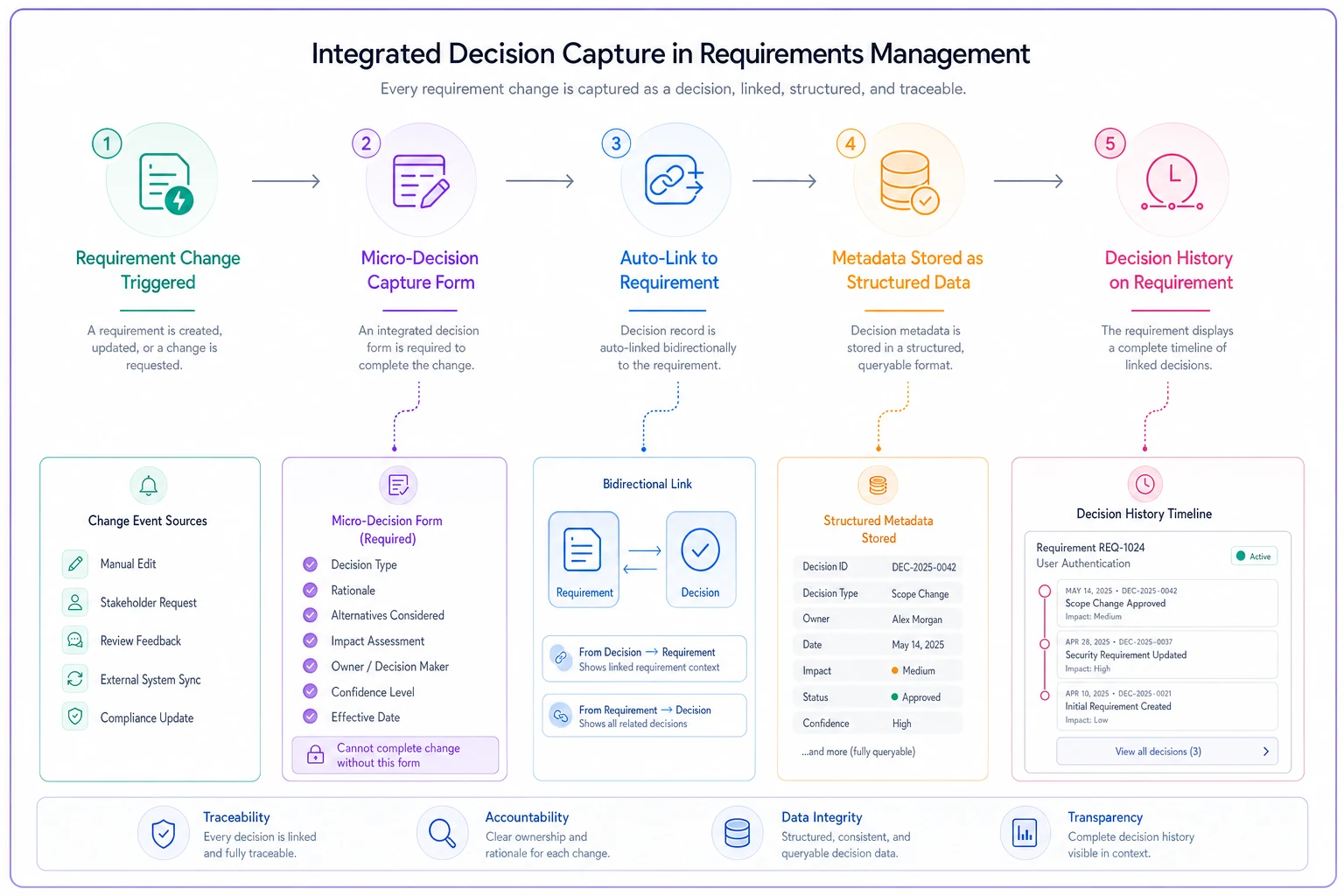
Start with templates that force the connection. Every requirement change should trigger a micro-decision record. The fields aren't complicated:
-
Previous state
exact text of old requirement
-
New state
exact text of new requirement
-
Rationale
why this change happened
-
Stakeholders consulted
who agreed
-
Trade-offs considered
what was given up
-
Dependencies affected
what else might break
This isn't bureaucracy — it's operational memory. Takes two minutes to fill out, saves two weeks of confusion later.
The template becomes powerful when it's integrated directly into requirement tools. Not as an optional field. As a required gate for changes. Your requirement management platform should literally prevent saving changes without completing the rationale fields.
Here's a quick workflow to visualize the process.
| Traditional Approach | Living Rationale System |
|---|---|
| Decisions in separate wiki pages | Decisions embedded in requirement objects |
| Manual linking between artifacts | Automatic bi-directional references |
| Point-in-time documentation | Versioned decision history |
| Search by document title | Search by requirement ID, decision type, or stakeholder |
| Static "as-of" snapshots | Timeline view of evolving rationale |
A setup like this doesn't need to be perfect on day one. Even a partial version of this — capturing rationale for high-risk changes only — is better than nothing.
Making rationale searchable and traceable
The real breakthrough comes from treating decisions as first-class entities in your requirement ecosystem. Not documents — structured data.
Each decision becomes a searchable object with a unique identifier, timestamp, author, affected requirements, decision type (scope, technical, compliance, etc.), status (proposed, accepted, superseded), and keywords for discovery.
Now when someone searches "payment compliance decisions," they find every decision tagged with those concepts, regardless of the document title. When they pull up a requirement, they see its complete decision history in chronological order. Modern requirements artifacts need proper structure to support this kind of integration. The decision layer becomes part of your artifact ecosystem, not an afterthought.
A healthcare software company implemented this after a near-miss with FDA compliance. They'd changed a data retention requirement from 7 years to 5 years without realizing the original 7-year decision was driven by FDA guidelines, not internal policy. Their new system tracks every requirement with its "decision chain" — a linked list of all decisions that shaped it. During their next FDA audit, they pulled the complete rationale history for every compliance-related requirement in minutes, not weeks.
Integration patterns that actually stick
The most elegant system fails if it requires extra effort. Decision capture needs to happen where teams already work.
Jira Integration Pattern: When a requirement issue transitions states, trigger a decision capture form. The issue can't complete the transition until the form is filled. The decision automatically links back to the requirement and appears in the issue's activity feed.
Azure DevOps Pattern: Use work item rules to create linked decision records. Changing certain fields — acceptance criteria, priority, estimation — automatically generates a draft decision record that the author must complete.
GitHub Pattern: For teams treating requirements like code, embed decisions in pull request templates. Merging requirement changes requires completing decision fields that become part of the commit history.
The key is making decision capture feel like part of the natural workflow, not an additional step bolted on afterward.
Surviving tool migrations and team changes
Tools change. Teams reorganize. The rationale system needs to outlast both.
Build your core decision records in a tool-agnostic format. Structured JSON or YAML files in version control give you portability. The UI layers on top, but the core data stays accessible even if you switch from Jira to Azure DevOps to whatever comes next.
| key | value |
|---|---|
| decision_id | DEC-2024-0892 |
| requirement_refs | [REQ-331, REQ-332] |
| type | technical_architecture |
| date | 2024-01-15 |
| author | sarah.chen@company.com |
| title | API Rate Limiting Strategy |
| rationale | Chose 1000 requests/minute per client based on: - Current peak usage: 600 req/min - Competitor benchmarks: 500-2000 range - Infrastructure cost analysis: linear scaling up to 1500 |
| trade_offs | - Higher limit increases DDoS risk - Lower limit may frustrate power users - Considered dynamic limits, too complex for MVP |
| supersedes | DEC-2023-0623 |
| status | active |
This structure survives tool migrations, integrates with multiple systems, and remains searchable through basic text tools if everything else fails. Version control gives you the change history for free — who modified the decision, when, what changed. Git already tracks all of it.
Building audit trails that auditors actually trust
Compliance audits care about two things: what you decided and whether you can prove it. Most teams scramble to reconstruct decision histories from emails and meeting notes. With integrated decision records requirements, you generate audit trails automatically.
Every requirement shows its initial specification with rationale, every change with timestamp and reason, who approved each change, what decisions influenced it, and related requirements affected. During an audit, you don't hunt for documentation. You query: "Show me all security-related requirement decisions from Q2" and get a complete, chronological report.
A payments company cut audit prep time from three weeks down to around three days using this approach. Their auditors actually complimented the traceability — apparently that's rare enough to be worth mentioning.
Measuring rationale system health
Without proper metrics, your rationale system degrades into another documentation graveyard.
-
Decision coverage — percentage of requirement changes with linked decisions
-
Rationale completeness — how many decisions have all template fields filled
-
Search effectiveness — can team members find decisions within two minutes?
-
Link decay rate — how many decision-requirement links break monthly
-
Supersession clarity — do people understand which decisions are current?
One product team discovered their decision coverage dropped from 89% to 34% over six months. The culprit was straightforward — they'd added three new requirement types but hadn't updated their decision templates to handle them. The incompatible templates discouraged teams from documenting decisions at all.
Metrics don't have to be elaborate. Even a simple monthly review of coverage and link integrity tells you whether the system is holding up or quietly falling apart.
When rationale systems become operational assets
The real payoff comes when your decision records requirements integration starts preventing problems rather than just documenting them.
-
Requirement clarification requests dropped roughly 40%
-
Time spent in "why did we decide this?" meetings fell from around 8 hours to about 2 hours weekly
-
New engineer onboarding time decreased by approximately 5 days
-
Requirements needing rework due to misunderstanding dropped from 18% to around 7%
Those aren't huge infrastructure changes. They're downstream effects of teams spending less time confused about context.
The ongoing maintenance reality
Perfect documentation is a myth. Your rationale system needs regular pruning.
Schedule quarterly reviews to archive superseded decisions, update broken links, consolidate duplicate rationales, tag untagged decisions for searchability, and review whether your templates are still working.
More importantly, assign ownership. Someone needs to champion the system, train new team members, and push back when people skip the rationale capture. Without an owner, even the best system degrades into checkbox compliance within a year.
Anti-patterns to avoid
Some approaches seem logical but create more problems than they solve.
The novel-length rationale. Teams write extensive essays for every decision. Nobody reads them. Keep rationales under 200 words unless the complexity genuinely demands more.
Retroactive documentation. "We'll document decisions at the end of the sprint." It never happens. Capture rationale at the moment of decision or lose it forever.
Over-structuring. Twenty required fields for every decision. Teams revolt and start putting "N/A" everywhere. Start minimal, add structure only when patterns emerge.
Tool obsession. Spending months evaluating the perfect decision management platform while decisions go undocumented. A spreadsheet with good process beats sophisticated tools with poor adoption every time.
Operational software as the connective tissue
Manual linking between decisions and requirements eventually breaks down. The overhead becomes too high, especially as team size grows.
Modern AI-enhanced requirement management platforms can automatically extract decision points from meeting transcripts, link decisions to requirements based on content analysis, flag requirements with outdated rationales, generate audit reports from scattered decision records, and surface relevant past decisions during requirement reviews.
The automation doesn't replace human judgment — it removes the clerical burden that makes teams skip documentation in the first place. When capturing a decision takes 30 seconds instead of 10 minutes, teams actually do it. These platforms work best when they integrate with existing tools rather than forcing wholesale migration. They pull from Jira, push to Confluence, sync with Git, and generate reports in whatever format an audit requires.
Making it stick
The gap between decision and requirement isn't technical — it's operational. Teams know they should document rationale. They skip it because the friction is too high and the payoff feels distant.
Lower the friction through templates and integration. Make the value immediate through better search and onboarding. Build the system into daily workflows rather than treating it as extra work. Your requirements will still evolve. Teams will still change. But the reasoning — the expensive, hard-won understanding of why things work the way they do — that survives. And that's what separates teams that actually learn from teams that repeat the same discoveries every eighteen months.
Lower the friction through templates and integration. Make the value immediate through better search and onboarding. Build the system into daily workflows rather than treating it as extra work. Your requirements will still evolve. Teams will still change. But the reasoning — the expensive, hard-won understanding of why things work the way they do — that survives. And that's what separates teams that actually learn from teams that repeat the same discoveries every eighteen months.
Ready to transform your product delivery?
Join 2,000+ teams using GoReqly to improve requirements accuracy, reduce rework, and accelerate time to market.