



The fastest way to blow a release date isn't a failing test. It's a signoff email sitting unanswered for four days because you sent your compliance officer a 40-page artifact dump and asked her to "review and approve." She opened it, saw a wall of Jira exports, and quietly moved it to the bottom of her queue.
Different approvers care about wildly different things. Engineering wants to know the thing works and won't page someone at 2am. Legal wants to know what you're contractually promising and where the liability sits. Compliance wants a mapped, defensible trail. Sales wants to know what they can actually say to customers without getting corrected later. When you hand all four the same evidence bundle, three of them have to dig through noise to find the one thing they're accountable for — and every one of those digs adds a day.
This post is about building stakeholder signoff templates that are archetype-specific: minimal evidence bundles, each mapped to the exact requirement links the approver needs to sign against. Not more documentation. Less — but the right less.
The core mistake: treating signoff as a document, not a decision
Most teams build one "release package" and route it to everyone. The logic feels efficient — assemble once, distribute widely. In practice it does the opposite. Every approver becomes responsible for filtering out the 80% that isn't theirs.
You see the same pattern over and over. A PM assembles a release bundle with test results, architecture notes, a security scan, a data-flow diagram, the changelog, and updated acceptance criteria. That bundle goes to four people. Engineering skims for test and monitoring evidence. Legal hunts for the terms-facing changes. Compliance looks for the control mapping. Sales wants the feature capability summary. Each person reads maybe a quarter of the document and spends the first ten minutes just orienting.
The real cost isn't reading time — it's decision latency. An approver who can't immediately see what they're signing against will defer. Deferral is the default human response to ambiguity when your name is going on the approval. So the bundle rots in inboxes, someone starts nudging, and a release that was technically ready Tuesday gets its final signoff Friday.
A signoff is a decision. The evidence exists to make that specific decision fast and defensible. Anything that doesn't support this approver's decision is just friction.
What each archetype actually signs against
The trick is to reverse-engineer the bundle from the question each approver is really answering. Not the role title — the underlying decision.
Stop losing track of critical project requirements.
GoReqly helps you capture, organize, and track every requirement with precision and clarity.
- Centralized requirements repository
- Collaborative editing & commenting
- Traceability & version control
No credit card required
| Approver archetype | The real question they're answering | Minimum evidence they need | What they don't need |
|---|---|---|---|
| Engineering | "Will this work in production and can we operate it?" | Requirement→test link status, monitoring/alerting coverage for new paths, rollback plan, known-issue list | Legal terms, sales positioning, full compliance mapping |
| Legal | "What are we promising, and where's the exposure?" | Requirements touching contracts/terms/data handling, changes to user-facing commitments, third-party obligations | Test coverage %, deployment mechanics, internal architecture |
| Compliance | "Can I defend this in an audit with a clean trail?" | Requirement→control mapping, evidence links per control, sign-history, gaps register | Sales enablement, UI copy, performance benchmarks |
| Sales / GTM | "What can we truthfully tell customers is available?" | Shipped-capability list mapped to requirements, limitations/known-issues, availability by segment/plan | Test logs, control mappings, rollback runbooks |
The overlap is smaller than most people expect. Engineering and compliance both touch requirement links, but engineering wants the test edge of that link and compliance wants the control edge. Same requirement, different attached evidence. That distinction is the whole game.
Building the minimal bundle per archetype
"Minimal" trips people up. It doesn't mean thin. It means scoped to the decision — everything the approver needs to sign confidently, nothing that forces them to filter.
-
The scope statement — which requirements are in this release, in the approver's language. Legal sees "changes to data-retention commitments." Engineering sees "3 new services, 2 modified endpoints."
-
The evidence links — not attachments, links. Each requirement points to the specific artifact this approver signs against. Compliance's link goes to the control-mapping row; engineering's goes to the test run and the monitoring dashboard.
-
The exceptions — what's not covered, known gaps, anything deferred. This is the most underused section, and it's the one that saves you in an audit.
That third item deserves emphasis. Approvers stall when they suspect something's hidden. A visible, honest exceptions section paradoxically speeds signoff — it removes the fear of an unknown gap. A compliance officer who sees "control 4.2 not applicable this release, rationale linked" signs faster than one who sees no mention of 4.2 at all and starts wondering.
Make the exceptions section explicit and link to the requirement rationale so approvers can verify gaps quickly.
The engineering bundle, concretely
Engineering signoff fails most often not on test coverage but on operability evidence. The tests pass, but nobody's confirmed there's an alert on the new payment-retry path or that the rollback actually works with the new schema migration.
A tight engineering bundle links each in-scope requirement to its test run result, the monitoring coverage for any new failure mode, and a rollback note. That's it. If a requirement introduces a new code path with no corresponding alert, that shows up as a visible gap — and now the engineering lead is making an informed decision instead of assuming coverage exists.
The legal bundle, concretely
Legal doesn't want your architecture. They want the delta in what you're promising. A legal bundle should surface only the requirements that touch user-facing terms, data handling, third-party obligations, or regulatory-adjacent claims — each linked to the specific wording or commitment that changed.
The common failure is invisible legal-relevant changes. A requirement to "cache user location for faster results" is an engineering ticket to the team, but it's a data-handling change to legal. If your bundle only flags requirements someone manually tagged as "legal," you'll miss these. Better to mark data-handling and terms-facing implications at the requirement level when it's written — that way the legal bundle assembles itself from those tags rather than relying on someone's memory later.
The compliance bundle, concretely
Compliance is the one archetype where the structure of the evidence matters as much as its content. They're building a defensible trail. Their bundle is essentially a requirement→control map with an evidence link per control and a sign-history showing who approved what and when.
If you've already built a traceability model for audits, this bundle is nearly free — you're just filtering the existing map to this release's scope. Teams that haven't done that groundwork end up assembling compliance evidence by hand every release, which is where most audit pain actually comes from. If that's where you are, the approach in building a lightweight compliance-ready requirements traceability model is the prerequisite work that makes archetype bundles possible.
The sales bundle, concretely
Sales signoff is the one most teams skip, and it's why customers get told about features that don't quite exist yet or work differently than pitched. The sales bundle is a capability list — what shipped, mapped to the requirements — plus limitations and any segment or plan gating.
The pattern to avoid: shipping a feature that works for 90% of cases and letting sales assume it's universal. A known-limitations section, linked to the specific requirements that got descoped, keeps the pitch honest.
A real scenario
A mid-size B2B software company, roughly 60 people, was running a two-week release cadence but consistently slipping to closer to three. When they mapped where the time went, last-mile signoff was eating around four to five days per release — mostly dead time waiting on approvers, not active review.
They were sending one combined bundle to all four archetypes. Compliance was the usual bottleneck; their officer was part-time and would set the bundle aside because parsing what she owned took too long.
They rebuilt signoff around archetype-specific packets. Each approver got a scoped bundle with their requirement links, evidence, and an exceptions section. Nothing fancy — the compliance packet was the control-map rows for the release, the engineering packet was test-plus-monitoring links, and so on.
Signoff dropped to roughly a day and a half. Not because anyone worked faster, but because each approver could see their decision immediately. The compliance officer went from "I'll get to it" to signing in one sitting, because she was looking at six mapped controls instead of a 40-page document. Over a quarter that recovered close to a full release cycle.
When this is worth it — and when it isn't
Archetype bundles pay off when you have genuinely distinct approvers with distinct accountabilities and releases frequent enough that signoff friction compounds. If you ship monthly with three separate approvers, this is high-leverage.
When it's a bad idea: if you're a five-person team where the same person is effectively engineering, compliance, and product, splitting bundles is theater. You'd be building four packets for one brain. Keep it as a single lightweight review and move on.
Who should not do this: teams that don't yet have requirement-level traceability. Archetype bundles are a filtering layer on top of a traceability model. Without the underlying requirement links, you're not filtering — you're re-authoring evidence four times per release, which is worse than the single-bundle problem you started with. Build the trace layer first.
There's also a real risk of over-engineering the signoff process itself. Adding sub-archetypes, approval matrices, and escalation tiers for a team that ships fine just trades one kind of friction for another. If you're already fighting heavyweight process, the mindset in a lightweight requirements governance blueprint applies directly — bundle only as much as the decision requires.
A checklist for building your archetype bundles
Use this checklist when you're assembling archetype bundles.
-
List your actual approvers and write down the one question each is really answering
-
For each archetype, identify which edge of the requirement link they sign against (test? control? terms? capability?)
-
Tag requirements at authoring time for their legal, compliance, and data-handling implications — don't retrofit
-
Build each bundle from links, not attachments, so evidence stays current
-
Always include an exceptions/known-gaps section per bundle
-
Confirm the bundle assembles automatically from existing traceability, not by hand each release
-
Track signoff latency per archetype for a few releases to find your real bottleneck
Track signoff latency per archetype for a few releases to find your real bottleneck.
The workflow that ties it together
Once it's running, the flow is fairly simple. A release enters the signoff stage. The system pulls in-scope requirements and filters them per archetype using tags set at authoring time. Each approver gets a scoped view: their requirements, the linked evidence at the edge they care about, and the exceptions. They sign against their view. The sign-history writes back to the traceability record, so the compliance trail builds itself as a byproduct of normal approvals rather than as a separate documentation exercise.
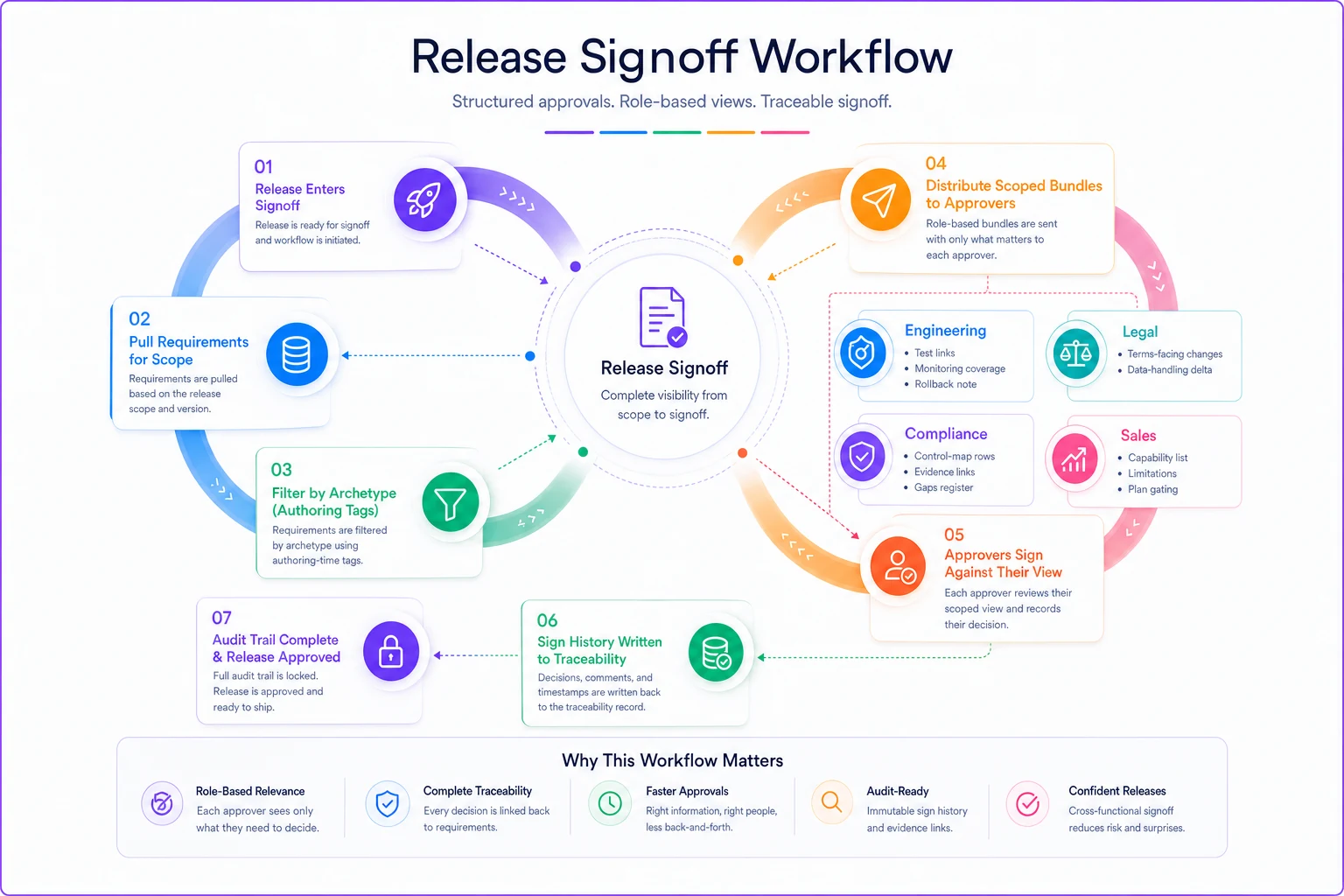
The quiet win here is that the audit trail and the signoff process stop being two different jobs. When the sign-history is attached to the requirement links, an auditor asking "who approved this control and when" gets answered from the same data that ran your release gate. One source of truth, and both the speed problem and the defensibility problem get solved by the same structure.
Archetype-based signoff works not because it adds rigor, but because it removes the filtering burden from the people whose deferral costs you the most. Give each approver exactly the evidence their decision requires, mapped to the requirements they're accountable for, and signoff stops being the thing that slips your release date.
Ready to transform your product delivery?
Join 2,000+ teams using GoReqly to improve requirements accuracy, reduce rework, and accelerate time to market.