


Most teams can run experiments. Fewer can trace what an experiment proved back into a funding decision. And almost nobody can do it fast enough that the backlog actually reflects what they learned last month.
That gap — between evidence existing and evidence changing what you build next — is where product strategy quietly rots. You end up with dashboards nobody acts on, decision debates that reopen every quarter, and a backlog that reflects political memory instead of measured reality. The teams that scale well aren't the ones running more experiments. They're the ones whose requirements feedback loop experiments telemetry actually flows into a decision register and out into reprioritized work without a human having to babysit every step.
This article is about that whole pipe. Not one tool, not one metric — the full loop from signal to funding shift.
Where the loop actually breaks
If you trace a real decision backward, the break almost always happens in one of four places — and rarely where people expect.
The first is evidence that never becomes a threshold. A team ships an experiment, results land in an analytics tool, someone screenshots a chart into a deck, and that's it. No pre-agreed rule for what the number needs to hit to matter. So when it comes back at, say, 3.1% lift, the conversation becomes "is that good?" instead of "that cleared the bar we set." You can't scale a loop where every result triggers a fresh argument about significance.
The second is decisions that never get written down. People confuse Slack consensus with a decision. Six weeks later nobody can say whether the team actually committed to doubling down on a feature or just stopped talking about it. Without a durable record, the loop has no memory, and a loop with no memory runs the same debate forever.
The third is the backlog never hearing about it. The decision gets made, maybe even recorded somewhere, and then the backlog sits untouched because reprioritizing is manual, political, and nobody owns the hand-off. Evidence changed. The plan didn't.
The fourth is time. Even when everything connects, it connects too slowly. An experiment wraps up in week 2 and doesn't influence planning until week 9. By then the context is stale and the team has emotionally committed to the old roadmap.
These four breaks compound. Fix the dashboards but not the decision record, and you just produce prettier evidence nobody acts on any faster.
The chain, laid out
Below is the spine of a working loop. Each stage has a specific output that becomes the input to the next. If any stage produces something vague, the whole thing jams downstream.
Stop losing track of critical project requirements.
GoReqly helps you capture, organize, and track every requirement with precision and clarity.
- Centralized requirements repository
- Collaborative editing & commenting
- Traceability & version control
No credit card required
| Stage | Input | Output that must exist | Common failure |
|---|---|---|---|
| Experiment evidence | Running experiment + telemetry | Clean result tied to a hypothesis | Results detached from the original question |
| Threshold rules | Metric + pre-agreed bar | Pass / fail / inconclusive verdict | No bar set before the experiment ran |
| Decision register | Verdict + context | A recorded, owned decision | Consensus that lives only in chat |
| Backlog reprioritization | Decision + affected items | Reordered, re-funded backlog | Decision made, backlog untouched |
The important mental shift: thresholds are set before the experiment, not after. When you define the bar afterward, you unconsciously move it to match the result you want. A 2% lift becomes "meaningful" if you're attached to the feature and "noise" if you're not. Pre-registering the threshold removes that negotiation.
One practical thing that helps: treat the rationale as a first-class artifact from the start, not an afterthought. If the "why" gets lost between stage one and stage three, the decision register fills with verdicts nobody can explain later. We've written about this in more depth in preserving experiment rationale across the discovery-to-requirements lifecycle.
Here's a concise workflow diagram that ties the stages together.
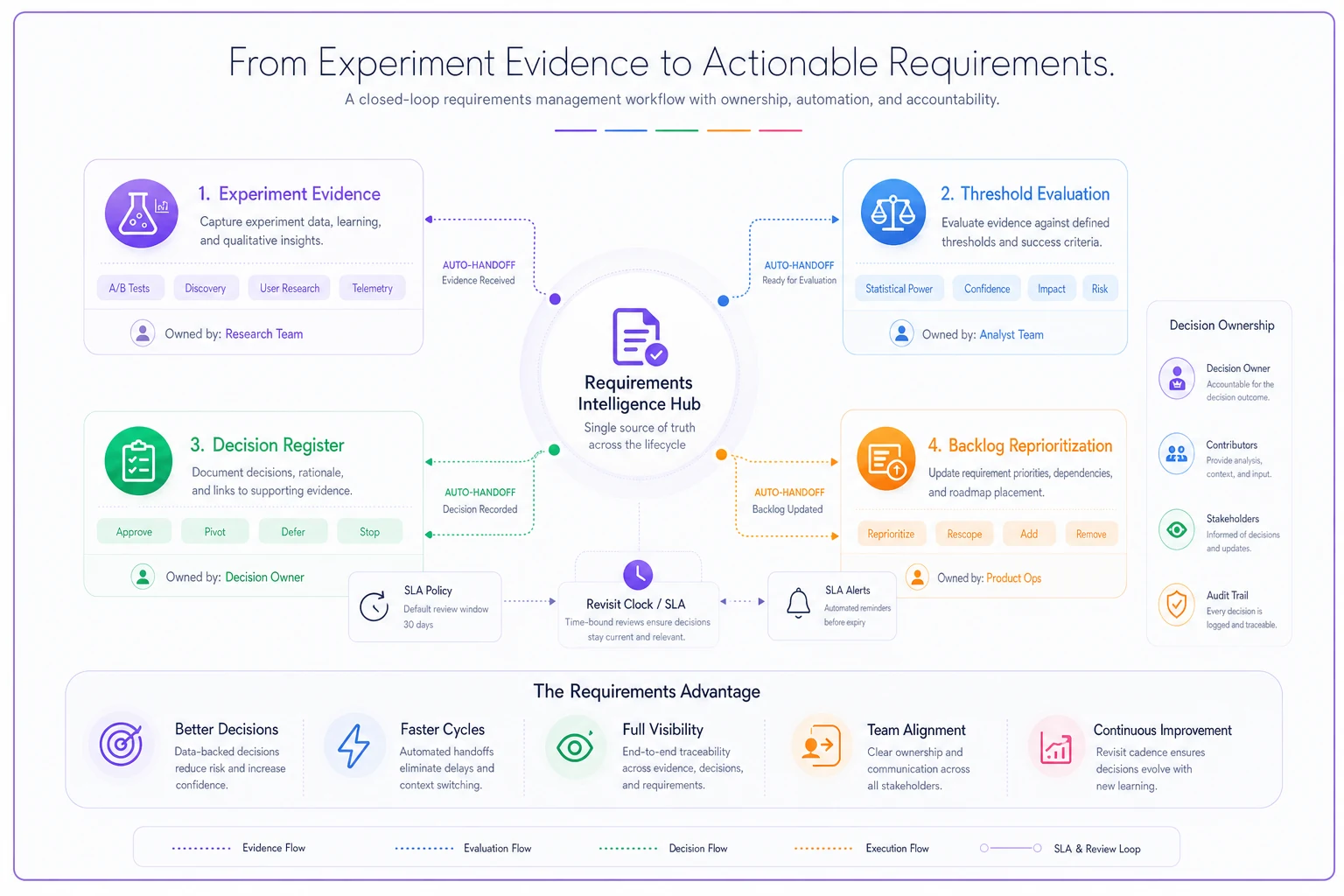
If any stage produces something vague, the flow shows where the leak happens and which hand-off to automate next.
Threshold rules: the part everyone underbuilds
Thresholds are where most teams get lazy. They set a single number — "we need a 5% conversion lift" — and ignore everything about confidence, duration, and downstream cost.
A real threshold rule has more than one condition:
-
Primary metric bar
the lift or absolute value that defines success
-
Confidence floor
minimum statistical confidence before the result counts at all
-
Guardrail metrics
things that must not degrade (latency, refund rate, support volume)
-
Minimum exposure
how many users or how long before you'll even look at it
-
Cost-of-change gate
if acting on this costs more than the value it unlocks, it fails even if the metric passed
That last one catches teams off guard. A typical example: experiment shows a 4% lift on a secondary funnel step. Looks like a win. But acting on it requires rebuilding an integration that'll eat six engineer-weeks. The threshold rule should flip this to "inconclusive — revisit when cheaper," not an automatic green light.
Include the cost-of-change gate as a line item in your experiment brief so engineering can estimate feasibility before you run it.
When thresholds are structured this way, the verdict becomes close to mechanical. Evidence comes in, the rule evaluates it, you get pass / fail / inconclusive without a meeting. That's the only way this scales past a handful of experiments a quarter.
The decision register is the memory of the loop
If there's one artifact that separates teams who learn from teams who relitigate, it's the decision register. Not a meeting note. A durable, searchable record where each entry captures: what was decided, what evidence drove it, who owns it, what it affects, and when to revisit.
In practice, this breaks down because the register gets treated as documentation instead of infrastructure. Documentation is something you write after and rarely read. Infrastructure is something the next step depends on. The decision register only works when backlog reprioritization literally cannot happen without pulling from it.
-
Decision
"Fund expansion of the guided onboarding flow; defer the referral widget."
-
Evidence
experiment #142, 3.4% activation lift, confidence above the floor, no guardrail breaches.
-
Threshold outcome
passed primary + cost gate.
-
Owner
PM for activation.
-
Backlog impact
three stories promoted, one epic deprioritized.
-
Revisit date
end of next quarter, or if activation regresses.
The fields for "backlog impact" and "revisit date" are doing the real work. Most registers stop at the decision and the evidence, which means the loop dead-ends right where it was supposed to produce action.
There's a strong overlap here with how funding gates should be tied to evidence rather than opinion — the mechanics covered in portfolio requirements governance that ties investment gates to requirement evidence. The decision register is what makes those gates auditable instead of theatrical.
Putting an SLA on decisioning
The loop needs a clock. Teams skip this entirely, and it's where things quietly fall apart.
Evidence has a shelf life. A result acted on within two weeks still carries its context — the team remembers the setup, the edge cases, the reason it mattered. Wait eight weeks and that context evaporates. The decision step needs an SLA the same way an incident response does.
-
Experiment concludes → verdict recorded
within 3 business days. The threshold rule should make this nearly automatic.
-
Verdict → decision logged in register
within 5 business days. This is the human judgment window — the only step that genuinely needs a person.
-
Decision → backlog reflects it
within one planning cycle, not "whenever we get to it."
Without an SLA, nothing dramatically breaks. Decisions just drift. A verdict sits in a doc for three weeks because no meeting felt urgent. By the time it's discussed, two new experiments have landed and the backlog conversation becomes an overwhelming batch instead of a steady flow. Batching decisions is how you get quarterly roadmap thrash instead of continuous adjustment.
The SLA also exposes who the actual bottleneck is. In most orgs it's not the data team and it's not engineering — it's the decision step itself, where someone with authority has to actually commit. Measuring time-to-decision makes that visible for the first time.
Dashboards that show funding shifts, not just metrics
Most experiment dashboards show you what happened to the metric. Useful, but it's the wrong altitude for strategy conversations. The dashboards that actually move strategy show where money and attention moved as a result of evidence.
Three views worth building:
Funding shift view. A before/after of where engineering capacity sits across themes, annotated with the decisions that caused each shift. When a leader asks "why are we putting more people on onboarding," the answer is a decision record and its evidence, linked right there. You might show onboarding moving from roughly 15% to 25% of sprint allocation, with the two decision IDs that drove it visible inline.
Decision latency view. Time from experiment conclusion to decision logged, trended over weeks. If that number creeps up, the loop is clogging regardless of how many experiments you're running. Honestly the single most honest health metric for the whole system.
Evidence coverage view. What fraction of currently funded backlog items trace back to a logged decision with real evidence versus items funded on "we've always planned to." A healthy team is never at 100% — some bets are legitimately intuition — but when the uncovered share is most of the backlog, you're running on momentum, not learning.
That last view tends to be uncomfortable the first time a team builds it. It's common to find that well under half the funded work has any evidentiary basis. That's not a failure — it's the baseline the loop exists to improve.
Automation recipes to push decisions into backlog workflows
The hand-off from decision to backlog is where good intentions die. Manual and tedious, it's exactly the kind of connective work that benefits from light automation — not replacing judgment, just removing the copy-paste friction that lets decisions evaporate.
-
Threshold evaluation on experiment close. When an experiment's data hits its minimum exposure, the pre-registered threshold rule runs automatically and posts a draft verdict into the decision register as a stub awaiting human confirmation. The person isn't computing significance — they're confirming judgment.
-
Decision-to-backlog propagation. When a decision is logged with a "backlog impact" field, affected items get flagged for reprioritization automatically, with the decision ID attached as context. No one has to remember which stories a decision touched.
-
Revisit reminders. Each decision with a revisit date generates a prompt when that date arrives, pulling the current metric so the team can see whether the original evidence still holds. This is how you catch decisions that were right six months ago and wrong now.
-
Latency alerting. If a verdict sits in the register without a confirmed decision past the SLA window, it escalates. The clock enforces itself instead of relying on someone noticing.
The point of automating these isn't speed for its own sake. Manual hand-offs leak, and every leak means evidence that never reaches the backlog. The automation exists to make the loop's default behavior "the decision reaches the plan" instead of "the decision gets forgotten."
A related pattern worth borrowing: the same extraction-and-prioritization discipline that works for converting noisy inputs into ranked work — covered in turning support tickets into prioritized requirements through a traceable pipeline — applies directly to experiment evidence. Both are about converting raw signal into something the backlog can actually consume.
A real scenario
A mid-sized B2B product team — roughly 40 people across product and engineering — was running around a dozen experiments a quarter and feeling like none of it changed anything. Evidence existed. Strategy didn't move.
When they traced it, the break was almost entirely in the decision step. Experiments concluded, results landed in their analytics stack, and then nothing had an owner. Average time from experiment conclusion to any logged decision was north of six weeks, and more than half of concluded experiments produced no recorded decision at all. The backlog, predictably, reflected last year's planning, not last month's learning.
They didn't add tooling first. They added two things: pre-registered thresholds on every experiment, and a 5-day SLA on logging a decision once a verdict existed. The threshold rules killed the "is this good?" debates. The SLA forced the decision step to stop drifting.
Over the following two quarters, time-to-decision dropped under two weeks, and the share of experiments producing a recorded decision went from under half to the large majority. The more interesting outcome wasn't speed — two features the team had been quietly protecting got defunded once their experiments repeatedly failed the pre-set threshold. Evidence finally outranked attachment.
When this makes sense — and when it doesn't
This whole system is overhead. Worth being honest about when it earns its keep.
When it makes sense: You're running enough experiments that debates and lost decisions have become a real tax on the team. Multiple teams whose priorities interact. Funding decisions get made and reopened repeatedly. Stakeholders need to understand why the roadmap shifted, not just that it did.
When it's a bad idea: You're pre-product-market-fit, running two experiments a quarter mostly on gut. Building a decision register and SLAs at that stage is ceremony that slows you down. A shared doc is plenty. The loop earns its keep when experiment volume and organizational coordination both cross a threshold — ironically, you need a threshold rule to decide whether you need threshold rules.
Who should skip this entirely: A single-team startup where the founder is also the PM and the decisions live in one head. The overhead of formalizing a loop exceeds the cost of the occasional forgotten decision. Wait until the decision-maker is no longer the same person as the experimenter.
Product strategy doesn't drift at scale because of a shortage of data or smart people. It drifts because the path from "we learned something" to "we're building differently because of it" has too many manual hops, no clock, and no memory. Build the chain deliberately — pre-registered thresholds, a decision register the backlog actually depends on, an SLA that keeps the loop moving, and enough automation to stop hand-offs from leaking — and strategy starts moving at the speed of your evidence instead of the speed of your next quarterly offsite. That's the difference between a team that runs experiments and a team that actually learns from them.
Ready to transform your product delivery?
Join 2,000+ teams using GoReqly to improve requirements accuracy, reduce rework, and accelerate time to market.