


Most portfolio decisions still run on vibes. A steering committee looks at a slide deck, someone says "we're 70% done," a green status dot glows next to a program that's actually bleeding scope, and another tranche of money gets released. The requirement artifacts — the actual source of truth about what's being built and whether it's understood — never make it into the room.
That's the gap this article is about. Not requirements quality for its own sake, and not governance for its own sake, but the wiring between them: how portfolio KPIs should map back to requirement-health signals, and how those signals should gate investment decisions with evidence that survives an audit.
If you've read our take on why most requirements KPIs don't drive action, this is the portfolio-level extension of that idea. The metrics only matter if they change where money goes.
The disconnect nobody wants to name
Here's the pattern across almost every mid-to-large portfolio: the people making funding decisions and the people producing requirement evidence are separated by three or four abstraction layers, and each layer smooths the data.
A team lead knows the payments requirement has ambiguous acceptance criteria and two open dependencies. That reality gets rolled into a "yellow with mitigation" status at the program level. At the portfolio level it becomes a green dot with a footnote. By the time it reaches the investment board, the footnote is gone and the program looks fundable.
Nobody's lying. Each summarization is locally reasonable. But the aggregate effect is that investment gates get decided on the smoothest possible version of reality, while the requirement artifacts that actually predict trouble sit untouched in some tool three layers down.
What breaks isn't the reporting. It's the assumption that a status color carries the same information as a requirement's actual health. It doesn't. A green program with 40% of its high-risk requirements still lacking testable acceptance criteria is not the same as a green program where those requirements are locked, traced, and evidenced — but the gate treats them identically.
What "requirement-health signals" actually means here
When people hear "requirement health" they picture a completeness percentage. That's the least useful version. A requirement can be 100% "complete" by template standards and still be a landmine.
Stop losing track of critical project requirements.
GoReqly helps you capture, organize, and track every requirement with precision and clarity.
- Centralized requirements repository
- Collaborative editing & commenting
- Traceability & version control
No credit card required
The signals worth feeding into a portfolio model are the ones that predict downstream cost and rework. In practice, that's a small set:
-
Ambiguity density — how many high-value requirements still have unresolved open questions or vague acceptance language
-
Trace coverage on critical paths — whether requirements that touch money, compliance, or safety actually link forward to tests and backward to a decision or objective
-
Volatility — how often a requirement has churned in the last few sprints, which is often a better risk predictor than raw count
-
Ownership gaps — requirements with no accountable owner, or an owner who's left the team
-
Evidence freshness — how recently the linked test results, sign-offs, or decision records were actually updated versus copy-pasted forward
A typical example looks like this: a program reports 92% requirements complete, but when you filter to just the requirements tagged as regulatory-critical, trace coverage is around 55% and half the linked evidence hasn't changed in five sprints. That's not a green program. That's a program with a well-decorated hole in it.
The insight most portfolios miss: health has to be measured on the subset that matters, not the average across everything. Averages hide the exact requirements that blow up delivery.
Why this breaks specifically at scale
At a single-team level, you don't need any of this. The person writing requirements is the person building against them. The feedback loop is a conversation. Governance is overhead.
The failure begins the moment requirement evidence has to travel further than the people who created it. Three shifts happen as a portfolio grows:
Coordination cost outruns visibility. With three teams, a program manager can hold the real state of requirements in their head. With fifteen teams across four programs, nobody holds it. The state now lives only in the artifacts — and if the artifacts aren't structured to roll up, the state effectively disappears at the portfolio layer.
Handoffs multiply and evidence degrades at each one. Every cross-team boundary is a place where a requirement's context gets thinned. We covered the mechanics of this in the program-level requirements operating model, but the portfolio consequence is specific: by the time a requirement's status reaches an investment gate, it may have passed through four handoffs, each of which dropped some nuance.
Money starts moving on a slower clock than the requirements change. Investment gates might fire quarterly. Requirements churn weekly. So the gate is always reacting to a photo of a moving target — and usually an old photo. A program can pass a gate in March based on a requirement baseline that was already obsolete by February.
The pattern underneath all three: governance built for a small portfolio assumes humans carry the context. At scale, the artifacts have to carry it, because the humans can't.
The systems model: from requirement artifact to investment gate
The fix isn't more reporting. It's a defined path that connects a requirement artifact all the way up to a funding decision, with each link auditable.
Think of it as four connected layers:
| Layer | What lives here | What it feeds |
|---|---|---|
| Requirement artifacts | Individual requirements, acceptance criteria, traces, decision records | Raw health signals |
| Health signals | Ambiguity, trace coverage, volatility, ownership, evidence freshness | Program KPIs |
| Portfolio KPIs | Weighted rollups scoped to critical requirements per program | Gate criteria |
| Investment gates | Go / hold / conditional-release decisions with evidence attached | The actual money |
The critical rule that makes this audit-friendly: every number at a higher layer must be traceable to specific artifacts at the lowest layer. A portfolio KPI of "68% critical-path trace coverage" isn't a typed-in figure — it's a computed value that resolves to a list of exactly which requirements are and aren't covered, on demand.
If a KPI can't be drilled back to the source requirements, it doesn't belong in a gate decision. That single rule kills most of the smoothing problem, because you can no longer summarize away the bad requirements — they're always one click from the board.
A simple visual of that flow can help align stakeholders.
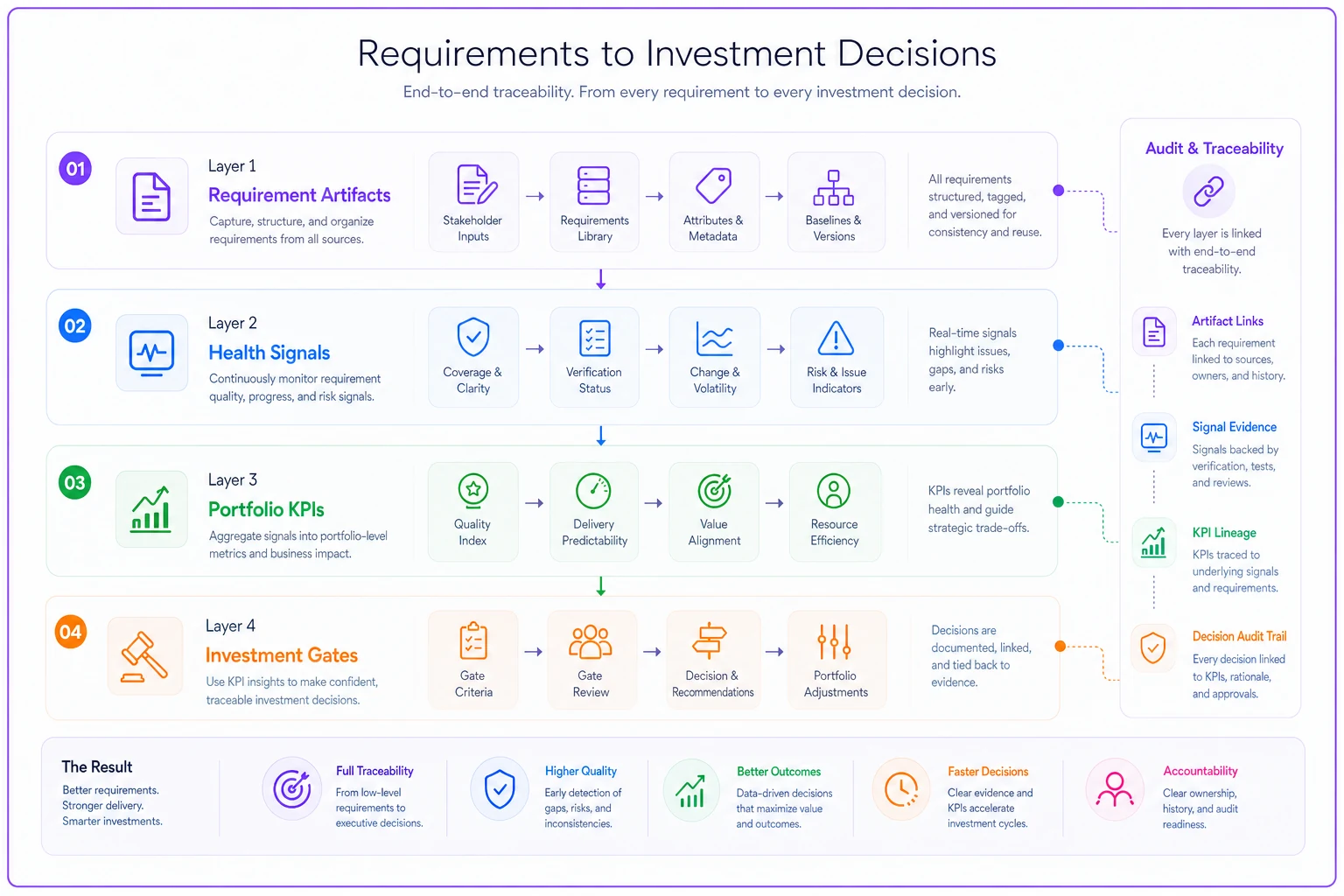
The graphic emphasizes traceability: every portfolio number points to named requirements.
The decision timeline that starts from the artifact
Most gate processes work backward from a calendar date. Better ones work forward from requirement state. Here's a process that originates decision timing from the artifacts themselves:
-
Tag the gate-relevant requirement set. Before a gate, define which requirements this funding decision actually depends on. Not all of them — the ones tied to the outcomes being funded.
-
Snapshot the evidence. Freeze the current health signals for that set, with timestamps, so the gate decision references a fixed, cited baseline rather than a live dashboard that shifts underneath everyone.
-
Compute the gate criteria against the snapshot. Trace coverage, ambiguity density, and evidence freshness for the tagged set — not the program average.
-
Classify the decision. Go, hold, or conditional release. Conditional release means money moves but with named requirement conditions that must clear by a defined date.
-
Record the rationale as a linked decision record. The decision points at the exact requirements and their state at decision time. If someone audits it in eighteen months, the evidence is still attached to the reasoning.
-
Set the re-evaluation trigger from requirement volatility, not the calendar. If the tagged requirements churn past a threshold, the gate re-opens early. If they stay stable, the next review can wait.
Step six is the one most teams skip and the one that matters most. Gates tied only to a calendar are always either too early or too late. Tying the re-evaluation trigger to requirement volatility means the decision clock runs at the same speed as the thing it's governing.
A real scenario
A financial-services firm running a portfolio of about a dozen programs — mostly customer-onboarding and compliance work — had a recurring problem: programs kept passing their Q2 gate and then imploding in Q3. Roughly one in three funded programs needed emergency rescope within a quarter of getting its money.
When they dug in, the pattern was consistent. The programs that failed weren't low on completeness. They were low on trace coverage for their compliance-critical requirements — sitting somewhere around 50–60% — while showing 90%+ overall completeness. The gate was reading the 90% and ignoring the 55%.
They changed one thing first: gate criteria were scoped to the compliance-critical requirement subset, and every KPI in the gate had to resolve to a named requirement list. No drilldown, no number.
The immediate effect was uncomfortable. Two programs that would have passed got held, because their critical-path evidence was clearly thin once it couldn't be averaged away. But over the next couple of quarters, emergency rescopes dropped to roughly one in eight. The rework savings alone — somewhere in the low six figures per avoided rescope — paid for the extra rigor several times over.
The interesting part wasn't the tooling. The same information had been available the whole time. It was just sitting in the artifacts where the gate couldn't see it.
Where the tooling actually helps
None of this works if computing the signals is a manual, monthly, heroic effort by one analyst. That's where operational software matters — not as the point of the exercise, but as the thing that makes the wiring sustainable.
The parts worth automating are the boring, error-prone ones: continuously computing trace coverage on the critical subset, flagging requirements whose linked evidence has gone stale, detecting volatility spikes, and generating the auditable snapshot at gate time. AI-assisted platforms are genuinely useful for surfacing ambiguity in acceptance criteria and catching requirements that reference outdated decision records — the kind of review that's tedious and inconsistent when done by hand across thousands of artifacts.
Automate the gate snapshot generation so the evidence cited in a decision is reproducible and timestamped rather than manually assembled.
The point isn't to hand the funding decision to a machine. It's to make sure that when a human makes the funding decision, the requirement evidence in front of them is current, complete, and traceable — instead of a smoothed-over color from three layers down.
When this makes sense — and when it doesn't
This model earns its overhead in specific conditions. It's a bad idea in others.
Do this when:
-
You have multiple programs competing for a shared budget
-
Funding decisions are periodic and material enough that being wrong is expensive
-
You operate in a regulated or audit-heavy space where evidence has to survive scrutiny
-
Requirements churn enough that a static baseline goes stale fast
Don't do this when:
-
You're a single team where the builders and the requirement authors are the same people
-
Your funding isn't gated — if money flows continuously regardless, gates are theater
-
The requirement artifacts are so immature that computing signals would just measure noise
Who should not attempt this yet: teams whose requirements don't have owners, traces, or acceptance criteria in any consistent form. Bolting portfolio governance onto artifacts that aren't structured produces confident-looking metrics built on sand. Fix the artifact discipline first; the governance layer is worthless without it.
The shift in thinking
The whole approach comes down to a single reframe: an investment gate is a claim about requirement health, whether you admit it or not. When you release funding, you're implicitly asserting that the work is understood well enough to build. Most portfolios make that claim without ever checking the evidence that would support it.
Tying gates to requirement evidence just makes the claim honest. It forces the smoothed-over reality back into the room where the money moves, and it leaves a trail that an auditor — or your own team six months later — can actually follow. The programs don't get easier. But the surprises get smaller, and the ones that do hit tend to show up in the requirement signals long before they show up in the budget.
The whole approach comes down to a single reframe: an investment gate is a claim about requirement health, whether you admit it or not. When you release funding, you're implicitly asserting that the work is understood well enough to build. Most portfolios make that claim without ever checking the evidence that would support it.
Tying gates to requirement evidence just makes the claim honest. It forces the smoothed-over reality back into the room where the money moves, and it leaves a trail that an auditor — or your own team six months later — can actually follow. The programs don't get easier. But the surprises get smaller, and the ones that do hit tend to show up in the requirement signals long before they show up in the budget.
Ready to transform your product delivery?
Join 2,000+ teams using GoReqly to improve requirements accuracy, reduce rework, and accelerate time to market.