


Most release planning happens in the wrong place. Teams argue about dates in sprint reviews, in Slack threads, in that one recurring meeting nobody wants to attend — and the actual signal that should drive the decision, the state of the requirements themselves, never comes up. You end up shipping on a calendar instead of on readiness. Something half-baked goes out, a dependency nobody tracked breaks in production, and the rollback turns into an all-hands scramble because nobody wrote down what "undo" actually means.
A requirements-driven release strategy flips that. Instead of the calendar deciding when a feature is "done enough," the maturity of the underlying requirements and their trace links decides it. Cadence, dependency windows, and rollback choreography all fall out of the same data you should already be maintaining. This isn't about adding governance for its own sake — it's about making release decisions boring and predictable, which is exactly what you want them to be.
Why release dates and requirement readiness drift apart
Here's the pattern. A team commits to a quarterly release. Three requirements are fully specced, traced to tests, and stable. Two are still churning — acceptance criteria changing weekly, the owning team renegotiating scope, no clear test coverage. The release date doesn't care. It arrives, and the two unstable requirements get shoved out anyway because pulling them "would blow the whole release."
That's the core disconnect: release cadence is treated as a fixed input, and requirement readiness is treated as something you hope catches up. It should be the other way around. The requirements you actually have in a mature, traceable state should define what your release boundary even is.
The drift usually starts small. One requirement slips its readiness date, the PM waves it through because "it's basically done," and now your release evidence has a gap nobody flagged. Six releases later that's normal behavior, and your rollback plans are fiction because half of what shipped was never fully understood to begin with.
Teams that avoid this treat requirement maturity as a gate, not a suggestion. A requirement that hasn't hit a defined maturity level simply isn't eligible for the release boundary. Not "we'll risk it" — ineligible. That single rule eliminates an enormous amount of the negotiation theater around release dates.
Defining requirement maturity so it can drive decisions
Maturity only works as a release input if it's concrete. "Mostly done" isn't a level. You need stages with clear entry criteria, because the whole point is that someone — or some automated check — could look at a requirement and tell you which stage it's in without a debate.
Stop losing track of critical project requirements.
GoReqly helps you capture, organize, and track every requirement with precision and clarity.
- Centralized requirements repository
- Collaborative editing & commenting
- Traceability & version control
No credit card required
| Maturity level | What it means | Release eligibility |
|---|---|---|
| Draft | Captured, but scope still moving | Never |
| Specified | Acceptance criteria stable, owner assigned | Behind a flag only |
| Traced | Linked to design, tests, and dependencies | Eligible for standard release |
| Verified | Tests passing, evidence collected | Eligible + auto-approve gate |
| Deprecated | Being retired, needs rollback plan | Requires choreography review |
The important thing here isn't the exact labels — it's that eligibility is attached to the level. Once you do that, "can we ship X?" stops being an opinion. If X is at Specified, it can ride along behind a feature flag but can't be a release-defining item. If it's Traced or better, it's fair game.
The mistake most teams make is defining maturity levels that require human judgment to distinguish. If deciding between "Specified" and "Traced" requires a meeting, the ladder is useless under pressure. Tie each level to the existence of trace links, not to someone's confidence. "Traced" means the links exist and resolve. That's checkable.
Trace links are what make dependency windows real
Cadence tells you how often you ship. Dependency windows tell you when within that cadence a given change can safely go out, given what it depends on. And you can't compute a dependency window without trace links — because the window is literally derived from the chain of requirements a change touches.
Keep trace links queryable and surfaced in your release tooling so dependency windows can be computed automatically.
Say Requirement A (a new pricing rule) traces to a shared calculation service that also serves Requirement B (an invoicing change) owned by a different team. If A ships before B's tests are verified, you've created a live coupling nobody planned for. The trace link between A, the shared service, and B is what surfaces that. Without it, you find out in production.
This is where real version discipline on your requirement artifacts pays off. If you've already adopted the practices in treating requirements like code — branching, tagging, and merge patterns, your trace links aren't a static spreadsheet — they're something you can query against a release tag. You can ask: "for everything tagged into release 24.3, what dependencies cross a team boundary and aren't yet verified?" That query is your dependency window analysis.
A dependency window, practically speaking, is a time slot where all the upstream requirements a change relies on are at the right maturity, and all downstream consumers are ready to absorb the change. When you can't find a window, that's not a scheduling problem — it's a signal that the requirement graph isn't ready, and forcing the date won't change that.
Gating rules: turning maturity and traces into go/no-go
Gating rules are the connective tissue. They take the maturity levels and the trace-link state and turn them into an automatic decision at each release boundary. The goal is that by the time a release candidate reaches its gate, the answer is already computed — you're confirming, not deciding.
-
Eligibility gate — Every requirement in the release tag must be at Traced or above. Anything at Specified must be flag-gated and cannot affect default behavior. Draft items are auto-rejected from the tag.
-
Dependency gate — For every cross-boundary trace link, the upstream requirement must be Verified. If an upstream item is only Traced, the release either waits for its window or excludes the dependent item.
-
Evidence gate — Each Verified requirement must have its linked test results and rationale attached. Missing evidence blocks the gate — not because of process theater, but because you can't roll back safely without knowing what "correct" looked like.
-
Rollback-readiness gate — Every requirement that changes existing behavior must have a documented reversal path. No rollback plan, no boundary crossing.
Gates should fail closed. If the data needed to evaluate a gate is missing, the answer is no. Teams get this backwards constantly — they let things through when information is absent, which is exactly when you have the least idea what you're shipping.
Where this connects to the bigger picture is at the program level. When multiple teams feed one release train, gating rules have to be shared contracts, not per-team preferences. The mechanics of those handoffs and shared boundaries are covered in the program-level requirements operating model, and gating rules are essentially the enforcement layer sitting on top of those artifact contracts.
Planning rollback choreography before you ship, not after
Rollback is the part everyone skips until the night it's needed. And the reason it goes badly is almost never technical — it's that nobody defined the order of reversal, or which requirements are entangled enough that you can't roll one back without the others.
That's what "choreography" means here. It's not "hit the revert button." It's the sequence: which changes come out first, what data migrations need reversing, which dependent teams need to be notified, and what state the system lands in when you're done. That sequence comes directly from the same trace links you built for dependency windows — just read in reverse.
A rollback choreography plan, at minimum, answers:
-
Which requirements in this release changed existing behavior versus added net-new behavior? (Net-new is usually safe to leave; behavior changes are the dangerous ones.)
-
For each behavior change, what's the reversal action, and does it depend on another change being reversed first?
-
Are there data migrations that can't be cleanly undone? Those need a forward-fix plan, not a rollback — and you need to know that before the release.
-
Who owns the reversal of each cross-team dependency, and how do they get notified?
A useful pattern is to require the rollback plan as part of reaching Verified maturity. Not a separate document written under duress — a field on the requirement itself. If you can't articulate how to undo a change, the change isn't actually verified, because you don't fully understand its blast radius.
Teams that do this well end up with rollbacks that are almost anticlimactic. The sequence is written, the dependencies are known, the notifications are templated. You execute a plan instead of improvising one at 2 a.m.
A short real scenario
A mid-sized B2B SaaS company — around 40 people, three product squads — was shipping monthly and having a rough time with it. Roughly one in three releases needed a partial rollback within the first week, and each of those cost close to two engineering days to untangle because nobody knew which changes were coupled.
They didn't overhaul anything dramatic. They defined a four-level maturity ladder, made "Traced" the eligibility floor, and required a rollback field before anything hit Verified. The first couple of releases after that were slower to assemble — some items that used to slip through got held back, which felt like a step backward at the time.
Over the following quarter, though, the numbers moved. Rollbacks requiring more than a day of work dropped to roughly one every three or four releases, and the genuine emergencies — the 2 a.m. kind — basically stopped, because dependency coupling was now visible before release instead of after. The cadence itself didn't change. What changed was that the release boundary actually meant something.
When this approach makes sense — and when it doesn't
When it fits well:
-
Multiple teams are feeding shared release trains and cross-team dependencies keep surprising you.
-
Rollbacks are frequent, painful, or improvised.
-
You already have some traceability discipline and want it to drive decisions instead of sitting in a repository.
-
Audit or compliance pressure means release decisions need to be defensible after the fact.
When it's overkill:
-
A single small team shipping continuously with tight feedback loops. If you can revert a change in minutes and nobody else depends on it, formal choreography is just drag.
-
Very early-stage products where requirements are supposed to be churning. Gating on maturity when your whole job is to change direction fast will slow you down for no real benefit.
Who should not do this yet: teams without any working trace links. This entire model is built on the assumption that you can follow a requirement to its tests, dependencies, and evidence. If those links don't exist, start there. Building maturity gates on top of missing traces just creates gates that always fail closed, which trains everyone to route around them. Get traceability functioning first, then layer the release logic on top.
Bringing cadence, windows, and rollback into one loop
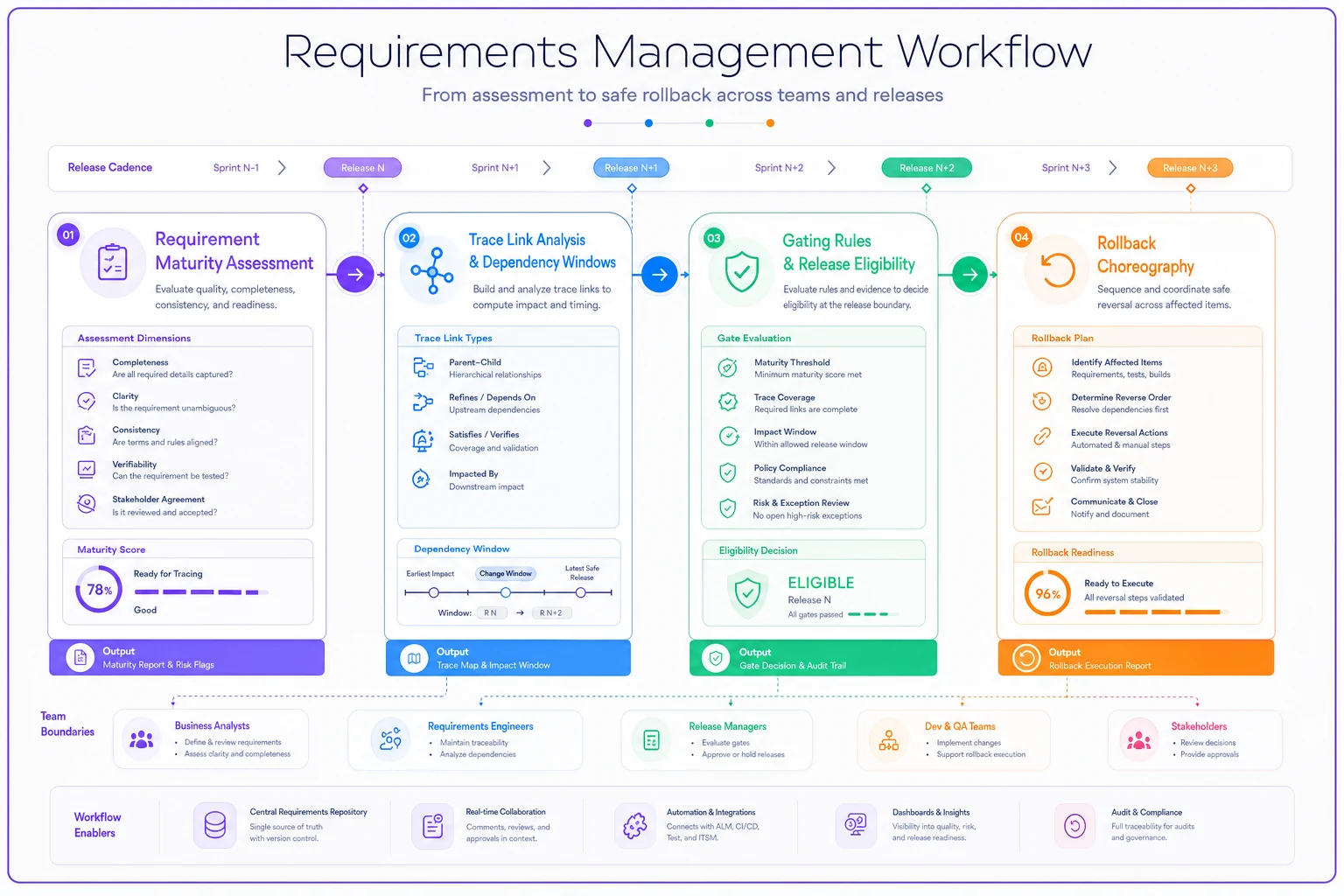
The reason to tie all of this to requirement maturity is that it collapses three decisions people usually make separately — when to ship, what can ship together, and how to back out — into one coherent read of the same data. Your cadence sets the rhythm. Your maturity levels decide who's eligible for each beat. Your trace links compute the windows and the reversal order. Your gating rules make the whole thing automatic enough that the decision is confirmed rather than argued.
Here's a simple workflow that ties maturity assessment, trace analysis, gating, and rollback choreography together.
None of this removes judgment from releases. What it removes is the wrong kind of judgment — the pressure-driven, calendar-versus-readiness fight that happens when there's no shared definition of ready. Once the maturity of your requirements drives the boundary, releases stop being events you brace for and start being something the system tells you is safe. Less drama, more predictability, and rollbacks that read like a script instead of a fire drill.
None of this removes judgment from releases. What it removes is the wrong kind of judgment — the pressure-driven, calendar-versus-readiness fight that happens when there's no shared definition of ready. Once the maturity of your requirements drives the boundary, releases stop being events you brace for and start being something the system tells you is safe. Less drama, more predictability, and rollbacks that read like a script instead of a fire drill.
Ready to transform your product delivery?
Join 2,000+ teams using GoReqly to improve requirements accuracy, reduce rework, and accelerate time to market.