



Requirement changes rarely blow up because the change itself was wrong. They blow up because someone found out too late, found out by accident, or didn't find out at all until QA filed a bug that turned out to be "working as newly intended."
That's usually not a tooling gap. Most teams have Slack, email, and some kind of release notes doc. What they're missing is a repeatable way to decide who hears about a change, on which channel, within how long, and what happens if a change is severe enough to need someone to actually stop and respond. That's the whole point of a requirement change communication playbook — turning "let's message people" into a set of defaults you don't have to renegotiate every sprint.
Why change comms quietly fall apart
The failure pattern is almost always the same, and it's not laziness.
Someone updates an acceptance criterion in the tracker. Small edit — a threshold changes from 5 seconds to 8, or a field goes from required to optional. The person making the edit knows exactly why it's fine. What they don't have in front of them is the list of everyone downstream who quietly depended on the old version. The mobile team built a validation rule around "required." The data team wrote a report assuming the field was always populated. Support wrote a help article. None of them are in the room.
-
A firehose — the person @-mentions fifteen people in a channel "just to be safe," everyone tunes it out, and the two people who actually needed it miss it in the noise.
-
A whisper — a quiet edit with a one-line commit message that nobody reads until it breaks.
Both come from the same root: there's no mapping between what changed and who cares, and no shared expectation about how fast different severities need to travel. Every change becomes a judgment call, and judgment calls made under sprint pressure default to whatever is fastest for the sender.
Severity has to mean something concrete
Most teams have a severity label that's basically vibes. "This feels like a big one." That's useless for communication because you can't attach a rule to a vibe.
Stop losing track of critical project requirements.
GoReqly helps you capture, organize, and track every requirement with precision and clarity.
- Centralized requirements repository
- Collaborative editing & commenting
- Traceability & version control
No credit card required
Severity for change comms should be defined by blast radius and reversibility, not by how the change feels. Here's a workable four-tier model that's tight enough to actually use:
| Severity | What it means | Trace signal | Comms speed |
|---|---|---|---|
| S1 – Contract-breaking | Changes an interface, data shape, or acceptance criterion other teams build against | Requirement has downstream trace links to another team's stories/tests | Immediate, needs acknowledgment |
| S2 – Scope-shifting | Changes what a feature does within one team's boundary | Trace links stay inside one team | Same day, no ack required |
| S3 – Clarification | Sharpens wording without changing behavior | Links unchanged, tests unaffected | Batched, next standup or digest |
| S4 – Cosmetic | Typos, formatting, tag cleanup | No behavioral links | Log only, no notification |
What makes this work is that severity isn't self-assigned in a vacuum — it's partly derived from trace links. If a requirement has trace links pointing to another team's test cases and you change its acceptance criteria, that's structurally an S1. The person editing doesn't get to talk themselves into "eh, it's small." The links tell you the blast radius.
This is where solid traceability stops being a compliance chore and starts paying for itself. If you've already invested in linking decision records to requirements, you're most of the way there — the same links that give you searchable rationale also tell you who's downstream when something moves.
Stakeholder mapping: stop guessing who to tell
The second half of the problem is the recipient list. You don't want to maintain a giant spreadsheet of "who cares about what" — it rots within a month. Map stakeholders to artifact types and areas, not to individual requirements.
A practical mapping looks like roles attached to domains:
-
Owners — the team that owns the requirement's area. Always notified.
-
Consumers — teams whose artifacts have inbound trace links from this requirement. Notified when severity is S1 or S2.
-
Interpreters — QA, support, docs. They translate requirements into tests, articles, and answers. Notified on S1–S3.
-
Watchers — PMs, program leads. They want the digest, not the play-by-play. Batched only, unless it's S1.
Map to the role-on-the-area and let the current owner inherit the notifications rather than mapping to named individuals.
The consumer list is generated, not hand-maintained. If your requirement has trace links to three services owned by two other teams, those two teams are your consumers for that change — automatically. When the links change, the recipient list changes with them. No spreadsheet to keep alive.
A common mistake: teams map communication to people instead of roles tied to areas. Someone goes on leave, reorgs happen, and half your notifications go to someone who left six months ago. Map to the role-on-the-area and let the current owner inherit the notifications.
Time-boxing: the part everyone skips
Notifying people is only half of it. The reason S1 changes still cause damage even when a message was sent is that "sent" and "acknowledged" got treated as the same thing.
Time-boxing means each severity gets a defined window and a defined consequence for silence. Here's the escalation logic in plain steps:
-
Change is flagged S1. Notification goes to Owners + Consumers with a required acknowledgment.
-
Two-hour window opens. Consumers are expected to react — thumbs-up, question, or objection.
-
No acknowledgment from a consumer team within the window. The playbook escalates: a direct message to that team's lead, not just the shared channel.
-
Still no response by end of day. The change is flagged as unacknowledged-blocking and surfaced in the next standup as an open risk. It does not silently proceed.
For S2, the window is longer and there's no acknowledgment requirement — it's a same-day FYI. S3 rolls into a daily or twice-weekly digest. S4 never interrupts anyone.
What makes escalation sane rather than annoying is that it only fires for the tier where silence is actually dangerous. If you escalate everything, people learn to ignore escalations, and you're back to the firehose problem. The whole model is built to keep S1 rare and loud, and everything else quiet.
Here's a simple visual of the S1 escalation workflow to share with the team.
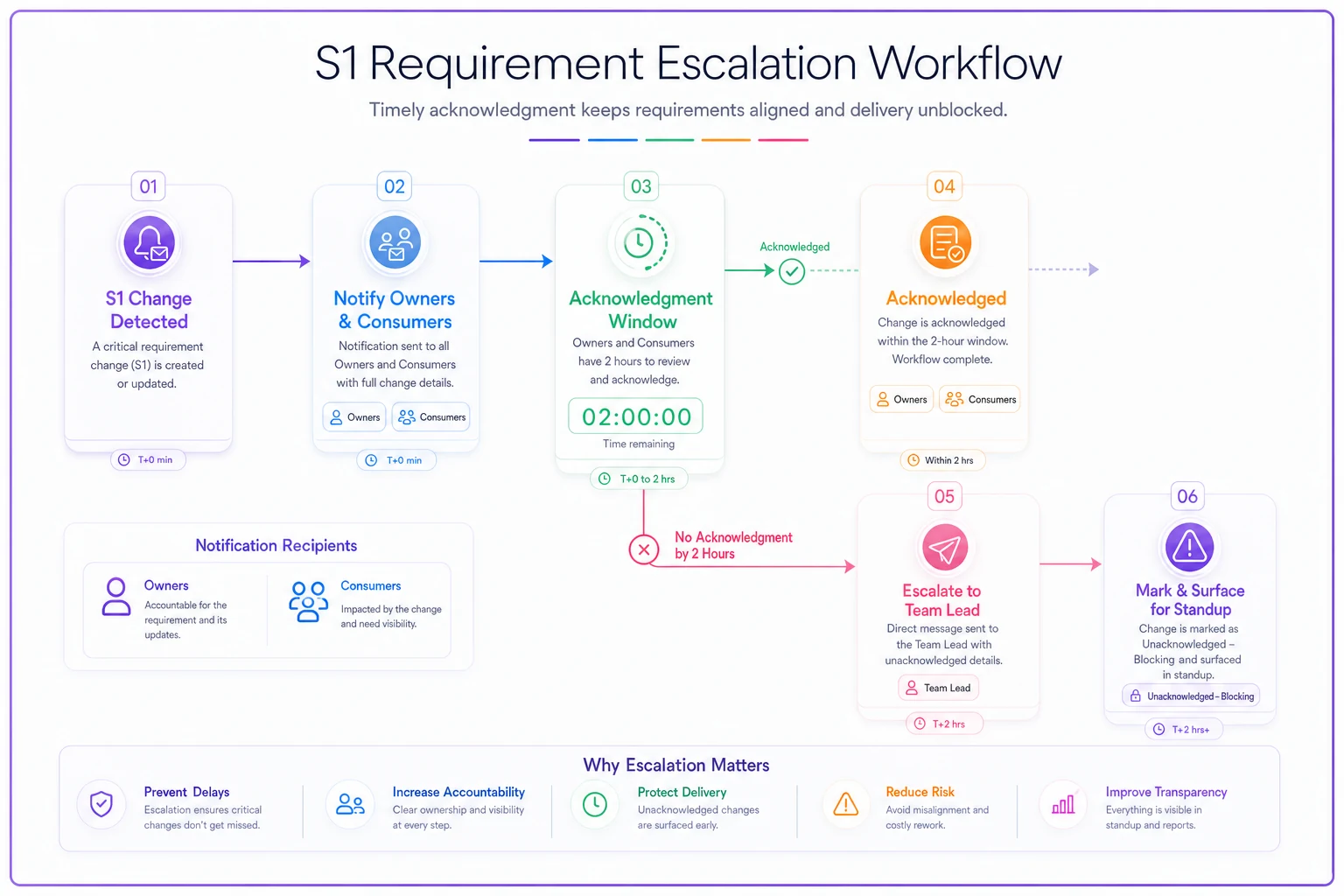
Use this diagram to align on who does what during the ack window and where escalations go if silence persists.
Templates per channel — because the channel changes the message
The same change should not read the same way in Slack, in email, and in release notes. Each channel has a different reader in a different mode.
Slack (fast, in-the-flow): short, scannable, action at the top.
``
[S1 · CHANGE] Checkout requirement REQ-482 acceptance criteria updated
What changed: payment retry limit 3 → 1
Who's affected: @payments-team @mobile (you have linked tests)
Action needed: ack by 3pm or raise a concern
Trace: REQ-482 → TC-1190, TC-1204 (mobile)
``
Email (durable, for people not living in the channel): more context, standalone. Someone should understand it a week later without scrolling backward. Include the before/after, the reason, the affected artifacts, and a link back to the requirement and its decision record.
Release notes (external-facing or cross-org): strip the internal noise. No @-mentions, no "ack by 3pm." Just the user-visible or integration-visible effect, framed for someone who wasn't part of the conversation.
A recurring failure: teams write one message and paste it into all three places. The Slack message ends up too long to scan, the email lacks context because it was written for people already in-thread, and the release note leaks internal ticket IDs to external readers. One change, three audiences, three formats. The content is the same underneath; the packaging isn't.
A real scenario
A mid-sized fintech product team — around 40 people across four squads — kept getting bitten by cross-squad requirement drift. The specific pain: a squad would tweak an API contract's requirement mid-sprint, mention it in their own channel, and the consuming squad wouldn't find out until integration testing.
Over a quarter they logged roughly 18 integration defects that traced directly back to a requirement change the consuming team never heard about in time. Each one cost somewhere between half a day and two days of rework once you counted the back-and-forth, the re-test, and the "wait, when did this change?" archaeology.
They put in a severity model tied to trace links and a two-hour ack window for anything S1. Nothing fancy — the notifications were still Slack and email, just templated and routed by who was downstream.
The next quarter, change-driven integration defects dropped to around five. Not zero — a couple slipped because trace links were missing, which honestly just exposed a separate gap. But the ones that came from nobody was told essentially stopped. The team lead's summary was blunt: they weren't communicating more, they were communicating less, but the right people were finally in the loop on the changes that mattered.
When this is worth it — and when it's overkill
Whether this setup makes sense depends a lot on your team's size and how often requirements actually move after refinement. There's no point adding notification machinery to a problem you don't have.
This makes sense when:
-
You have multiple teams building against each other's requirements.
-
Changes routinely surprise a downstream team.
-
You already have some trace links to key off of.
This is overkill when:
-
You're a single team of five in one room. Just talk to each other.
-
Your requirements almost never change post-refinement.
-
You don't have trace links yet — build those first, or the severity derivation has nothing to stand on.
Who should NOT do this: teams that are already drowning in process and low on delivery. If your problem is too much governance, more notification machinery isn't the fix. Tighten what you have before layering on escalation rules. There's a real risk of turning a communication playbook into another approval gauntlet, and that's worth actively guarding against. The lightweight governance approach is a better starting point if that's your situation — get the weight right first, then add targeted comms on top.
It's also worth being honest that this model assumes your trace links are reasonably current. If they're patchy or outdated, the severity derivation breaks down and you're back to guessing. Fix the links before you trust the routing.
A short checklist to stand this up
Getting started doesn't require a big rollout. Most teams can wire up the basics in a sprint or two if they already have trace links in decent shape.
-
Define four severity tiers by blast radius, not gut feel
-
Derive S1 automatically from cross-team trace links
-
Map stakeholders to roles-on-areas, not named individuals
-
Generate the consumer list from trace links, not a spreadsheet
-
Write one template per channel, not one template for all channels
-
Set an ack window only for S1, with a clear escalation path
-
Put S3 and S4 into a digest so they never interrupt
-
Review missed-notification incidents monthly and check whether the miss was a routing gap or a trace-link gap
The monthly review step is easy to skip but genuinely useful. Most notification failures cluster around a small number of recurring gaps — either the trace link was missing, or the role mapping hadn't been updated after a reorg. Catching those patterns early saves a lot of repeat incidents.
The one thing to get right
If you take only one idea from this, make it the link between trace and severity. Once your notification routing is driven by what a requirement actually connects to rather than by the sender's estimate of importance, most of the "we didn't know" failures dry up on their own. Everything else — the templates, the windows, the digests — is just packaging around that core decision.
Get the routing honest and automatic, keep S1 rare, and let the small stuff stay quiet. That's the difference between a change process people trust and one they route around.
If you take only one idea from this, make it the link between trace and severity. Once your notification routing is driven by what a requirement actually connects to rather than by the sender's estimate of importance, most of the "we didn't know" failures dry up on their own. Everything else — the templates, the windows, the digests — is just packaging around that core decision.
Get the routing honest and automatic, keep S1 rare, and let the small stuff stay quiet. That's the difference between a change process people trust and one they route around.
Ready to transform your product delivery?
Join 2,000+ teams using GoReqly to improve requirements accuracy, reduce rework, and accelerate time to market.