

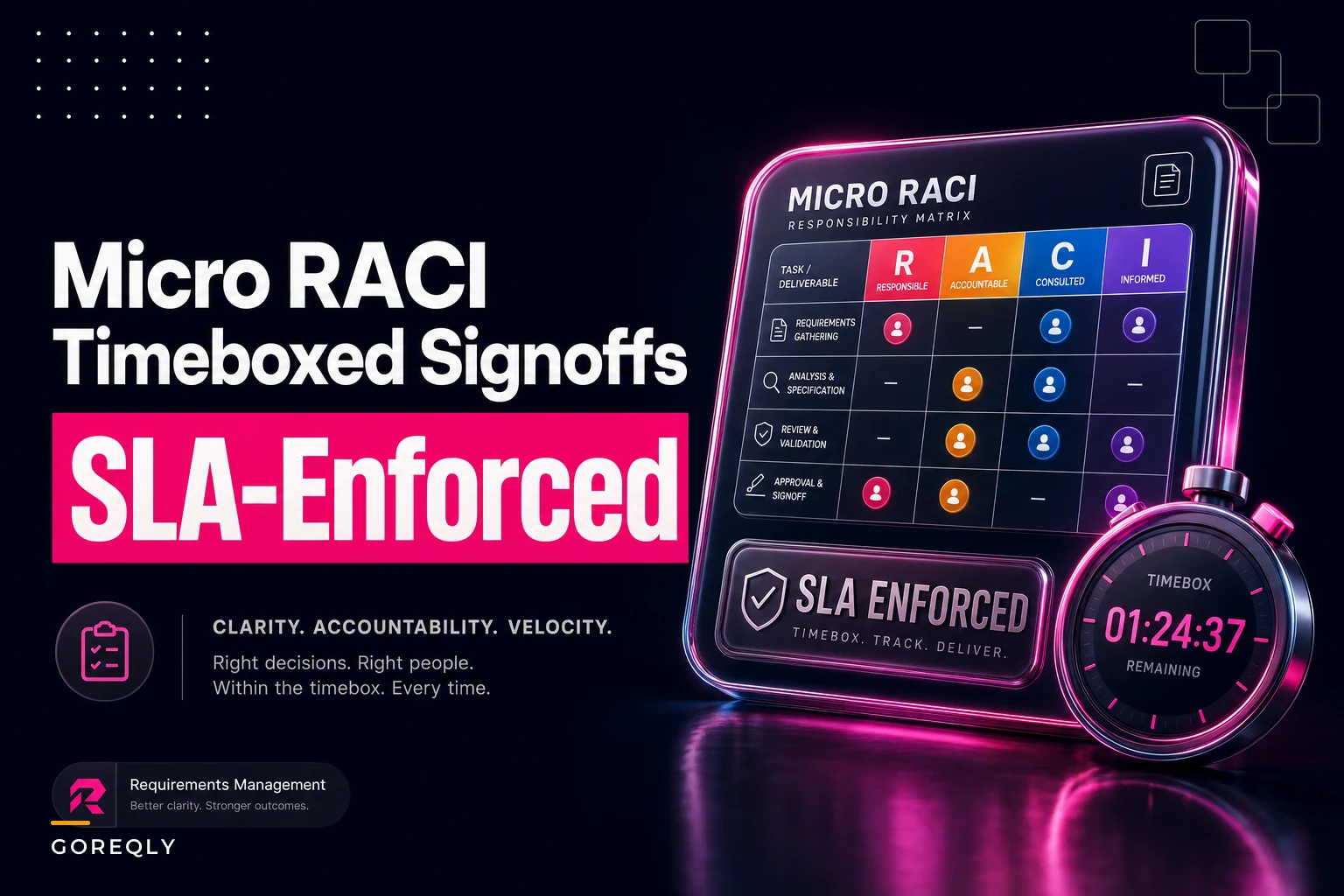

Most RACI setups die the moment a team goes iterative. You build a careful matrix during project kickoff — Responsible, Accountable, Consulted, Informed, all neatly mapped per feature area — and then two sprints later nobody looks at it because the feature area it described no longer exists. The work moved. The matrix didn't.
The deeper problem isn't that RACI is wrong. It's that classic RACI assumes approvals happen at project-sized boundaries, while iterative delivery produces approval-worthy artifacts every few days. A single sprint can generate acceptance criteria, an updated API contract, a changed analytics event, and a reworded NFR — each needing a different person to say "yes, this is what I meant." When you try to route all of that through one heavyweight signoff ceremony, you get the classic agile deadlock: engineering is blocked because "the PM hasn't signed off," the PM is blocked because "legal hasn't reviewed," and legal doesn't even know the ticket exists.
Micro-RACI is the fix for that mismatch. Instead of one big responsibility map, you attach a small, timeboxed approval to each type of artifact, with an SLA that forces the thing to resolve. This post covers how to design micro-signoffs per artifact type, how to set and enforce the SLAs in whatever tracker you already use, and what the actual signoff packages should contain so approvers can decide in two minutes instead of two days.
The specific failure this solves
Here's the pattern that keeps showing up on teams running two-week sprints.
A story is "done" from engineering's side on Wednesday. It needs a product acknowledgment that the acceptance criteria were met, and — because it touches a pricing field — a quick confirmation from finance that the rounding behavior is correct. Neither approval has a deadline attached. They just sit in a column called "Needs Review."
Thursday passes. Friday, the PM acknowledges it but doesn't know to loop in finance because the RACI doc from kickoff listed "Billing Team" generically, and the person who owned billing left in Q2. Monday, someone finally pings finance in Slack. Finance replies Wednesday. By then the sprint is closed, the story rolls over, and in retro everyone agrees "we need better communication."
It wasn't a communication problem. It was an ownership resolution problem plus a missing clock. Nobody knew exactly who, for this exact artifact type, and nothing forced a decision inside the sprint window.
This almost always happens because the approval granularity doesn't match the delivery granularity. You're delivering in artifacts; you're approving in projects.
Why "micro" is the operative word
When approvals stall, the instinct is to add more governance — more required reviewers, more gates, more sign-off fields. That almost always makes things slower. The better move is the opposite: shrink the unit of approval until each one is trivially decidable.
Stop losing track of critical project requirements.
GoReqly helps you capture, organize, and track every requirement with precision and clarity.
- Centralized requirements repository
- Collaborative editing & commenting
- Traceability & version control
No credit card required
A micro-signoff has three properties:
-
It covers exactly one artifact type. Not "the story." The acceptance criteria. Or the contract change. Or the analytics event. Different approvers, different evidence, different clocks.
-
It's timeboxed. The approver has a fixed window — often 24 or 48 working hours — after which something automatic happens (escalation, auto-ack, or a flag).
-
It asks for an acknowledgment, not an essay. The approver confirms a specific claim is true, not "reviews the work."
That last point matters more than people expect. When you ask someone to "review the story," they feel responsible for everything and so they stall. When you ask "Does the rounding on line 3 match the finance spec? Yes / No / Needs change," they answer in 30 seconds.
If you've already read our take on keeping governance lightweight on iterative teams, micro-RACI is basically the approval-layer version of the same philosophy: minimum ceremony that still produces a real decision trail.
Mapping artifact types to approvers
The core design work in micro RACI requirements is building a small table that says, for each artifact type: who's Responsible, who's the single Accountable approver, the SLA, and what evidence the micro-signoff package must contain. Keep this to one page. If it needs scrolling, it's already too complex to survive a sprint.
| Artifact type | Accountable (single) | Consulted | SLA (working hrs) | On breach |
|---|---|---|---|---|
| Acceptance criteria met | Product owner | QA lead | 24 | Auto-escalate to PM lead |
| API/contract change | Owning service eng lead | Consuming team eng | 48 | Block merge, flag in standup |
| Analytics event change | Data/analytics owner | PM | 48 | Auto-ack with warning note |
| Pricing/billing field | Finance ops contact | PM | 24 | Hard block, page finance channel |
| NFR wording change | Architecture owner | Security | 48 | Escalate to tech lead |
| Copy / UX string | UX writer | Legal (if regulated) | 24 | Auto-ack, log for post-hoc review |
The column people skip and then regret is "On breach." An SLA with no defined breach behavior is just a suggestion. Notice the breach actions aren't all the same — a billing field gets a hard block because a wrong value is expensive, while a UX copy string auto-acknowledges because the cost of a slightly-off button label is low and you can review it later. That asymmetry is the whole point. You spend your blocking budget where mistakes actually hurt.
Don't put two names in the Accountable column, ever.
One thing worth flagging: don't put two names in the Accountable column, ever. The second you list two people, each assumes the other has it, and you're back to the Slack-ping problem. Consulted can be a list. Accountable is always singular.
What goes in a micro-signoff package
Approvals drag almost never because approvers are lazy. They drag because the artifact lands in someone's queue with zero context, so actually approving it means going off to dig — opening the ticket, finding the spec, comparing what changed, figuring out what question they're even supposed to be answering. Each of those is a small friction, and small frictions on a non-urgent task mean it gets deferred indefinitely.
-
The claim being confirmed, stated as a yes/no question ("Does this match spec X?")
-
The before/after diff, not the whole document — only what changed
-
A direct link to the source requirement or decision record
-
The specific person accountable, named, so there's no ambiguity
-
The deadline, shown as a date and time, not "by end of sprint"
Here's a concrete version of a package for a contract change:
> **Micro-signoff: API contract change — GET /invoices
> Claim to confirm: The currency field added here matches the pricing requirement in REQ-412.
> Changed: added currency (ISO-4217 string), made amount non-nullable.
> Source: REQ-412 · prior decision: ADR-29
> Accountable: Priya (payments eng lead)
> Decide by: Thu 14:00. On breach: merge blocked, flagged in Fri standup.
> Respond: ✅ Approve · 🔁 Needs change · ❓ Question
No "please review the attached document." Everything the approver needs is in six lines. Teams that switched from "review the PR" to this format saw contract approvals that used to average two-plus days drop to same-day, because the decision got small enough to make from a phone.
This connects to something covered in depth in stakeholder signoff by archetype — different approver types genuinely need different evidence. A finance approver wants the numeric diff; a security approver wants the threat-relevant change; a UX writer wants the string in context. Build the package around what that archetype actually decides on, and you cut the back-and-forth significantly.
Enforcing the SLA in your tracker
The timebox is only real if something enforces it. You don't need a fancy platform — most teams can wire basic SLA enforcement into Jira, Linear, GitHub, or Azure DevOps with a scheduled script or the tracker's native automation. The logic is simple; it's the consistency that matters.
The enforcement loop works like this:
-
Stamp an SLA deadline when the artifact enters its review state. When a ticket moves to "Needs Acceptance Signoff," write a
sla_duetimestamp = now + the SLA hours for that artifact type (skipping weekends). -
Poll on a schedule. Every few hours, scan open signoff items for anything where
now > sla_dueand status is still pending. -
Apply the breach action defined for that artifact type. Escalate, auto-ack with a warning, or hard-block the merge.
-
Log the breach. Write it to a lightweight register so you can see patterns in retro — which artifact types and which approvers keep blowing the clock.
A stripped-down version of the polling step looks roughly like this:
runs every 2h on a scheduler for item in tracker.query(state="pendingsignoff"): if now() > item.sladue: rule = BREACHRULES[item.artifacttype] if rule == "escalate": tracker.reassign(item, escalationowner(item)) notify(channel=item.teamchannel, msg=f"SLA breach: {item.key}") elif rule == "autoack": tracker.transition(item, "signedoff") tracker.comment(item, "Auto-acknowledged after SLA. Logged for post-hoc review.") elif rule == "hardblock": tracker.blockmerge(item) page(financeoncall, item) breachlog.append(item, reason="sla_expired", at=now())
The part most teams get wrong is step 4. They enforce the SLA but never log breaches, so they never learn that, say, the finance contact breaches 40% of the time — which is a staffing or routing problem, not a reminder problem. The breach log turns SLA enforcement from nagging into actual signal about where your approval design is broken.
One more detail worth getting right: weekend math. If you use raw calendar hours, every Friday-afternoon artifact breaches by Monday morning and your team learns to ignore the alerts. Count working hours only, and the alerts stay meaningful.
This diagram shows the enforcement loop and how items move from "pending_signoff" to either escalation, auto-ack, or hard-block.
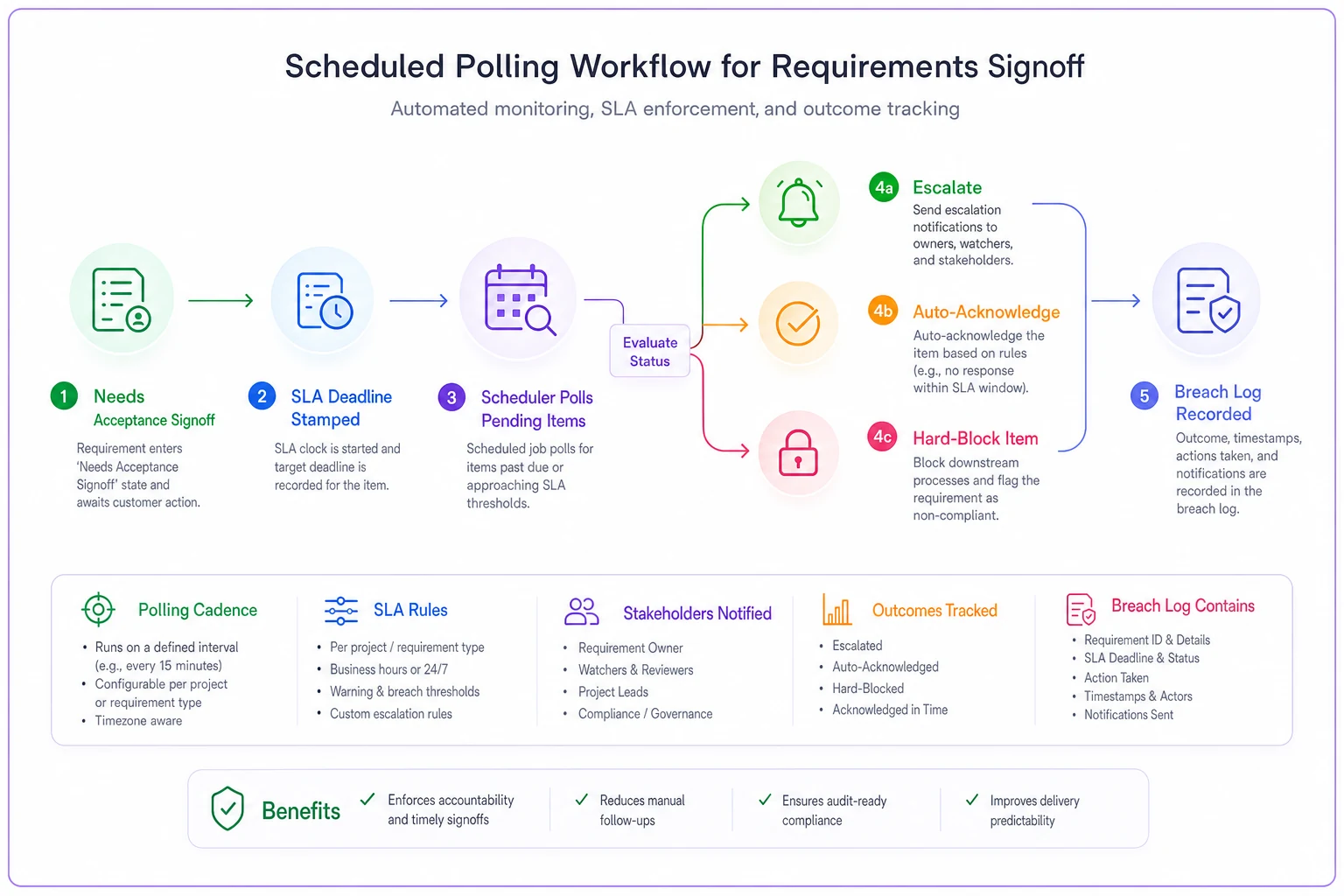
A visual like this helps teams align on where automation acts and where human escalation is required.
A real scenario
A mid-size B2B SaaS team — roughly 18 people, two squads, two-week sprints — kept rolling over about a third of their stories not because the code wasn't done but because signoffs lagged. Their kickoff RACI was a 40-row spreadsheet nobody had opened since the project started. The two chronic offenders were pricing-field confirmations and cross-team contract changes.
They scrapped the spreadsheet and built a one-page artifact-to-approver table, about six rows. They set 24-hour SLAs on pricing and acceptance, 48-hour on contracts and NFRs. They wrote a small scheduled script to stamp deadlines, poll, and post breaches into each squad's channel. The signoff packages got cut down to the six-line format above.
The change wasn't dramatic overnight. Over about three sprints, the rollover rate from stalled approvals dropped from roughly a third to under 10%. The more useful outcome was the breach log: it showed the pricing contact breaching SLA on nearly half of requests. Turned out that person owned finance approvals for four teams and was genuinely underwater — invisible before, because it just looked like "communication issues." Once it was a number, they re-routed low-risk pricing confirmations to a second approver and kept the original finance contact only for changes above a dollar threshold.
That's the quiet benefit of this approach. It stops ambiguous blame and surfaces the actual bottleneck.
When micro-RACI makes sense
This fits teams where approvals happen continuously and the delivery unit is small. If you're shipping multiple approval-worthy artifacts per sprint and people keep getting blocked on "who signs this," micro-RACI directly targets that.
-
You have regulated or costly artifact types (pricing, security, legal copy) mixed in with low-risk ones, and you want to spend blocking effort only where it matters.
-
Ownership changes often — reorgs, contractor churn — and your static RACI goes stale faster than you can maintain it.
-
Approvals cross team boundaries, where the consuming team genuinely doesn't know the owning team's reviewer.
These aren't edge cases. On most product teams past a certain size, at least two of those three are true simultaneously.
When it's a bad idea
Micro-RACI is overhead if your approval volume is low. A small team shipping one or two features a month, all reviewed by the same two people who sit next to each other, doesn't need SLA scripts and per-artifact tables. You'd be building machinery to solve a problem you don't have.
It's also a poor fit if your organization requires heavyweight, document-signed approvals for compliance reasons that can't be reduced to a yes/no acknowledgment. In those cases the micro layer can feed the formal signoff, but it can't replace it, and pretending otherwise will fail an audit.
And don't bother if you won't maintain the breach log. SLA enforcement without reviewing breaches just trains people to ignore automated alerts, which is worse than no enforcement — now the clock has no teeth and everyone knows it.
Who should not run this yet
If your artifact types aren't clearly defined — if "a requirement," "a story," and "a change" are all mushed into one tracker field — fix that first. Micro-RACI depends entirely on being able to say "this is a contract change, route it this way."
Teams without that distinction should spend a sprint tagging artifact types before attaching approvals to them. Otherwise you're routing by vibes, and no SLA script saves you from that.
Getting started without boiling the ocean
Don't roll this out across every artifact type at once. Pick the one that stalls most — usually whichever cross-team or financial approval keeps showing up in retro — and do just that one:
-
Define the single Accountable owner for it.
-
Set one SLA and one breach action.
-
Write the six-line signoff package template.
-
Add the deadline stamp and the polling check.
-
Watch the breach log for two or three sprints.
Then add the next artifact type. By the time you've done three or four, you'll have a one-page table that actually reflects how your team works now — not how it was organized at kickoff — and it'll keep reflecting that because every row earns its place by solving a real stall.
The whole idea behind micro-RACI is to stop treating approval as a ceremony and start treating it as a series of small, clock-bound decisions. When each one is tiny, named, and timed, the approvals stop being the thing your sprint waits on — and your RACI finally matches the speed you're actually delivering at.
Ready to transform your product delivery?
Join 2,000+ teams using GoReqly to improve requirements accuracy, reduce rework, and accelerate time to market.