


When an acquisition closes, the clock on integration starts immediately. But the product and engineering reality underneath that deal is usually a black box. You've bought a portfolio of features, commitments, half-documented promises, and a pile of requirements artifacts that nobody on your side has ever read. Due diligence looked at financials and contracts. It almost never looked at whether the acquired product can actually do what the sales deck claimed, or whether there's a regulatory landmine buried in an acceptance criterion from three years ago.
That's the gap this article is about. Not the legal side of M&A, but the operational scramble that hits product managers and business analysts in the first 30 to 90 days after a deal — when you're asked to assess risk across a product you don't understand, built by people who may already be gone.
The teams that survive this well don't improvise. They run a repeatable discovery-and-packaging method that treats requirements like evidence in a case file: find it, score it, prove it exists, and reconcile what the seller said against what you can actually verify. Below is that method, with the checklist, scoring rubric, and manifest patterns that make it work at portfolio scale.
Why acquired portfolios are so hard to read
The core problem isn't that documentation is missing. It's that it's inconsistent and unverifiable, and you have no baseline to judge it against.
Every company builds requirements differently. One acquired team kept everything in Jira with disciplined linking. Another kept the real decisions in Slack threads and a founder's head. A third wrote beautiful PRDs that haven't matched the shipped product since 2021. When you absorb all three at once — which is common in roll-up or platform-consolidation deals — you're not reading one messy system, you're reading three mutually incompatible ones, under time pressure, with people's incentives working against you.
There's also a pattern worth naming: the quality of the artifacts is almost never correlated with the quality of the product. Some of the cleanest-running acquired products have the worst paper trails, because the original team was small and everyone just knew how things worked. That tribal knowledge evaporates the moment key engineers take their retention bonus and leave. So "good docs = low risk" doesn't work as a shortcut. You have to actively discover, not passively review.
The second structural issue is that requirements in an acquired portfolio were written for a different purpose than what you need them for now. Theirs were written to build the product. Yours need to answer a specific question: what did this company commit to, to whom, and can we still honor it? The source material was never organized to answer that second question. That's why reconciliation — not discovery alone — is where the real risk surfaces.
The three artifacts that make discovery repeatable
Rapid M&A requirements due diligence falls apart when every analyst does it their own way. You get a 40-page report from one person, a spreadsheet from another, and no way to compare portfolios against each other. The fix is standardizing on three artifacts that force consistency:
Stop losing track of critical project requirements.
GoReqly helps you capture, organize, and track every requirement with precision and clarity.
- Centralized requirements repository
- Collaborative editing & commenting
- Traceability & version control
No credit card required
-
A discovery checklist — what you go looking for, in what order.
-
A scoring rubric — how you rate what you find, so two analysts reach similar conclusions.
-
An evidence manifest — a structured record of what exists, where it lives, and whether you verified it.
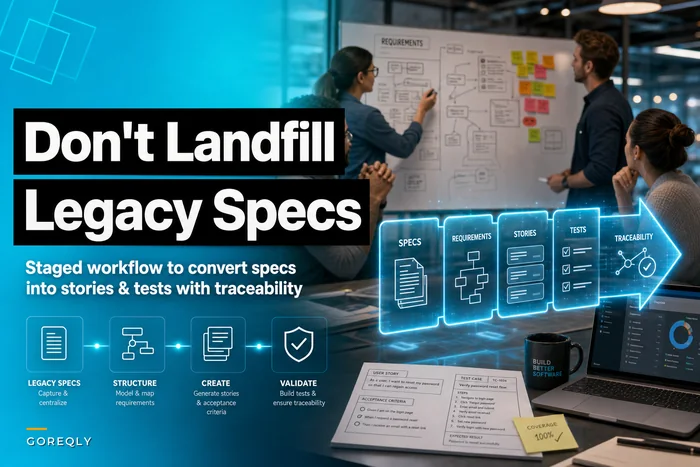
The discipline here is similar to converting old, abandoned specs into something usable. If you've worked through a staged workflow to convert legacy specs into stories and tests, you already know the hardest part isn't the conversion — it's deciding what's worth keeping. M&A discovery is that same problem on a deadline, across an entire company you didn't build.
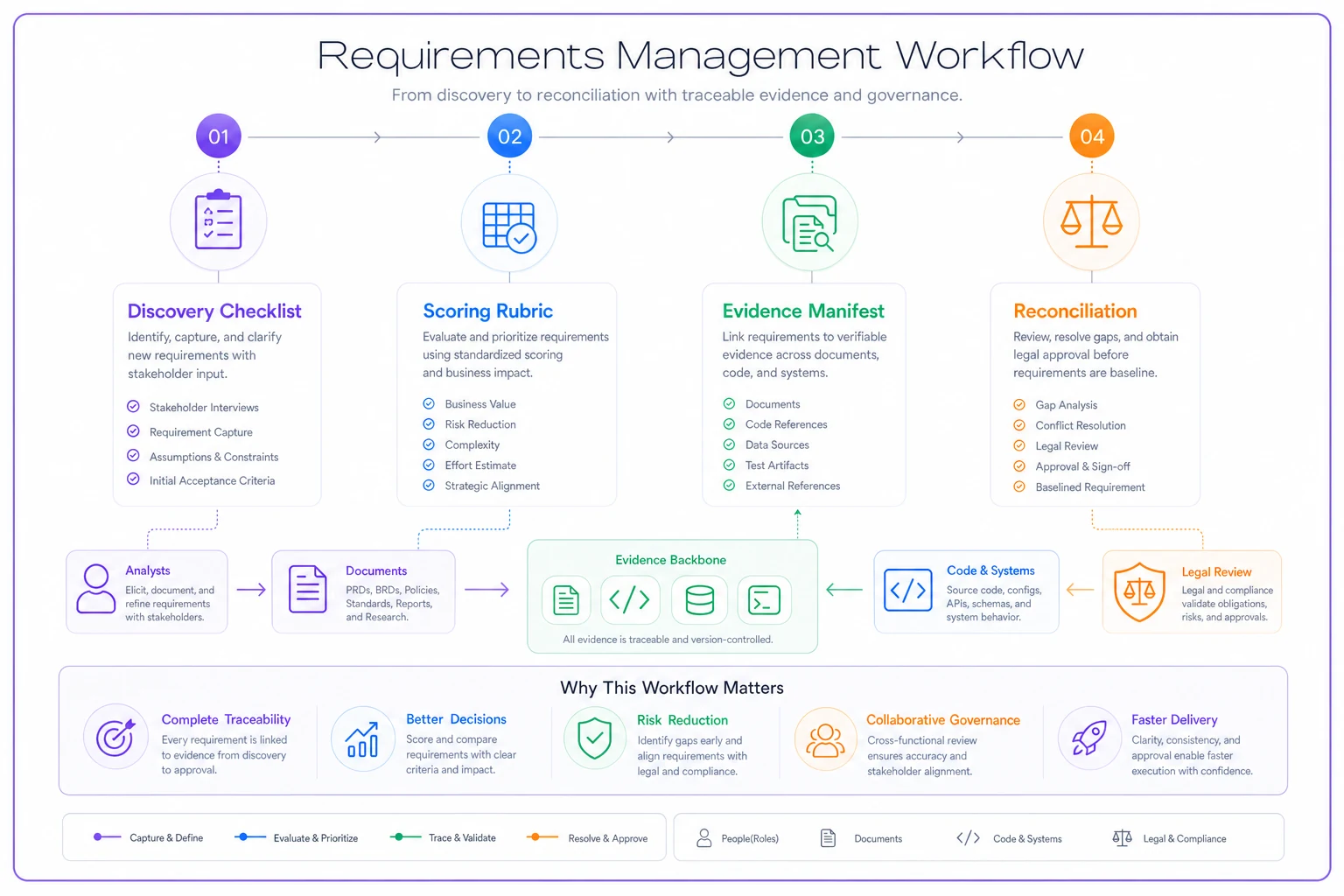
A visual of the three artifacts flowing into reconciliation helps teams run the method consistently.
The discovery checklist
The checklist exists to stop you from going down rabbit holes. In the first week after a deal, there's a strong pull to deep-read whatever document you open first. That's how analysts burn ten days on a feature that turns out to be deprecated. The checklist enforces breadth before depth.
Run this per product line, not per document:
-
Commitments & obligations — Any requirement tied to a customer contract, SLA, regulatory rule, or public roadmap promise. These carry legal and financial weight, so they get discovered first.
-
Data & privacy surface — Where does the product collect, store, or move personal or regulated data? Which requirements govern it? Missing or vague answers here are the highest-risk finding in most deals.
-
Integration dependencies — Third-party APIs, vendor services, and internal systems the product can't function without. Each one is a potential break point post-migration.
-
Security & access requirements — Auth, roles, encryption, audit logging. Often undocumented, and often where the ugly surprises hide.
-
Acceptance criteria coverage — Which shipped features actually have acceptance criteria and tests behind them, versus features that just… exist.
-
Open commitments — In-flight work, promised-but-unbuilt features, and anything a salesperson committed verbally. The hardest category to find and the one most likely to cause reputational damage.
-
Ownership & tribal knowledge — Who understood this requirement? Are they staying? If not, how long until the knowledge is gone?
The ordering matters. You discover by risk and perishability first — contractual obligations and the knowledge of people who are leaving — not by whatever's easiest to read. The things that will hurt you fastest are also the things that disappear fastest.
Run the checklist per product line, not per document.
The things that will hurt you fastest are also the things that disappear fastest.
The scoring rubric
Discovery without scoring produces a pile of findings nobody can prioritize. The rubric converts findings into a comparable risk signal. Keep it blunt on purpose — a four-dimension score that fits on one line per requirement.
| Dimension | 1 (Low risk) | 3 (Moderate) | 5 (High risk) |
|---|---|---|---|
| Evidence strength | Documented, linked, test-backed | Documented but unverified | Verbal / none |
| Obligation weight | Internal nicety | Customer-facing feature | Contractual or regulatory |
| Knowledge continuity | Multiple owners staying | One owner, uncertain | Owner already gone |
| Reconciliation gap | Docs match reality | Minor drift | Docs contradict shipped product |
A requirement scoring 5 on obligation weight and 5 on evidence strength — contractual but undocumented — goes straight to legal and leadership. A requirement scoring low across the board gets a quick note and nothing more. The point isn't precision, it's triage. You want to spend your scarce analyst hours on the roughly 15% of findings that actually move the risk picture.
One mistake teams make: over-engineering the rubric with weighted formulas and ten dimensions. Under deal pressure, nobody fills out a ten-field rubric honestly. The blunt four-column version gets used, which makes it better. Scoring you'll actually complete beats scoring that's theoretically superior.
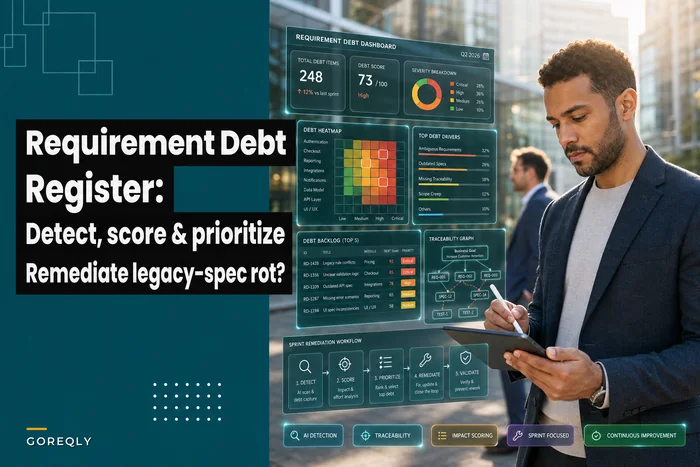
If you're also inheriting a backlog of degraded legacy specs — which almost every acquisition brings — it's worth running those through a dedicated requirement debt register that detects, scores, and remediates legacy-spec rot rather than lumping them into due-diligence scoring. Due diligence tells you what you bought. The debt register tells you what it'll cost to clean up. Keep them separate or they muddy each other.
The evidence manifest
This is the artifact that holds everything together, and the one most teams skip. The manifest is a structured ledger: every material requirement, where its evidence lives, who verified it, and its score. It's what you hand to leadership, legal, and your own integration team. It's also what protects you when, six months later, someone asks why a commitment got missed.
REQ-ID: ACQ-PAY-014 Title: PCI-scoped card tokenization on checkout Source: Legacy PRD v3 + contract SLA (Enterprise tier) Evidence location: /legacy-docs/payments/prd-v3.pdf (p.22); contract MSA-2022-118 §7.3 Verified by: J. Okafor, 2024-xx-xx Verification method: Code walkthrough + vendor attestation Evidence strength: 2 Obligation: 5 Continuity: 4 Recon gap: 3 Status: VERIFIED — contradiction flagged (see note) Note: Contract promises quarterly pen-test evidence; no evidence of tests after 2023. Escalated to security.
What makes this work is the combination of a claim, a location, and a verification method. A manifest that just lists requirements is a table of contents. A manifest that forces someone to write down how they confirmed it is an audit trail. That distinction matters enormously the moment a regulator, customer, or your own board asks a hard question.
For any acquired product carrying compliance obligations, the manifest also becomes the seed for your ongoing retention strategy. Mapping it against a portfolio evidence retention policy and audit-readiness model early means the evidence gathered during due diligence doesn't rot in a deal folder — it feeds directly into how you'll prove compliance later.
Reconciliation patterns: where the real risk lives
Discovery finds claims. Scoring prioritizes them. Reconciliation is where you compare what the seller represented against what you can actually verify — and this is almost always where deals turn out to be more complicated than the data room suggested.
Claim-to-code reconciliation. The PRD says the feature does X. The code does X-minus-a-caveat. This is the most common gap and usually the least dangerous — it's a product quality issue, not a legal one. You document the drift and move on, unless the caveat touches an obligation.
Contract-to-capability reconciliation. The contract promises something the product can't actually do, or can't do at the SLA level committed. This is the dangerous one. A typical example: an enterprise MSA guarantees 99.9% uptime with quarterly security attestations, but the acquired team never produced attestation evidence and the architecture can't hit the uptime number. You didn't buy a feature gap — you bought a breach-in-waiting.
Roadmap-to-reality reconciliation. Sales committed features that were never built, often verbally, often to the biggest accounts. These show up nowhere in the requirements artifacts because they were never real requirements. You find them by interviewing account managers and cross-referencing against the backlog, not by reading docs. In roll-up deals this category alone can account for a meaningful chunk of post-close churn.
The pattern worth internalizing: documented requirements under-report your risk. The things written down are, almost by definition, the things someone was organized enough to track. Your worst exposures are the undocumented verbal commitments and the quiet contradictions between what was sold and what was built. Reconciliation is the only step that surfaces them.
A short real scenario
A mid-market SaaS company acquired a smaller competitor — roughly 40 people, three product lines, a messy but functional codebase. The deal thesis assumed a clean six-month integration.
The due-diligence product review had been light: a skim of the data room, no structured discovery. In the first 60 days post-close, the acquiring team ran the checklist-rubric-manifest method across the three product lines and built a manifest of around 180 material requirements.
Reconciliation surfaced two things that reshaped the plan. First, about a dozen enterprise contracts carried data-residency commitments the acquired product didn't actually honor — data was sitting in the wrong region for several named accounts. Second, two of the departing founders held essentially all the knowledge of the billing engine, which had almost no documented acceptance criteria. Neither was catastrophic because both were caught early. The data-residency items went to legal and got remediation timelines before any customer noticed. The billing knowledge got captured in a two-week knowledge-transfer sprint before the founders left. The honest outcome wasn't a dramatic save — the projected six-month integration slipped to roughly nine months on purpose, with the risks named and owned, instead of blowing up unexpectedly at month seven. That's what good due diligence actually buys you: fewer surprises, not fewer problems.
When this full method makes sense — and when it's overkill
This is a real investment of analyst time, so match the rigor to the deal.
When it makes sense:
-
Acquisitions in regulated spaces (fintech, health, anything touching personal data).
-
Roll-ups where you're absorbing multiple portfolios with incompatible documentation.
-
Deals where key technical staff are leaving and knowledge is perishable.
-
Any acquisition where the product carries meaningful contractual SLAs.
When it's overkill:
-
Acqui-hires where you're buying the team, not the product, and plan to sunset what they built.
-
Tiny tuck-ins with a handful of features you'll rebuild anyway.
-
Pure asset purchases with no ongoing customer obligations.
Who should not run this themselves: a solo PM with no analyst support and a 30-day deadline across five product lines. The method scales, but it still needs hands. If you're that under-resourced, cut scope — run the checklist and reconciliation on contractual obligations only, skip the rest, and be explicit with leadership that you assessed legal risk but not product-quality risk. A narrow assessment you finished beats a comprehensive one you didn't.
Keeping the evidence usable after the deal closes
The quiet failure mode of M&A discovery is that all this work gets done, saved to a deal folder, and never touched again. Six months later a customer escalation hits, someone goes looking for why a commitment was made, and the manifest that would have answered it instantly is buried in a SharePoint graveyard nobody remembers.
The manifest should become a living input to your integrated requirements system, not a one-time artifact. The verified requirements flow into your backlog. The flagged contradictions become remediation tickets with owners. The retention-sensitive evidence gets filed under your standing policy. Done right, due diligence isn't a report you produce once — it's the first load of data into how you'll run the acquired portfolio going forward.
This is also where lightweight automation earns its place, without turning the process into a tooling project. Pulling requirements and their links out of the acquired team's systems, flagging where documented claims don't match linked tests or tickets, keeping the manifest current as integration proceeds — these are repetitive, error-prone jobs that benefit from a platform that centralizes requirements and their evidence rather than leaving everything scattered across two companies' worth of tools. The method above works on spreadsheets. It works considerably better when the evidence trail maintains itself as the two organizations merge.
The takeaway for product and analyst teams
The companies that absorb acquisitions cleanly aren't the ones with the best documentation. They're the ones with a repeatable way to find, score, prove, and reconcile requirements under deadline, regardless of what state the acquired paperwork is in.
The checklist gives you breadth. The rubric gives you triage. The manifest gives you an audit trail. Reconciliation gives you the truth the data room didn't. Run it the same way every time, and each acquisition gets a little easier to read than the last — because you're no longer improvising against a black box, you're running a known process against an unknown portfolio. That's the whole game: making the unfamiliar legible fast enough to act before the risks you inherited become the problems you own.
Ready to transform your product delivery?
Join 2,000+ teams using GoReqly to improve requirements accuracy, reduce rework, and accelerate time to market.