


The worst way to find out a contract clause changed is in production. You ship a feature that auto-renews subscriptions, legal quietly negotiated a 30-day cancellation window into the master agreement three weeks ago, and now you're explaining to a customer why their cancellation didn't process in time. Nobody connected the redline to the requirement. The clause lived in a PDF in someone's inbox, and the requirement lived in your backlog, and the two never met.
This is the gap most teams never close.
Contracts change constantly — vendor agreements, data processing addendums, SLAs, terms of service — and each edit might touch something your product does. The problem is figuring out which edits matter, how much, and who has to approve the resulting change before anyone writes code. Most teams either react to everything and drown, or react to nothing and get surprised. An impact matrix gives you a middle path.
The real failure: edits get read, not classified
When a contract comes back from legal with tracked changes, someone skims it. Maybe the PM, maybe a BA, maybe nobody until QA asks a question. The skim produces a vague feeling — "looks fine" or "we should probably look at this" — and that feeling is where the process dies.
Same pattern keeps repeating. A data processing agreement gets updated to require deletion of user data within 14 days of account closure, down from the old 90-day window. To the person reading it, that's one sentence. To your product, that's a requirement delta: a scheduled job frequency change, a new audit log entry, possibly a cascading delete across three services, and an acceptance criterion that didn't exist yesterday. The edit was read. It was never classified or mapped.
The distinction that actually matters is informational vs material. Not every legal change creates work.
-
Informational edits change wording, clarify intent, update a company name, adjust a notice address, or restate something your product already does. No requirement delta.
-
Material edits change an obligation, a timeline, a threshold, a data-handling rule, or a liability that your system has to enforce or produce evidence for. These create requirement deltas.
The whole point of a legal change impact matrix is to force that classification decision early, consistently, and with a named owner — instead of relying on whoever happened to read the redline.
What the matrix actually looks like
The matrix isn't a document you fill out once. It's a lookup you run against every contract edit. Two axes: how much the edit changes a product obligation (impact), and how certain you are that it does (confidence/ambiguity). Those two together decide the triage path.
Stop losing track of critical project requirements.
GoReqly helps you capture, organize, and track every requirement with precision and clarity.
- Centralized requirements repository
- Collaborative editing & commenting
- Traceability & version control
No credit card required
| Impact \ Ambiguity | Clear interpretation | Ambiguous / needs legal read |
|---|---|---|
| No product obligation | Log as informational, no action | Quick legal confirm, then close |
| Minor obligation shift | Create requirement delta, standard priority | Legal clarifies scope, then create delta |
| Material obligation / deadline | High-priority delta, owner signoff required | Escalate immediately — block dependent releases until resolved |
| Regulatory / liability exposure | Critical delta, gated verification + dual signoff | Treat as critical until proven otherwise |
One rule worth internalizing here: ambiguity raises priority, it doesn't lower it. Teams instinctively deprioritize things they don't understand — "let's come back to that clause." With legal changes, the clause you don't understand is usually the one most likely to hurt you. Default ambiguous-but-potentially-material edits upward until someone with authority downgrades them.
A visual workflow:
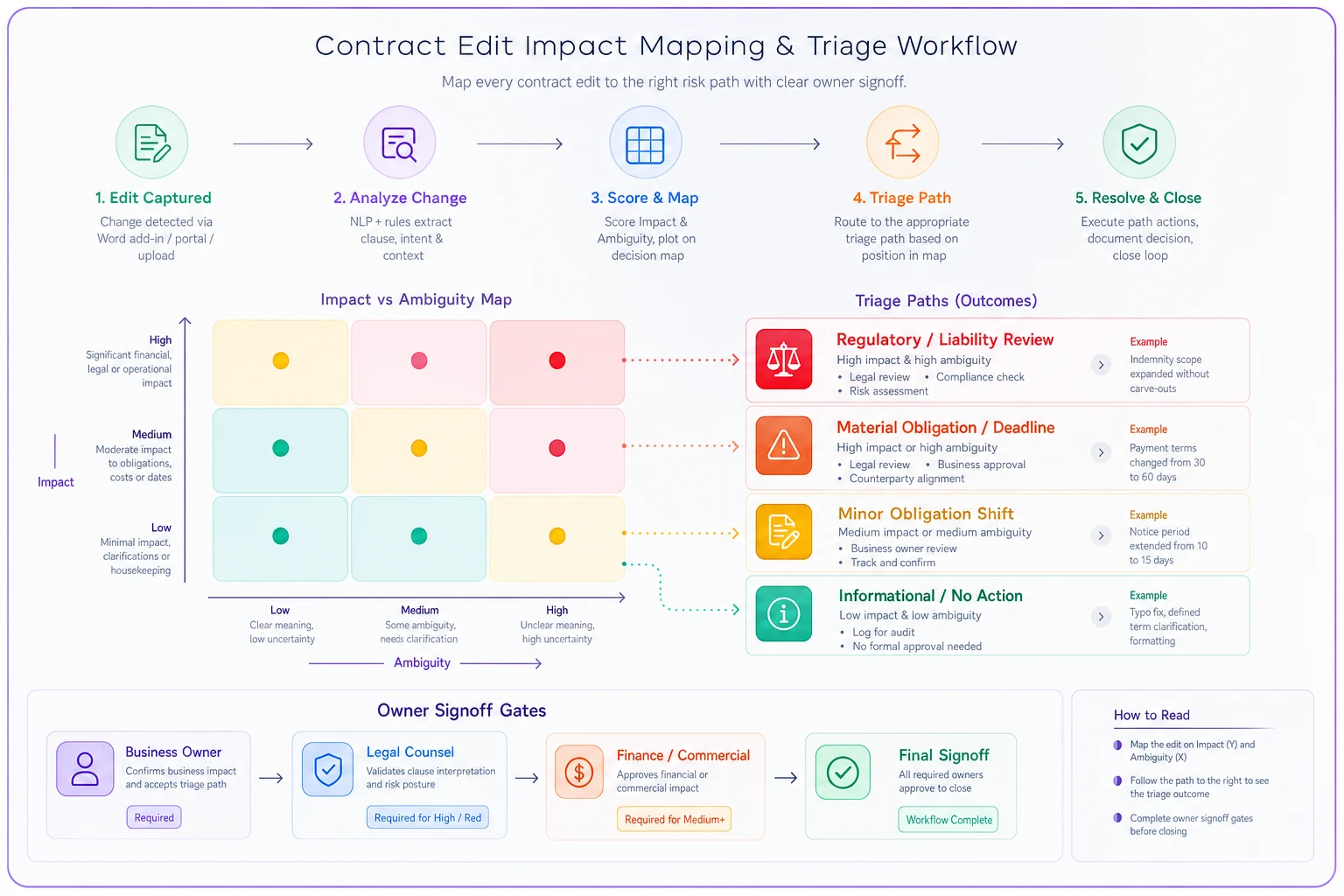
The matrix isn't a document you fill out once. It's a lookup you run against every contract edit. Two axes: how much the edit changes a product obligation (impact), and how certain you are that it does (confidence/ambiguity). Those two together decide the triage path.
Mapping a clause to a requirement delta
Classification tells you whether something matters. Mapping tells you what changes. This is the step most teams skip because it's tedious, and it's also the step that prevents the production surprise.
-
Which requirements does this clause touch? Not "the product" — the specific requirement IDs. A 14-day deletion clause touches your data-retention requirement, your account-closure flow, and probably your audit-evidence requirement.
-
What's the before and after? Old obligation
delete within 90 days. New obligation: delete within 14 days. Write both. The delta is the gap between them.
-
What new acceptance criteria does this create? "Given an account closed on day 0, user data is purged by day 14, and a deletion event is logged." If you can't write the acceptance criterion, you haven't finished mapping.
-
Who owns the obligation? Engineering owns the job; legal owns the interpretation; a compliance owner signs off that the implementation satisfies the clause.
A typical mapping that goes wrong looks like this: the team catches the 14-day change, updates the scheduled job, ships it, calls it done. Six months later an audit asks for proof that deletion happened within the window. There's no log, because nobody mapped the clause to the evidence requirement — only the behavior requirement. The deletion worked; the ability to prove it didn't. Material clauses almost always have an evidence component, and that's the part the mapping has to make explicit. If you're wiring this into a broader audit posture, the approach in building a lightweight compliance-ready requirements traceability model handles the evidence side well.
Priority rules that keep triage honest
Priority on legal changes can't run on gut feel, because the people reading redlines usually aren't the people who feel the consequences. You need rules that produce the same answer regardless of who runs the triage.
-
Deadline proximity. A clause with a compliance effective date 30 days out beats a vague "best practices" update with no date, even if the second one is bigger in scope.
-
Reversibility. Changes that are hard to undo once shipped — data deletion, pricing logic, consent flows — rank higher than cosmetic or additive changes.
-
Blast radius. How many requirements and services the delta touches. A clause affecting one isolated feature is lower priority than one threading through auth, billing, and logging.
-
Evidence burden. If the clause requires you to prove compliance on demand, it's higher priority than one you merely have to satisfy, because evidence has to be built in, not bolted on.
-
Penalty exposure. Clauses tied to financial penalties, regulatory fines, or contract termination jump the queue.
The common mistake is treating contract size or legal seniority as priority signals. A two-line edit to a DPA can outrank a thirty-page vendor renewal, because the two-line edit changes what your code must do and the thirty pages just restate existing terms. Priority follows the requirement delta, not the document.
Gated verification and owner signoff
For material and critical deltas, "we implemented it" is not the end state. There's a gate: someone with authority has to confirm the implementation actually satisfies the clause before the change counts as closed. This is where a lot of legal-change work quietly fails — the engineering task closes, and no one with legal context ever confirms the clause is covered.
-
Delta drafted — the before/after obligation and new acceptance criteria are written and linked to requirement IDs.
-
Legal confirms interpretation — the clause means what the delta says it means. This is a timeboxed confirm, not a negotiation.
-
Implementation + evidence built — behavior changed and the proof artifact (log, report, audit entry) exists.
-
Owner signoff — the compliance or legal owner confirms the implementation satisfies the clause, on the record.
-
Linked and closed — the signoff attaches to the requirement so the trail survives the next audit.
The key design choice is matching the signoff weight to the impact tier. Informational edits need no signoff. Minor deltas need one owner. Critical deltas — regulatory or liability — need dual signoff so a single person can't wave through something that creates real exposure. Deciding exactly what each approver needs to see (and what they don't) is its own discipline; the breakdown in stakeholder signoff by archetype keeps these gates from turning into approval theater where people rubber-stamp things they never actually read.
A real scenario
A mid-sized B2B SaaS company — around 40 people, selling into regulated industries — kept getting blindsided by contract edits. Their customer contracts and vendor DPAs changed often enough that something slipped roughly once a quarter. One quarter it was a data-residency clause nobody mapped; the fix took about three sprints of rework and an awkward customer call. Before any structured process, legal changes reached product through forwarded emails and hallway mentions, and the time from "clause changed" to "requirement updated" ran anywhere from a few weeks to never.
They put in a simple two-axis classification and a mapping template — nothing fancy, a shared sheet and a standing 30-minute weekly triage. Over the next couple of quarters, the pattern shifted. Material edits got caught in days instead of weeks, mostly because the weekly triage forced someone to actually classify each redline instead of skimming it. The number of edits that turned into rework dropped to near zero over about six months — not because they caught more changes, but because the ones they caught got mapped to requirements before anything shipped. The vendor-side version of this, with change-control gates baked into the integration specs, follows the pattern in specifying third-party integrations with vendor change-control gates.
When this is worth it — and when it isn't
Worth building if your product enforces contractual obligations in code — data handling, retention, SLAs, consent, pricing, auto-renewal — and if your contracts actually change with any regularity. Regulated industries, enterprise SaaS, and anything handling personal data basically need this.
Not worth the overhead if your contracts are static, your product doesn't encode contractual logic, or legal changes genuinely never create requirement deltas. Forcing a full triage workflow onto a team that sees two contract edits a year just adds ceremony nobody maintains.
Who should skip the heavy version: very small teams where the PM reads every contract personally and the backlog is small enough to hold in their head. For them, the matrix is still useful as a mental checklist — classify material vs informational, map the delta, confirm the obligation — without the standing meeting and signoff gates. Scale the formality to how often legal changes actually bite you.
Where teams get it wrong
A few failure modes show up repeatedly, regardless of team size:
-
Treating the matrix as a one-time review. It's a recurring lookup, not a kickoff artifact. The clause that changes in month seven is the one that gets you.
-
Mapping behavior but not evidence. If the clause requires proof, the proof is part of the delta. Shipping the behavior alone leaves you exposed at audit time.
-
Letting ambiguity lower priority. The clause nobody understands is not low-risk. It's unassessed risk, which is worse.
-
Closing engineering tasks without owner signoff. A done ticket is not a satisfied obligation. The gate exists precisely because those two things look identical from the backlog.
The thread running through all of these is the same: legal changes feel like legal's problem until they become code's problem, and by then the cost has multiplied. The matrix doesn't make legal changes less frequent. It makes sure that every edit gets a decision — informational or material, mapped or ignored, signed off or blocked — before it has a chance to surprise anyone in production. That decision, made consistently and early, is the entire value.
The thread running through all of these is the same: legal changes feel like legal's problem until they become code's problem, and by then the cost has multiplied. The matrix doesn't make legal changes less frequent. It makes sure that every edit gets a decision — informational or material, mapped or ignored, signed off or blocked — before it has a chance to surprise anyone in production. That decision, made consistently and early, is the entire value.
Ready to transform your product delivery?
Join 2,000+ teams using GoReqly to improve requirements accuracy, reduce rework, and accelerate time to market.