

Most teams don't have an integration problem. They have an ownership problem that only looks like an integration problem when something breaks at 2 a.m.
The connector to your payments provider stops returning webhooks. Nobody knows who owns it. The person who wrote the integration left eight months ago. The vendor changed a response schema in a minor version bump and never flagged it as breaking. By the time three teams have argued about whose problem it is in a Slack thread, you've lost half a day and a chunk of revenue. The code was fine. The operating model wasn't.
This is the gap most product and engineering orgs never close. They treat connectors as code artifacts — things that get built, merged, and forgotten — instead of living operational assets that need owners, maintenance budgets, and a defined response to the one thing you can't control: whatever the vendor on the other side decides to change next.
What follows is a working operating model for that. Ownership matrix, SLAs, vendor-change detection, gating, and the runbooks you actually pull up when a connector goes sideways. Less theory, more of the stuff you wish someone had set up before you inherited it.
Why connectors rot differently than the rest of your codebase
Internal code has a natural gravity toward owners. Someone's team shipped it, someone's name is on the service, and when it breaks the pager knows where to go. Integrations don't work like that.
A connector sits on a seam between two organizations. Half of it is your code. The other half is a contract you don't control and a roadmap you can't see. That asymmetry is why integrations need their own operating model rather than just inheriting whatever governance your services already have.
In real operations, the decay usually looks like this:
-
The integration is built during a project with a deadline, by whoever had bandwidth.
-
It works, so it disappears from everyone's attention.
-
The vendor deprecates an endpoint, tightens a rate limit, or quietly changes default behavior.
-
Nothing in your org is watching for that change.
-
You find out through a customer complaint or a failed transaction, not an alert.
What makes this worse at scale is volume. A startup with four integrations can hold the whole picture in one engineer's head. A company with sixty connectors — payments, identity, shipping, tax, CRM, analytics, messaging, half a dozen internal partner APIs — cannot. Nobody has the full map, and the connectors that break are almost always the ones nobody remembered existed.
The pattern worth internalizing: integrations don't fail because the code was bad. They fail because no operating structure survived the people who built them.
The ownership matrix: making "whose problem is this" a solved question
The single highest-leverage thing you can do is kill the "whose problem is this" conversation before it starts. That means every connector has a named owner, a backup, and a clear split between who owns the code and who owns the relationship.
Stop losing track of critical project requirements.
GoReqly helps you capture, organize, and track every requirement with precision and clarity.
- Centralized requirements repository
- Collaborative editing & commenting
- Traceability & version control
No credit card required
Those are two different jobs, and conflating them is a common mistake. The engineer who maintains the shipping connector is rarely the person negotiating SLAs or roadmap with the shipping vendor. When a connector breaks, you often need both — someone to patch the code and someone to get the vendor on the phone.
Here's a RACI breakdown that actually holds up when things go wrong:
| Activity | Technical Owner | Vendor Relationship Owner | Product Manager | Platform/SRE |
|---|---|---|---|---|
| Day-to-day connector maintenance | R/A | I | I | C |
| Monitoring & alerting health | R | I | I | A |
| Vendor change detection & triage | R | C | I | C |
| Break/fix during an incident | R | C | I | A |
| SLA negotiation & escalation | C | R/A | I | I |
| Roadmap / deprecation coordination | C | A | R | I |
| Approving a new integration | C | C | A | R |
A few things that make this work in practice and not just on paper:
-
One accountable person per connector, not a team. "The platform team owns it" means nobody owns it. Put a human name in the A column.
-
A named backup. Owners go on vacation and leave companies. A connector with a single point of human failure is a connector waiting to become an orphan.
-
The relationship owner is often non-technical. This is fine and often better. A partnerships or BizOps person who talks to the vendor monthly catches roadmap changes an engineer never would.
Automate a lightweight quarterly owner confirmation so the matrix doesn't rely on manual memory.
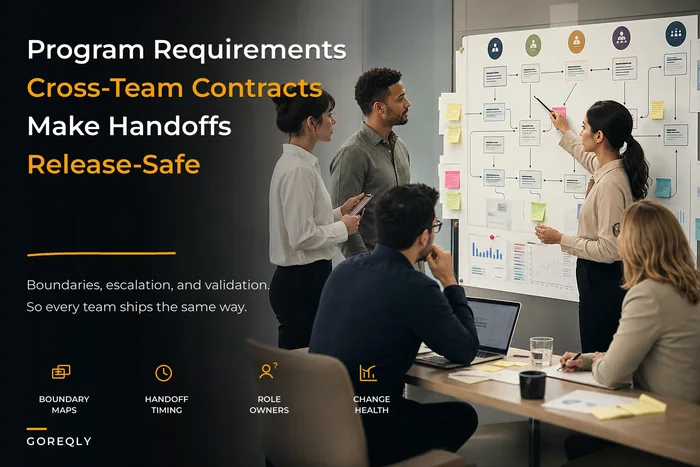
If you've read the broader program-level requirements operating model, this is the same philosophy pointed at a narrower target — artifact contracts and clear handoffs, applied specifically to the seam where your system meets someone else's.
Keeping the matrix from going stale
The ownership matrix itself is an artifact that rots. People change roles, connectors get retired, new ones appear mid-quarter. A matrix that's accurate at launch and wrong six months later is arguably more dangerous than no matrix, because people trust it.
Treat it like any other decaying link in your system. A lightweight recurring check — does every active connector still have a reachable owner, is the backup still employed — catches drift before it becomes an incident. The same discipline behind detecting stale requirement links applies directly here: a small automated review beats a heroic annual audit nobody wants to run.
SLAs for maintenance: what you promise internally vs. what the vendor promises you
There are two SLAs in play with any connector and teams constantly confuse them.
The first is the vendor's SLA to you — their uptime guarantee, support response time, deprecation notice window. The second is your internal maintenance SLA — how fast your team responds when the connector breaks, regardless of whose fault it is.
The second one is the one you actually control, and the one most orgs never write down.
A usable internal maintenance SLA template
Tier your connectors first. Not every integration deserves the same response. A rough tiering that works for most teams:
-
Tier 1 — Revenue or safety critical. Payments, auth, anything a customer transaction depends on. Outage = money or trust lost immediately.
-
Tier 2 — Important but degradable. Analytics ingestion, CRM sync, notifications. Breaks hurt but the business keeps running for hours.
-
Tier 3 — Convenience / internal. Nice-to-haves, back-office syncs, reporting feeds.
Then attach real numbers to each tier:
| Tier | Acknowledge | Mitigation target | Full fix target | Maintenance review |
|---|---|---|---|---|
| 1 | 15 min | 1 hour | 24 hours | Monthly |
| 2 | 2 hours | 1 business day | 5 business days | Quarterly |
| 3 | 1 business day | Best effort | Backlog | Semi-annual |
The numbers matter less than agreeing on them before an incident. During an outage, nobody should be debating whether a broken tax connector justifies waking someone up. The tier already answered that.
One thing worth flagging: teams often set aggressive SLAs they can't actually meet. A 15-minute acknowledge target means nothing without a real on-call rotation watching the right alerts. An SLA you consistently miss is worse than an honest, looser one — it trains everyone to ignore the targets.
The maintenance budget nobody allocates
Here's the uncomfortable part. Connectors need ongoing time, not just incident time. A mid-sized team with around 20 active integrations that never schedules maintenance will typically find 3–4 connectors degrading quietly every quarter — expired certs, stale API versions, creeping rate-limit warnings nobody acted on.
Budgeting even a few hours per Tier 1 connector per month for proactive review — checking deprecation notices, testing against the vendor's current version, confirming credentials aren't close to expiry — is cheaper than the firefighting it prevents. Most teams only figure this out after a certificate expires on a Saturday.
Vendor-change detection: catching the change before your customers do
The core failure mode in integrations is silent vendor change. The vendor ships something, doesn't warn you clearly, and your first signal is a production error.
Detection is about moving that signal as far upstream as you can. There are roughly four places you can catch a vendor change, in order of how much it hurts:
-
Before it ships — you read the deprecation notice or changelog. Cheapest possible catch.
-
In staging — your contract tests run against the vendor's new version and fail in a safe environment.
-
In production monitoring — error rates spike, schema validation fails, latency climbs. Still an incident, but a detected one.
-
In a customer complaint — the worst case. You're now reacting to reputational damage, not a log line.
Most orgs live almost entirely in categories 3 and 4. The whole game of vendor-change detection is pulling detection up into 1 and 2.
Detection rules worth setting up
-
Changelog and deprecation monitoring. For every Tier 1 and Tier 2 vendor, someone or something watches their changelog, status page, and developer announcements. If the vendor has a mailing list for API changes, the relationship owner is subscribed — and actually reads it.
-
Contract tests against live vendor sandboxes. Don't just mock the vendor. Run a scheduled suite against their actual sandbox so a schema change breaks your tests, not your customers.
-
Schema drift validation in production. Validate responses against the schema you expect. An unexpected field, a changed type, a missing value — flag it even if the code doesn't crash yet. Silent schema drift is the precursor to the loud failure.
-
Rate-limit and latency baselines. A vendor tightening limits rarely announces it loudly. A creeping 429 rate is an early warning.
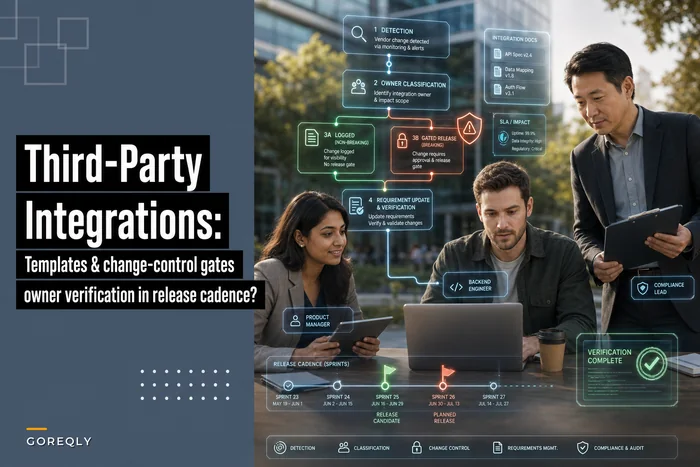
The chart below shows a typical vendor-change detection workflow.
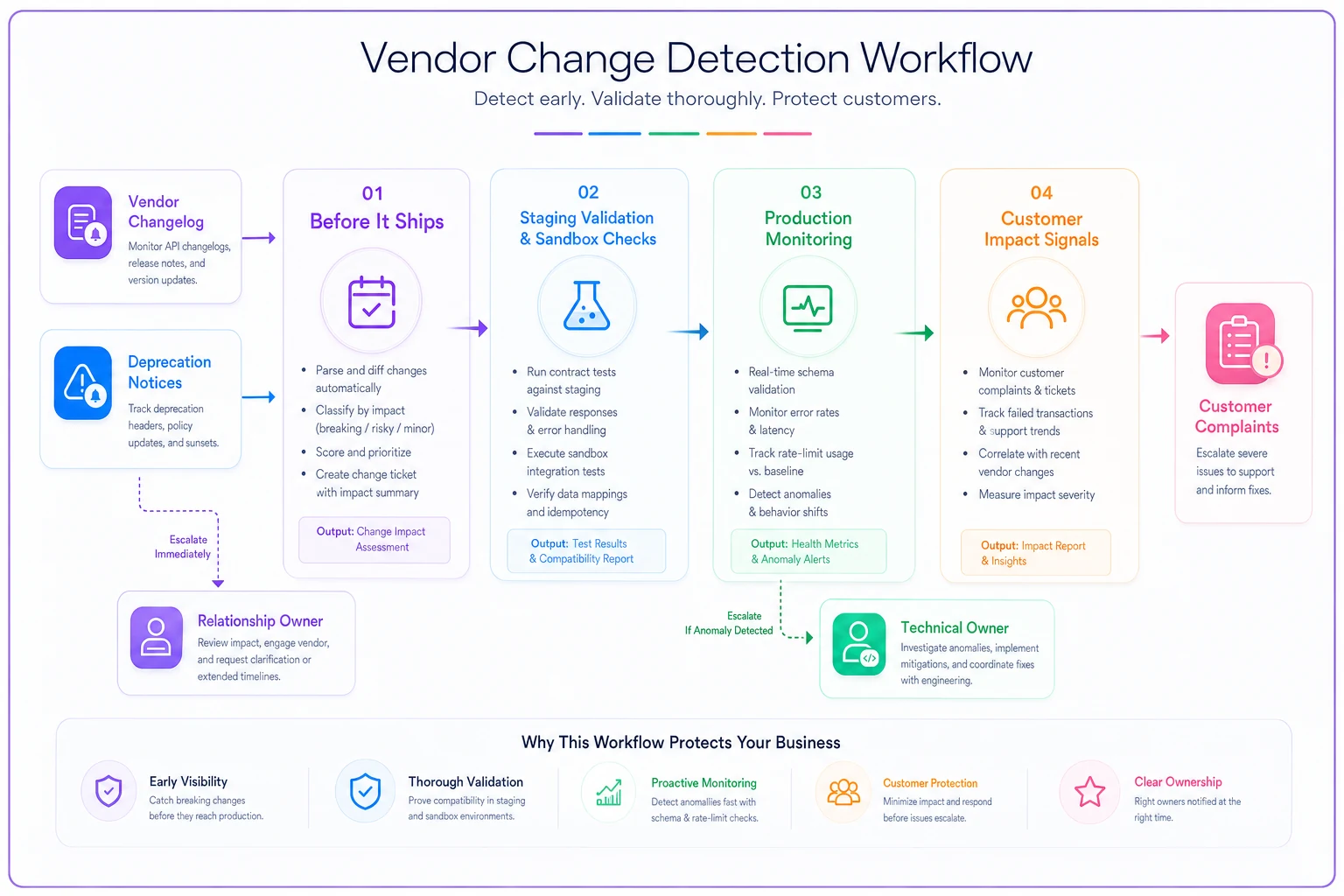
The deeper discipline around this — templates for change-control gates, vendor attestations, how you formalize the contract with a third party — is covered in more depth in specifying third-party integrations and vendor change-control gates. Detection rules are the runtime half; those gates are the design-time half.
Gating policies: what gets to touch production
Not every change — yours or the vendor's — should flow straight to production. Gating is where you decide what needs a human, what needs a test, and what can pass through automatically.
Three gates cover most real situations:
New integration gate. Before a new connector goes live, it needs: a named owner and backup, an assigned tier, contract tests, monitoring hooks, and a documented runbook. No owner, no launch. This single rule prevents the orphaned-connector problem at the source. The most common place teams cut corners is shipping the connector and promising to "write the runbook later." Later never comes.
Vendor-version upgrade gate. When a vendor pushes a new API version you intend to adopt, it passes through staging contract tests and a review of the changelog for breaking changes before it's enabled. For Tier 1 connectors, this is a human sign-off, not an automated merge.
Emergency change gate. During an incident you need a faster path, but faster isn't the same as ungoverned. An expedited change still logs who approved it and schedules a follow-up review. Speed with an audit trail, not speed with amnesia.
When heavy gating is a bad idea
Gating has a cost. Over-gate a Tier 3 internal reporting connector and you've added friction to something that barely matters. Teams either gate nothing and get orphaned connectors, or gate everything and grind simple changes to a halt.
Match the gate to the tier. A Tier 1 payments connector earns human sign-off on every vendor version change. A Tier 3 convenience feed can auto-deploy with passing tests and nothing else. If your gating policy treats both the same, it's the wrong policy.
Sample runbook: connector break/fix
A runbook's job is to let a tired on-call person who didn't build the connector still fix it. It should assume no context. Here's the shape of one that works:
-
Confirm the blast radius. What's broken, for whom, how bad? Check the tier. This sets the SLA clock and tells you who to wake up.
-
Check the obvious vendor-side causes first. Is the vendor's status page green? Did credentials expire? Is it a rate-limit wall? A large share of connector incidents are vendor-side or credential-related, not code bugs — check those before you start reading your own code.
-
Identify what changed. Your last deploy, the vendor's last change, an expired secret, a schema drift alert. If your detection is set up, this step is often already half-answered by an alert.
-
Mitigate before you fix. Can you fail over, queue requests, degrade gracefully, or switch to a fallback? Stopping the bleeding buys time to fix properly. For a Tier 1 connector, mitigation inside the SLA window matters more than an elegant root-cause fix.
-
Fix and verify against the vendor's current behavior. Not against your assumptions — against what the vendor actually returns now.
-
Pull in the relationship owner if it's vendor-side. If the vendor broke it, the technical owner can't fix the vendor. The relationship owner escalates through the support SLA.
-
Update the artifacts. Note what changed, update the runbook if the steps were wrong, log the incident. The next person deserves better information than you had.
That last step is the one everyone skips, and the reason runbooks go stale. A runbook that's wrong is worse than none — it sends the on-call person down a dead path while the SLA clock runs.
Sample runbook: roadmap coordination
Break/fix is reactive. Roadmap coordination is the proactive runbook — the one that prevents the deprecation you should have seen coming.
The workflow, in plain terms: the relationship owner for each Tier 1 and Tier 2 vendor runs a standing check — quarterly is enough for most — that walks through a short list. Any known deprecations with a date attached? Any new vendor features your product should adopt? Any version you're on that's approaching end-of-life? Any pricing or rate-limit changes coming?
Whatever surfaces gets turned into actual backlog items with owners and rough timelines, not a vague "we should upgrade someday" note. The single most common roadmap failure is knowing a deprecation is coming and letting it sit untracked until it becomes an emergency. The entire point of the coordination runbook is converting a known future problem into scheduled work while it's still cheap.
A quick checklist for the quarterly vendor review
-
[ ] Vendor changelog reviewed since last check
-
[ ] Any deprecation dates captured as dated backlog items
-
[ ] Current API version confirmed as supported (not nearing EOL)
-
[ ] Credentials / certs checked for upcoming expiry
-
[ ] Rate-limit and pricing changes reviewed
-
[ ] Ownership matrix confirmed accurate for this connector
-
[ ] Runbook spot-checked against current vendor behavior
Running this on even your top five connectors catches the overwhelming majority of surprises. The connectors that blow up are almost always the ones that never got a review.
A real scenario
A logistics-software company — maybe 40 people, product built on a dense web of carrier and tracking APIs — had around 18 active integrations and no clear ownership model. Connectors were "owned" by whoever last touched them, which in practice meant orphaned.
Over a rough stretch, they had three separate incidents in a single quarter traced to vendor changes nobody saw coming: a carrier deprecated a tracking endpoint, an address-validation API tightened its rate limits, and a shipping provider changed a response field type. Each one surfaced as a customer complaint. Each one burned the better part of a day in confused triage because nobody knew who owned the connector or where to start.
They didn't rebuild anything. They put the operating model in place: an ownership matrix with named owners and backups, three tiers with maintenance SLAs, changelog monitoring for the top integrations, and a quarterly roadmap review for Tier 1 and 2.
The change wasn't dramatic in code terms and took a few weeks to actually stick. Over the following two quarters, vendor-change surprises dropped from three customer-visible incidents to effectively one — and that one was caught in staging before it reached production. Average triage time on the incidents they did have fell from most of a day to a couple of hours, mostly because the "whose problem is this" argument simply stopped happening. The connectors weren't more reliable. The organization around them was.
Where this tends to go wrong
A few honest cautions, because an operating model can fail just as quietly as a connector.
-
Documentation theater. A beautiful matrix that nobody maintains is worse than a sticky note that's accurate. The model is only as good as its upkeep.
-
SLAs without the operational backing. A 15-minute acknowledge target with no real on-call rotation is a lie you tell yourself.
-
Owning everything equally. If you tier-1 every connector, you've effectively tiered none. The tiers only help if they genuinely change behavior.
-
Detection without response. A schema-drift alert that fires into a channel nobody reads is just noise with extra steps.
The teams that get this right aren't the ones with the most elaborate framework. They're the ones who picked a small set of rules — owners, tiers, detection, a couple of runbooks — and actually ran them every quarter without it being heroic.
Closing thought
The reason integrations feel chaotic isn't that APIs are hard. It's that connectors sit in the blind spot between "code someone shipped" and "a relationship someone manages," and most orgs have nothing that spans both. An integration operating model built around clear ownership, tiered SLAs, upstream change detection, and runbooks that assume zero context turns that blind spot into something boring and predictable — which, for anything load-bearing in production, is exactly what you want.
Start with your top five connectors. Give each a name in the accountable column, a tier, and a one-page runbook. You'll close most of the gap before you ever touch the other fifty-five.
Ready to transform your product delivery?
Join 2,000+ teams using GoReqly to improve requirements accuracy, reduce rework, and accelerate time to market.