



Markets just got a reality check. According to Bloomberg, traders are now fully pricing in another Fed rate hike this year after stronger-than-expected jobs data. The "higher-for-longer" rates narrative that everyone hoped would fade? It's becoming the base case.
For product teams already juggling tight roadmaps, this means the budget axe is coming. During the 2022 rate hikes, I watched this exact scenario unfold at three different SaaS companies—hiring freezes hit first, then discretionary project budgets got slashed by 30-40%, and suddenly every sprint retrospective turned into a cost justification meeting.
The cruel irony? Teams facing these constraints often create more waste, not less. When you're scrambling to show value with half the resources, requirements traceability becomes the first casualty. Yet that's exactly when you need it most.
Why requirements traceability breaks when budgets tighten
Most product teams treat requirements traceability like insurance—nice to have until you actually need it. Under normal conditions, you can absorb the cost of rework. A feature gets built wrong? Throw another sprint at it. Customer feedback reveals you misunderstood the need? Queue it for next quarter.
But when capital costs spike and budgets freeze, that buffer disappears. Every piece of rework becomes visible on someone's spreadsheet. Every requirement that wasn't properly traced to its origin becomes a question mark in a budget review.
The pattern goes like this: Team gets pressure to deliver faster with less. They start cutting "non-essential" activities. Requirements documentation gets lighter. Traceability links get skipped. Three sprints later, they're rebuilding features because nobody can remember why certain decisions were made.
One fintech startup I worked with learned this lesson brutally. They had a payment reconciliation feature that three different stakeholders requested. Without proper requirements traceability, the team built three slightly different versions over six months. Total waste: roughly $280k in engineering time. The kicker? All three stakeholders actually needed the same thing—they just described it differently.
The lightweight traceability system that actually works under pressure
After watching teams struggle with heavyweight requirements management tools that nobody actually uses, a simpler pattern emerges that actually sticks.
Stop losing track of critical project requirements.
GoReqly helps you capture, organize, and track every requirement with precision and clarity.
- Centralized requirements repository
- Collaborative editing & commenting
- Traceability & version control
No credit card required
Start with a single source of truth—not a complex tool, just a structured approach. Every requirement gets tagged with three elements: origin (who asked for it and why), impact (what metrics it affects), and dependencies (what it connects to).
Structure that works:
Requirement ID Format:
[Quarter]-[Source]-[Sequence]
Example: Q2-SALES-042
| Requirement | Origin | Business Metric | Dependencies | Status |
|---|---|---|---|---|
| Q2-SALES-042 | Sales team: churn calls | Monthly retention rate | Auth system, billing API | In development |
| Q2-PROD-018 | Product analytics | Feature adoption % | Q2-SALES-042, logging service | Blocked |
| Q2-CS-091 | Support tickets #4521-4589 | Ticket volume | Dashboard, reporting DB | Validated |
The magic happens when you connect this to your actual work. Every user story references its requirement ID. Every bug report links back to the original requirement. Every scope change gets traced to its business impact.
This isn't about creating more documentation. It's about making the documentation you already create useful when someone asks "Why are we building this?" three months later.
Converting traceability into ROI arguments that CFOs understand
Budget committees don't care about your backlog. They care about return on investment. Requirements traceability becomes your translator between engineering reality and financial metrics.
A marketplace platform that nearly got their entire product budget cut during a downturn survived by showing exactly how each requirement traced to revenue impact. Not vague promises—actual connections.
They mapped every requirement to one of four categories:
-
Direct revenue impact - Features that directly enable transactions
-
Retention impact - Features that reduce churn or increase engagement
-
Cost reduction - Features that reduce operational overhead
-
Risk mitigation - Features that prevent losses or compliance failures
Their traceability matrix included a "monthly impact" column. When the CFO asked why they needed three engineers on a search optimization project, they could show: "These five requirements from Q1 trace to $47k monthly in lost checkout conversions based on our funnel analysis."
Requirements that couldn't be traced to measurable impact? Those got cut. The team initially resisted, but later admitted it forced them to focus on work that actually mattered.
The anti-patterns that multiply rework (and how to spot them early)
When budgets tighten, certain requirements patterns guarantee expensive rework. I've catalogued these from watching teams burn through emergency fixes:
The "Obvious Requirement" Trap
Someone says "Obviously, users need to export their data." Nobody documents what format, what data, what frequency limits. Three months later, you're rebuilding the export feature because enterprise customers need CSV but you built JSON, or you didn't account for rate limits and crashed production.
The Stakeholder Telephone Game
Executive tells product manager who tells business analyst who tells engineer. By the time it reaches development, "we need better reporting" has morphed into a complex dashboard nobody asked for. Without traceability back to the original ask, you'll build the wrong thing.
The Scope Creep Snowball
Feature starts simple. During development, someone adds "just one more field." Then another. Then another. Without requirements traceability showing what was originally approved versus what got added, you can't push back. Your two-week feature becomes a two-month monster.
One e-commerce team had a simple inventory sync feature balloon from 3 story points to 34 story points through undocumented scope additions. When they finally implemented requirement change tracking, they discovered 80% of their "urgent" additions came from a single stakeholder who wasn't even a primary user.
Building your requirements defense system
Tight budgets expose every weakness in your requirements process. Teams that survive can defend their decisions with data.
Create a "requirements defense kit":
-
Original requirement statement
-
Business justification with metrics
-
Alternative solutions considered
-
Cost of not doing it
-
Cost of doing it wrong
Before any requirement enters development, it needs these five elements documented. Skip this step and you're gambling with resources you don't have.
One B2B software company implemented this after burning through 40% of their quarterly budget on a feature nobody used. Their new rule: No requirement moves forward without quantified impact. Their rework rate dropped from 35% to under 10% within two quarters.
Wiring requirements traceability into your existing workflow
The biggest mistake teams make is treating requirements traceability as a separate process. It needs to live inside your existing workflow.
In sprint planning: Every story card displays its requirement ID. Can't find the requirement? The story doesn't get pulled into the sprint.
In daily standups: When discussing blockers, reference the requirement impact. "I'm blocked on Q2-SALES-042, which affects our monthly retention metric."
In retrospectives: Track rework by requirement. Which requirements generated the most bugs? Which had the most scope changes? This becomes your early warning system.
In stakeholder updates: Report progress by business impact, not story points. "We've completed requirements affecting $128k in monthly revenue impact" hits different than "we finished 47 story points."
Teams that successfully embed requirements traceability treat it like code review—not optional, not negotiable, just part of how work gets done. Our previous analysis on operational metrics showed that teams tracking requirement stability saw 60% less emergency rework.
Make requirement IDs visible on story cards to prevent work being pulled without traceability.
Quick visual: how requirement IDs flow from request to deployment.
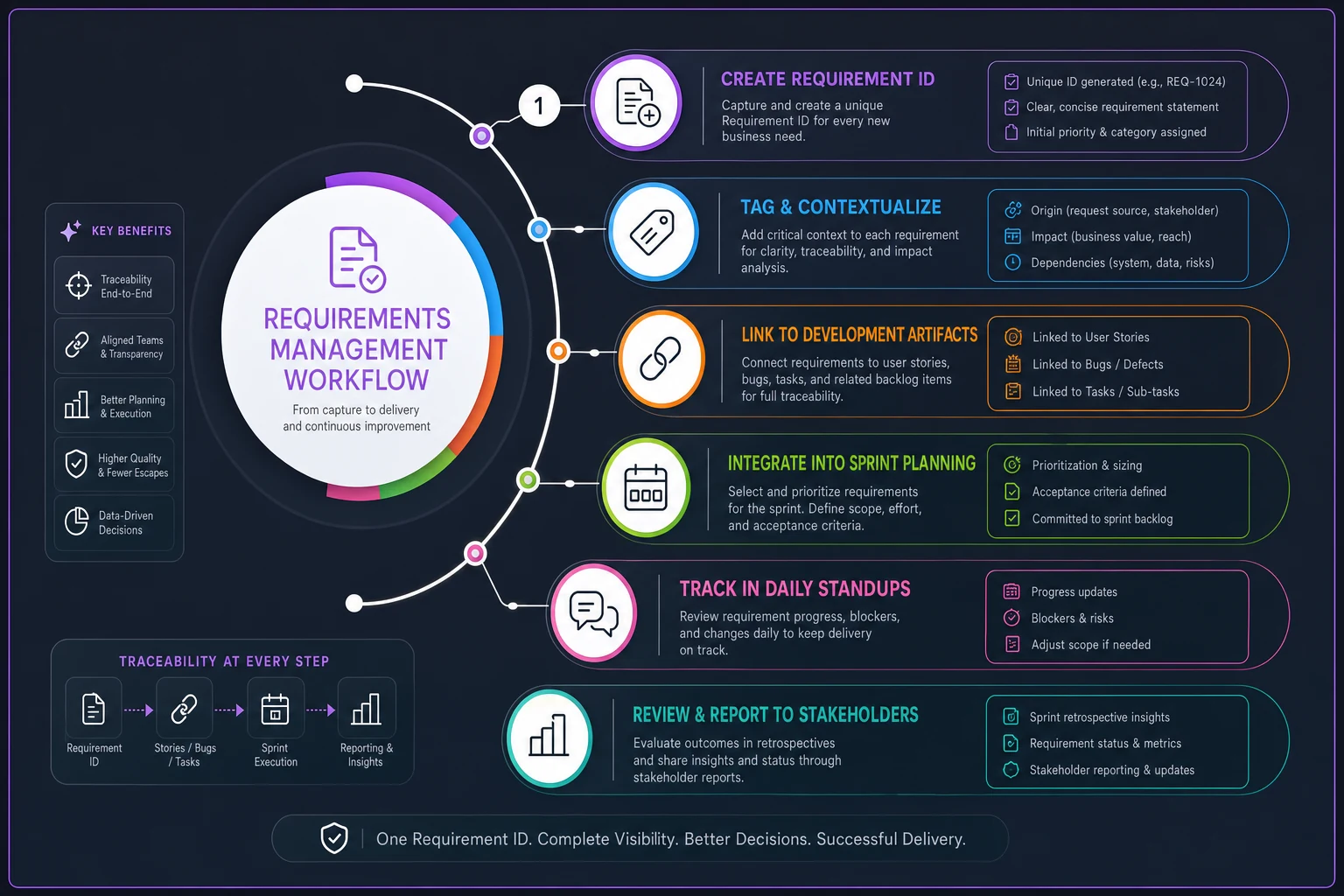
This visual summarizes the process.
The AI automation angle nobody talks about
Requirements traceability is perfectly suited for AI automation enhancement. Not the fancy "AI will write your requirements" nonsense, but practical automation that reduces the manual burden.
An AI-powered requirements management platform can automatically:
-
Link user stories to requirements based on description matching
-
Flag when requirements conflict with existing ones
-
Alert when dependent requirements change
-
Generate impact analysis when scope changes are proposed
-
Track requirement coverage across test cases
The value isn't in replacing human judgment—it's in catching the connections humans miss when they're rushing through sprint planning.
Teams using AI-enhanced requirements platforms catch dependency conflicts that would have caused two-week delays. The automation doesn't make decisions; it surfaces information at the moment you need it. When a developer starts working on a story, they immediately see related requirements, previous decisions, and potential conflicts.
Making the financial case for requirements infrastructure
When budgets tighten, investing in requirements traceability seems counterintuitive. Frame it as cost reduction, not cost addition:
The rework calculation: Average feature size × rework rate × engineering hourly cost = annual rework cost
A 50-person product organization typically burns $400k-800k annually on preventable rework. Even a 25% reduction pays for any requirements infrastructure investment.
The decision delay cost: Every day spent rediscovering why something was built costs money. One enterprise software team tracked this: they spent an average of 3.5 hours per sprint in "requirement archaeology"—digging through Slack, emails, and meeting notes to understand original intent.
The scope creep tax: Undocumented scope changes are budget killers. Track how much your last three projects overran. Calculate what percentage came from requirements that appeared mid-flight without proper impact analysis.
When you present these numbers, requirements traceability transforms from "nice to have documentation" to "operational cost reduction."
Who shouldn't implement requirements traceability right now
Not every team should add requirements traceability during a budget crunch.
Skip it if:
-
You're a five-person startup still finding product-market fit
-
Your entire roadmap might pivot next month
-
You're building throwaway prototypes
-
Your team has no history of rework problems
Mandatory if:
-
You're scaling beyond 15 engineers
-
Multiple stakeholders influence your roadmap
-
You're in a regulated industry
-
Rework is eating more than 20% of capacity
-
You can't explain why features exist
The assessment is simple: Calculate one month of rework cost. If it's more than the effort to implement basic requirements traceability, you can't afford not to do it.
The playbook for the next six months
Rates aren't dropping soon. CNBC's analysis suggests we're looking at sustained higher costs through at least mid-2027. Product teams need to adapt now.
Month 1-2: Foundation
-
Audit your current requirements documentation
-
Identify your top 3 rework patterns
-
Implement basic requirement IDs
-
Start tracking rework by requirement
Month 3-4: Integration
-
Wire requirements into sprint ceremonies
-
Train team on traceability practices
-
Connect requirements to business metrics
-
Begin tracking requirement stability
Month 5-6: Optimization
-
Automate requirement linking where possible
-
Build stakeholder reporting dashboards
-
Identify patterns in requirement failures
-
Adjust process based on data
Teams that nail this process won't just survive the budget crunch—they'll emerge leaner and more effective. While competitors waste cycles on rework, you'll be shipping features that actually move metrics.
The bottom line on requirements traceability
Budget pressure reveals operational truth. When money was cheap, we could afford sloppy requirements. We could rebuild features three times. We could chase every stakeholder whim.
That era is over.
Requirements traceability isn't about creating perfect documentation. It's about building an operational memory that prevents expensive mistakes. Every requirement you can't trace is a future budget overrun waiting to happen.
Teams fighting requirements traceability because "we don't have time" are often the same teams spending 30% of their capacity on rework. You don't have time NOT to trace requirements when capital is expensive and budgets are frozen.
Start small. Pick one team, one product area. Implement basic traceability. Track the reduction in rework. Use those numbers to expand. By the time the broader organization notices, you'll have proof that requirements traceability isn't overhead—it's operations.
The choice is straightforward: invest a little time in requirements traceability now, or spend a lot of time explaining budget overruns later. In this rate environment, you won't get many chances to get it wrong.
Budget pressure reveals operational truth. When money was cheap, we could afford sloppy requirements. We could rebuild features three times. We could chase every stakeholder whim.
Requirements traceability isn't about creating perfect documentation. It's about building an operational memory that prevents expensive mistakes. Every requirement you can't trace is a future budget overrun waiting to happen.
Start small. Pick one team, one product area. Implement basic traceability. Track the reduction in rework. Use those numbers to expand. By the time the broader organization notices, you'll have proof that requirements traceability isn't overhead—it's operations.
Ready to transform your product delivery?
Join 2,000+ teams using GoReqly to improve requirements accuracy, reduce rework, and accelerate time to market.