


Most product teams treat supply chain risk as someone else's problem — procurement's spreadsheet, the ops team's headache. Then a component shows up six weeks late, a hardware-dependent feature slips, and suddenly you're the one explaining to stakeholders why the release everyone signed off on is now a "soft commitment."
That's exactly where a lot of teams are right now.
What's actually happening
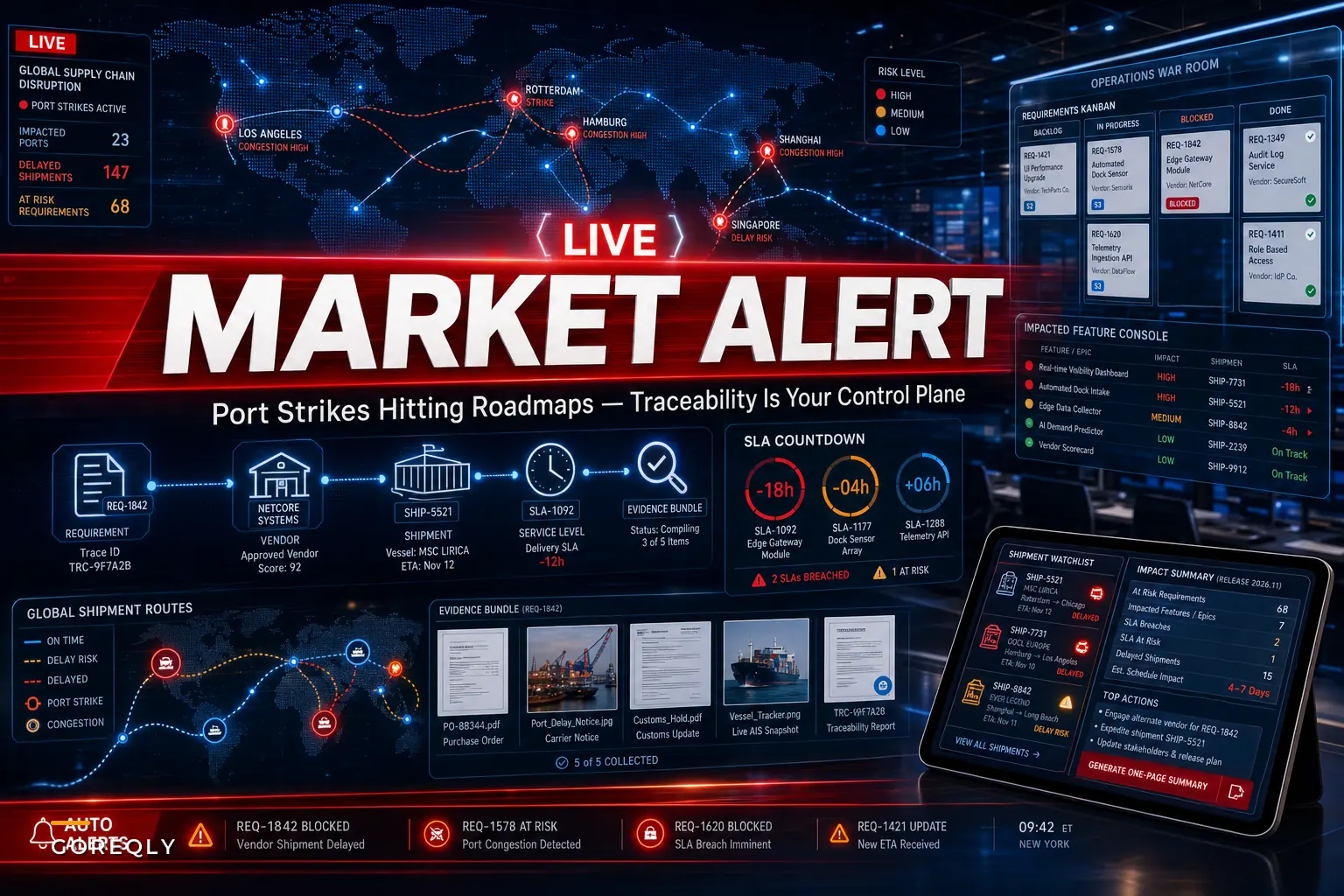
Coordinated dockworker strikes across more than 100 ports in 22 countries disrupted cargo flows on October 29–30, 2026. According to Reuters, the action hit shipments at a scale that will ripple into U.S. supply chains over the coming weeks — right as holiday fulfillment windows tighten and inventories are already thin from just-in-time purchasing habits.
For a pure-software product with no physical dependencies, this is background noise. But a lot of "software" roadmaps aren't actually pure software. They depend on dev kits shipped from overseas, reference hardware for firmware testing, IoT sensors, point-of-sale terminals, edge devices, vendor-provided appliances. When those don't arrive, the work scheduled around them doesn't happen — regardless of how clean your sprint board looks.
The strike itself isn't the interesting part. What's interesting is how badly most teams can trace the blast radius once a physical delay lands. That's the gap worth closing.
The real problem: your roadmap doesn't know what it depends on
When a physical delay hits a software roadmap, teams can usually tell you what is slipping, but not why in a way anyone upstream can actually act on.
Stop losing track of critical project requirements.
GoReqly helps you capture, organize, and track every requirement with precision and clarity.
- Centralized requirements repository
- Collaborative editing & commenting
- Traceability & version control
No credit card required
Someone says "the inventory-scanning feature is blocked." Blocked by what? The scanner hardware. Which vendor? A reseller. Who's the actual manufacturer? Nobody's sure. Which requirement depends on that hardware arriving? It's implied across three Jira tickets and a Confluence page nobody has touched since July. Which release does that requirement anchor? Depends who you ask.
By the time you reconstruct that chain by hand, you've burned two days and the de-scope decision has already been made for you by the calendar.
The underlying issue is that most teams trace requirements downward — requirement to story to test — but almost never sideways into the physical and vendor layer. The traceability graph stops at "code." It needs to extend one hop further: requirement → vendor → shipment → arrival date → dependent release.
Without that link, every external delay becomes a fire drill instead of a lookup.
A quick way to see how exposed you are
Before building anything, run a blunt exposure check on your current roadmap. This takes an afternoon, not a quarter.
-
Which features in the next two releases depend on something physical arriving? Hardware, devices, appliances, test rigs — anything you can't download.
-
For each of those, can you name the actual manufacturer, not just the reseller? Resellers are the layer that quietly absorbs delays and then surprises you.
-
Do you have a documented arrival date, or just an assumption? "Should be here by then" is not a date.
-
Which requirement IDs break if that item is late? If you can't point to specific requirements, your de-scope conversation will be guesswork.
-
Who signs off on cutting that scope, and what evidence do they need? If you don't know now, you'll be scrambling mid-sprint.
Most teams get through the first bullet feeling fine and hit a wall by the third. That wall is the whole problem.
Mapping the chain: requirement → vendor → shipment
The fix isn't complicated. It's extending the traceability discipline you already apply to requirements and tests out into the vendor and logistics layer. The goal is a single lookup that answers: if this shipment slips, what does it cost my roadmap?
Here's a lightweight model that holds up under real pressure:
| Layer | What you capture | Why it matters during a delay |
|---|---|---|
| Requirement | Requirement ID, owning release, acceptance criteria | The thing stakeholders actually care about |
| Dependency type | Hardware / SDK / appliance / test rig | Tells you whether a workaround even exists |
| Vendor | Reseller and underlying manufacturer | Delays hide at the manufacturer layer |
| Shipment | PO number, origin port, expected arrival | Links the abstract requirement to a real date |
| Criticality | Blocks release vs. degrades vs. nice-to-have | Drives the de-scope decision, not opinions |
| Fallback | Alternate vendor, rental rig, emulator, defer | Pre-decided so you don't improvise under stress |
Write fallbacks for blocking items before a delay happens so you can execute instead of inventing under pressure.
The column that saves teams most often is the last one. When you've already written down "if the scanner is late, we fall back to the software emulator for QA and defer the hardware acceptance test to the next release," the delay becomes a known branch instead of a crisis. You execute the plan instead of inventing one.
This is also where the connection to broader vendor discipline becomes obvious. A delayed shipment is just one failure mode of third-party risk. The same trace links that surface a late shipment are the ones that flag a vendor attestation failure or a manufacturer change. The deeper breakdown on managing that layer lives here: third-party governance for requirements, vendor attestations and transitive risk. The port strike is essentially a live stress test of everything that playbook covers.
A process for the week a delay lands
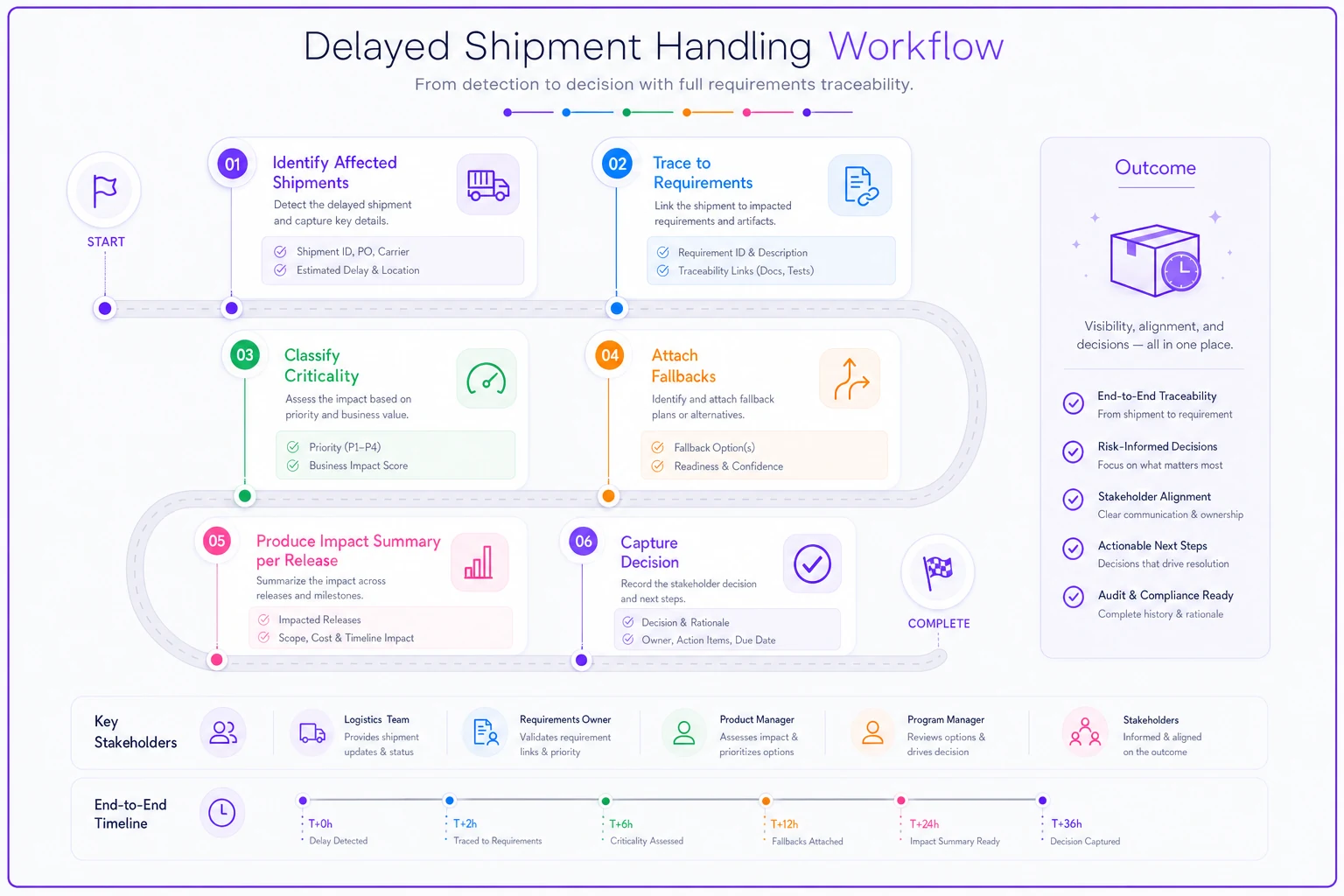
When a shipment actually slips, speed matters more than elegance. Here's a sequence that keeps the decision clean and defensible:
Use this sequence as a checklist during the week a delay lands.
-
Identify the affected shipments. Pull every PO tied to the disrupted ports or routes. Flag the ones feeding your next two releases.
-
Walk the trace backward to requirements. For each delayed shipment, list the requirement IDs that depend on it and the releases they anchor.
-
Classify each by criticality. Separate "release-blocking" from "degrades experience" from "cosmetic." Be honest — teams consistently over-classify things as blocking when they're really just annoying.
-
Attach a fallback to every blocking item. Emulator, rental hardware, alternate vendor, or deliberate defer. No blocking item leaves this step without a decision.
-
Produce a one-page impact summary per release. What slips, what the fallback is, what it costs, and what you're asking stakeholders to approve.
-
Capture the decision as evidence. Who approved the de-scope, on what date, based on what. This is the step everyone skips and regrets at the next audit.
The difference between teams that handle this well and teams that don't isn't intelligence. It's whether steps two and six already have a home. If reconstructing the trace is a research project every time, you'll never move fast enough. If logging the decision is an afterthought, you'll spend the post-mortem defending choices you can't document.
A realistic scenario
Take a small company building retail-floor analytics software. Their product depends on a vendor-supplied edge device that ships from an overseas manufacturer, and one of their Q4 releases includes a new in-store heatmap feature that can't pass acceptance testing without a batch of those devices on hand.
The devices were scheduled to clear port mid-November. With the strike, that window shifted by somewhere between two and five weeks — nobody can say exactly. In the old way of working, the team would have found out when QA flagged they had no hardware to test against, roughly a week before the planned release date.
Instead, because they'd mapped the requirement-to-shipment chain, they caught it the morning the strike news broke. The heatmap requirement was flagged as release-blocking. The fallback — already written down months earlier — was to validate against the manufacturer's device emulator for functional sign-off and defer physical acceptance testing to the first patch release, gated behind a feature flag so the feature wouldn't surface in production until real-device validation passed.
The whole re-plan took about half a day. The stakeholder review was a single page: here's what slips, here's why, here's the fallback, here's what we're accepting. No two-day scramble, no finger-pointing, no quiet scope cut that nobody signed off on. They pulled an expedited-shipping quote as a backup — somewhere in the low four figures — and ended up not needing it because the fallback held.
The delay became a managed branch instead of an emergency. That's the only real outcome you're aiming for.
When extending traceability this far is worth it — and when it isn't
This discipline has a real cost and isn't free to maintain.
It makes sense when:
-
Your roadmap has genuine physical dependencies — hardware, devices, appliances, test rigs.
-
You operate under audit or compliance pressure where de-scope decisions need a paper trail.
-
Releases are tightly coupled, so one late component cascades across several teams.
-
You've already been burned by a delay you found out about too late.
It's probably overkill when:
-
Your product is pure SaaS with no physical dependency anywhere in the stack.
-
Your release cadence is loose enough that a few weeks' slip genuinely doesn't matter.
-
You're a small enough team that everyone already knows every dependency by heart — though be careful, because "everyone knows" stops being true the moment one person leaves.
Who should skip this entirely for now: teams that haven't gotten basic requirement-to-test traceability working yet. Extending the chain into logistics before the core trace links are reliable is building a second floor on a shaky foundation. Get the fundamentals solid first.
The mistake that costs teams the most
The expensive error isn't the delay itself. Delays are a cost of doing business with the physical world. The expensive error is making scope cuts under pressure that nobody can reconstruct three months later.
What happens: a shipment slips, the team quietly pulls a feature to protect the release date, ships, and moves on. No decision record. No updated trace links. No note explaining why the acceptance criteria changed. Then the next audit, or the next planning cycle, or a new PM asks why that feature was cut and what the plan was to bring it back — and the answer is a shrug and some Slack archaeology.
Delays are survivable. Undocumented reactions to delays are what quietly erode trust in the roadmap and turn every future planning conversation into "well, last time you said X and then changed it." Keep the trace intact, log the decision, and a port strike on the other side of the world becomes a line item you managed — not a hole in your release history you can't explain.
The ports will reopen. The question is whether, when the next disruption hits, your roadmap can tell you in an hour what it depends on — or whether you'll be reconstructing the chain by hand while the clock runs.
Ready to transform your product delivery?
Join 2,000+ teams using GoReqly to improve requirements accuracy, reduce rework, and accelerate time to market.