

Most teams govern vendors the way they govern fire extinguishers — sign a contract, check a box, forget about it until something breaks. Then a dependency three layers deep ships a breaking change, your SLA quietly degrades, and nobody can answer the question that actually matters: which of our requirements just became untrue?
That's the real gap. It isn't that teams lack contracts or security questionnaires. It's that the questionnaire lives in a procurement folder, the requirement lives in your tracker, and the transitive dependency connecting them doesn't live anywhere. When a vendor changes something, the blast radius is invisible until it hits production.
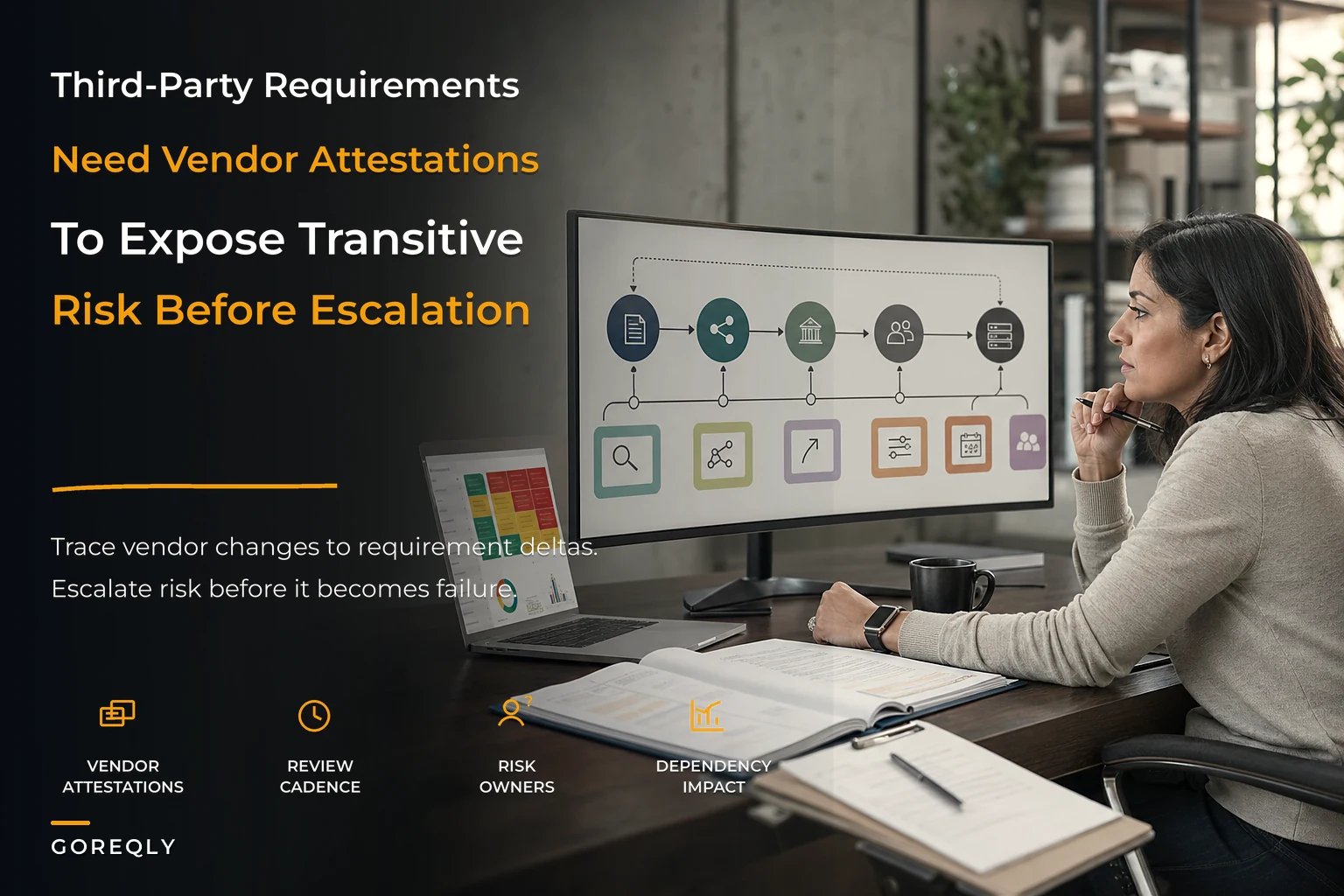
This post is about making that blast radius visible before it gets there — scoring vendors by the risk they actually introduce, setting attestation cadences that reflect that risk rather than the calendar, and wiring vendor-induced changes to concrete requirement deltas and escalation paths.
Why vendor governance breaks before it scales
Vendor risk isn't a property of the vendor. It's a property of how deeply your requirements depend on them.
A payments processor and a font CDN might both be "third parties," but one underpins a dozen revenue-critical requirements and the other affects nothing a user would ever notice. Treating them with the same questionnaire — or the same annual review cycle — is where most programs go wrong. You over-govern the harmless and under-govern the dangerous.
The pattern that shows up repeatedly across teams that haven't formalized this: governance effort gets distributed by contract size rather than requirement exposure. The big expensive vendor gets a quarterly review because finance cares about the spend. The $200/month API that silently backs your authentication flow gets ignored — until it deprecates an endpoint and locks a chunk of your users out.
And then there's the part almost nobody maps: transitive dependencies. Your vendor has vendors. Their uptime, compliance posture, and data-handling promises are only as good as their own supply chain. When a sub-processor two levels down changes region, your data-residency requirement might have quietly broken — and you'd have no attestation trail proving when it was ever true.
Scoring vendors by what they actually put at risk
Before you can set a cadence or an escalation path, you need a score that reflects real exposure. The mistake most scoring matrices make is grading vendors on vendor attributes — company size, SOC 2 status, years in business — instead of your dependency on them.
Stop losing track of critical project requirements.
GoReqly helps you capture, organize, and track every requirement with precision and clarity.
- Centralized requirements repository
- Collaborative editing & commenting
- Traceability & version control
No credit card required
A useful score blends both: how critical the vendor is to your requirements, and how trustworthy they are as an operator. Here's a breakdown that holds up in practice:
| Dimension | What you're measuring | Weight | Example signal |
|---|---|---|---|
| Requirement criticality | How many (and how important) requirements depend on this vendor | High | Backs auth, payments, or a compliance control |
| Data sensitivity | What class of data flows through them | High | PII, PHI, payment data vs. anonymized telemetry |
| Transitive depth | How many sub-processors sit behind them | Medium | 3+ named sub-processors in their DPA |
| Change volatility | How often they ship breaking changes | Medium | API deprecations in the last 12 months |
| Substitutability | How hard it is to replace them | Medium | Proprietary format, deep integration, migration cost |
| Operator trust | Their own attestation and audit posture | Low–Medium | Current SOC 2 Type II, clean pen-test history |
Score each dimension 1–5, multiply by weight, and you land on a composite that sorts your vendor list into tiers. The output you're aiming for is roughly three buckets: Critical, Material, and Low-touch.
What this usually surfaces is uncomfortable. Teams find a "low-touch" vendor sitting at the center of five Critical requirements because someone integrated it deeply a couple years ago and nobody re-scored it. That re-scoring moment — not the initial scoring — is where the value actually is. Exposure drifts. Scores have to drift with it.
Start with requirement criticality and data sensitivity first; expand dimensions only as your vendor inventory grows.
When heavy scoring is a bad idea
Don't build a 40-field rubric if you have eight vendors. The matrix above is for programs where vendor sprawl is real — dozens of integrations across multiple teams. If you're a small team with a handful of dependencies, a three-column spreadsheet (vendor, requirements it backs, replacement difficulty) gets you most of the value with none of the overhead. Governance that costs more than the risk it manages is just theater.
Attestation cadence: stop reviewing on the calendar
Annual vendor reviews are the smoke detector you test once a year. They feel responsible and catch almost nothing, because vendor risk doesn't arrive on an annual schedule.
Cadence should be driven by the risk tier and by change triggers — not by the calendar alone. The point of an attestation is to get the vendor, or your own team, to re-confirm that a set of promises is still true, and to generate an evidence artifact when they do.
| Tier | Scheduled attestation | Trigger-based attestation | Evidence captured |
|---|---|---|---|
| Critical | Quarterly | On any API/contract/sub-processor change | Signed attestation, SLA snapshot, sub-processor list |
| Material | Semi-annual | On breaking change or incident | Attestation, changelog review |
| Low-touch | Annual | On incident only | Lightweight confirmation |
The column that actually earns its keep is the middle one — trigger-based attestation. Scheduled reviews catch slow drift. Triggers catch the fast, dangerous stuff: a sub-processor swap, a region change, a deprecation notice buried in a changelog email nobody read.
The operational problem is that triggers are easy to define and hard to notice. A vendor emails a deprecation notice to a shared inbox; it gets buried; the attestation that should have fired never does. This is exactly the kind of gap that benefits from AI-assisted monitoring — platforms that watch vendor changelogs, status pages, and DPA updates, then flag when a change maps to a requirement you care about. The automation isn't doing the governance; it's making sure the governance actually gets triggered instead of silently skipped.
Mapping transitive dependencies to requirement deltas
This is the hard part, and where most governance programs stop short.
A vendor-induced change is only meaningful if you can translate it into a requirement delta — a concrete statement of which requirement is now at risk, satisfied differently, or outright invalid. "Stripe changed their API" is noise. "Requirement PAY-14 (idempotent retry on failed charge) now depends on a deprecated endpoint, breaking in 90 days" is a delta you can act on.
Requirement → integration point → vendor → sub-processor(s) → underlying infrastructure.
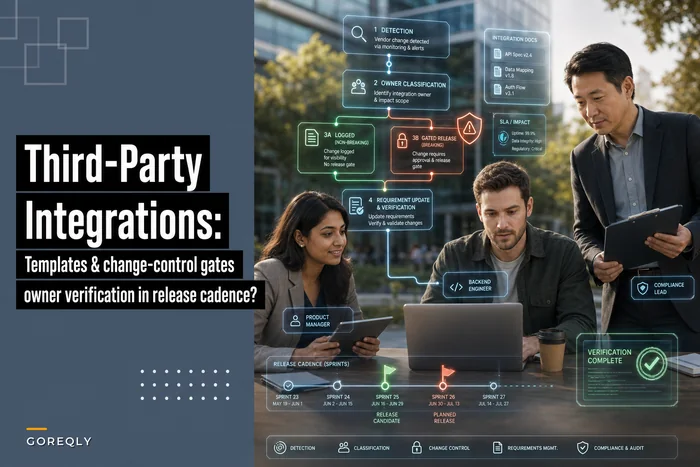
Most teams have the first link (requirement) and the third (vendor) but nothing in between, and nothing past the vendor. That missing middle is why vendor changes feel like surprises. The work of specifying third-party integrations with proper change-control gates is what populates those middle links — without that integration spec, there's nothing to map a change to.
Here's a workflow for turning a vendor change into a requirement delta:
-
Capture the change event. A changelog entry, a deprecation email, an incident report, a new sub-processor in an updated DPA.
-
Resolve the integration points. Which of your integrations touch the thing that changed?
-
Walk up to requirements. For each affected integration, list the requirements that depend on it. This is only fast if those links already exist.
-
Classify the delta. Is the requirement now broken, degraded, satisfied-differently, or unaffected?
-
Assign a deadline. Vendor changes almost always come with a clock — deprecation window, contract renewal, migration date.
-
Route to escalation based on the delta severity and the vendor tier.
The step that trips everyone up is #3. If your requirement-to-integration links are stale or missing, this walk takes days of archaeology instead of minutes. The quality of your transitive governance is capped entirely by the quality of your underlying traceability.
The diagram below shows the workflow from change capture to escalation.
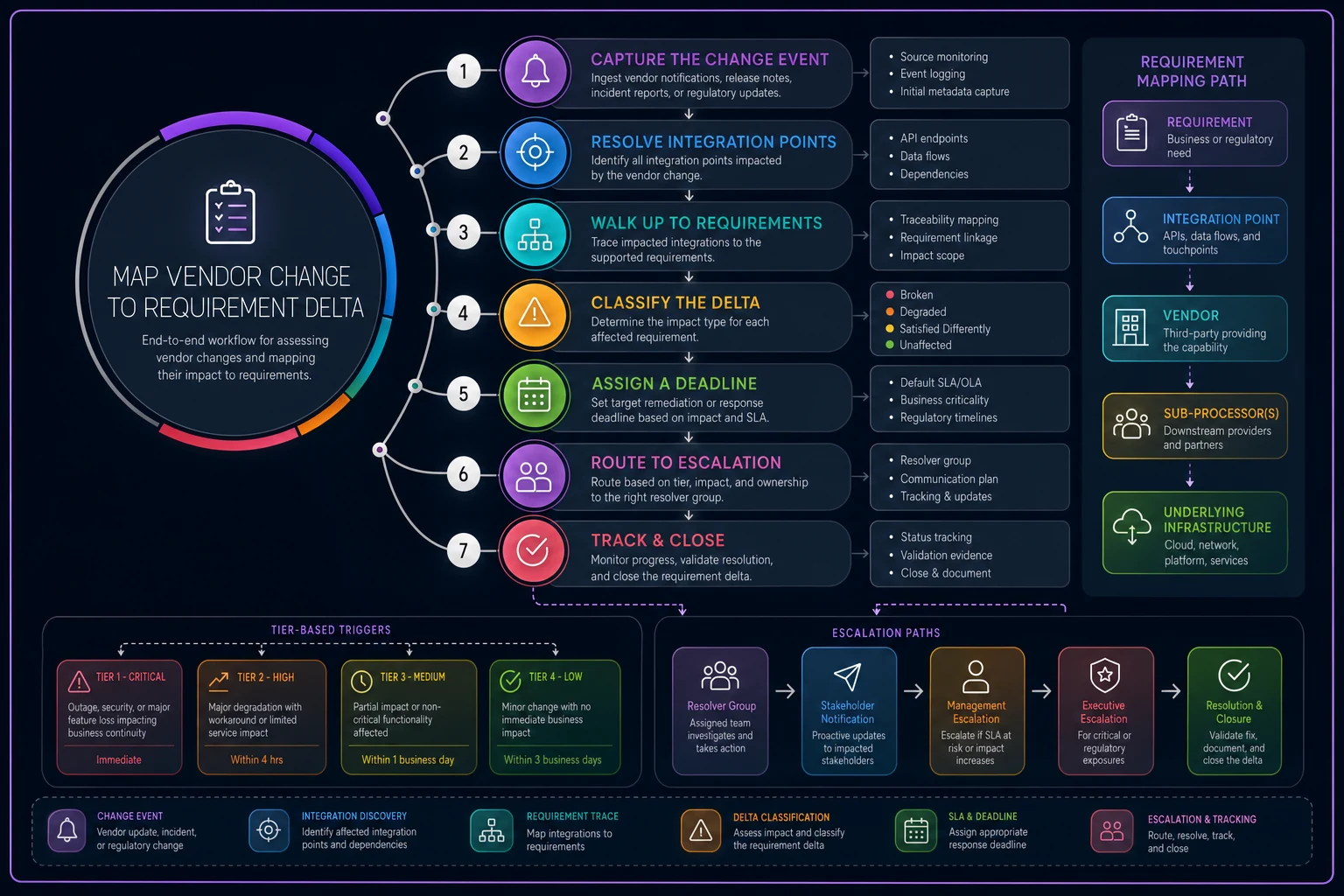
The quality of your transitive governance is capped entirely by the quality of your underlying traceability.
Escalation recipes for vendor-induced changes
Once you have a requirement delta with a severity and a deadline, you need a pre-agreed response — not a meeting to decide who should be in the meeting. Escalation recipes are just "if this kind of delta, then this path," decided in advance so nobody improvises during a 90-day deprecation window.
A few worth standardizing:
-
Critical requirement broken, hard deadline under 30 days. Immediate escalation to the product owner and eng lead. Spin up a remediation task, snapshot current behavior as evidence, notify affected stakeholders same day.
-
Material requirement degraded, 30–90 day window. Route to the owning team's next planning cycle with a flagged deadline. Request attestation from the vendor to confirm the degradation scope.
-
New sub-processor added, data-residency requirement touched. Compliance review before anything ships. Re-attest the data-handling requirement. Hold the integration if residency can't be confirmed.
-
Low-touch vendor change, no requirement impact. Log it, update the attestation date, move on.
The sub-processor recipe saves the most pain, because that's the change that's invisible by default. Your vendor doesn't break anything on your end — they quietly add a sub-processor in a new region, and your compliance posture shifts without a single line of your code changing.
A real scenario
A mid-sized B2B SaaS company — around 40 people, handling customer data across a handful of regulated accounts — ran annual vendor reviews and considered themselves reasonably diligent. One of their integrations was a document-processing API they'd scored as "material," used to extract data from uploaded files.
That API's provider added a new sub-processor for OCR, hosted outside the data-residency region two enterprise customers contractually required. The change showed up in an updated DPA email that landed in a procurement inbox. Nobody connected it to a requirement. It sat unnoticed for roughly four months, until one of those customers ran their own vendor audit and flagged it.
The scramble that followed cost the team around three weeks of engineering and legal time, plus a tense renewal conversation with an account worth a meaningful chunk of ARR. The failure wasn't the vendor's change — vendors change things constantly. The failure was that no part of their system connected that email to that requirement to that customer.
After they rebuilt around tier-based cadence and trigger monitoring, the next sub-processor change — a different vendor, similar situation — got flagged within a couple days and routed to compliance before it touched a customer. Same category of event, completely different outcome, because the governance fired automatically instead of depending on someone noticing an email.
Making the evidence durable
A scoring matrix and a cadence are worth nothing if the attestations evaporate. The whole point of attestation is to prove, later, that a vendor promise was true as of a specific date — which means every attestation needs to land as a retained, timestamped artifact, not a Slack thread.
This is where program-level governance connects to portfolio-level evidence. The attestations, SLA snapshots, and sub-processor lists you collect need a home in your broader evidence governance and attestation model for portfolios, and they need a retention policy so they're still there when an auditor — or a customer's auditor — comes asking a year later. The portfolio evidence retention policy and audit-readiness model is what keeps those vendor attestations from aging out right before you need them.
One thing teams consistently underestimate: vendor attestations have a longer useful life than they look like they do. You don't need the attestation when the vendor is behaving. You need it two years later, when a dispute or an audit asks whether a control was in place during a specific window. If you discarded it, you lose the argument by default.
A starting checklist
If you're building this from scratch, here's the minimum viable version —
-
- [ ] Inventory every third-party dependency, including the ones no one "owns"
-
- [ ] Score each vendor on requirement criticality and data sensitivity first, operator trust last
-
- [ ] Sort into Critical / Material / Low-touch tiers
-
- [ ] Record the dependency chain down to named sub-processors for Critical vendors
-
- [ ] Link each integration point back to the requirements it supports
-
- [ ] Set attestation cadence by tier, with explicit change triggers
-
- [ ] Define escalation recipes before you need them, keyed to delta severity
-
- [ ] Capture every attestation as a retained, timestamped artifact
-
- [ ] Re-score vendors on a regular cycle — exposure drifts, and so should scores
expand it as your vendor sprawl grows:
Where this actually pays off
Third-party requirement governance isn't about generating paperwork or satisfying a procurement checklist. It's about shrinking the gap between a vendor changed something and we know which of our promises just became fragile.
The teams that do this well aren't the ones with the thickest vendor questionnaires. They're the ones who scored by real exposure, matched attestation effort to that exposure, and wired vendor changes directly into requirement deltas with a pre-agreed escalation path. When a sub-processor swaps regions or an API deprecates an endpoint, nothing about it is a surprise — it's just the system working as designed.
Start with the scoring. Everything else — cadence, transitive mapping, escalation, evidence — hangs off knowing which vendors can actually hurt you, and which ones genuinely don't matter.
Ready to transform your product delivery?
Join 2,000+ teams using GoReqly to improve requirements accuracy, reduce rework, and accelerate time to market.