



The White House's June 2026 Executive Order on AI landed with a nasty surprise for product teams: 30-60 day operational directives that will reshape how federal contractors and critical infrastructure suppliers document AI features. According to Reuters' coverage, agencies must establish binding operational directives, create AI security clearinghouses, and implement vendor attestation requirements within two months.
If your product includes AI-powered features and you work with government entities or critical infrastructure sectors, your requirement artifacts just became compliance evidence. That chatbot feature? The predictive analytics dashboard? The automated document classification system? Each one now needs a traceable audit trail covering security assessments, vendor attestations, and remediation tracking.
Most product teams aren't ready for this. The typical agile backlog wasn't built to handle model vulnerability scans, algorithm bias assessments, or third-party AI component attestations. Your user stories probably don't capture how the AI makes decisions. Your acceptance criteria likely don't define security testing for ML models. And your release notes almost certainly don't track which AI models went through any kind of security clearance.
The compliance gap between agile backlogs and AI audit requirements
AI features don't fit cleanly into traditional requirement structures. When a product manager writes a user story for "implement customer churn prediction," they're actually creating requirements that span data pipelines, model training infrastructure, inference endpoints, monitoring systems, and explainability interfaces. Each component needs its own security assessment, vendor documentation, and remediation tracking.
A fintech product team I watched scramble through a banking regulator audit had beautiful Jira boards, comprehensive test suites, detailed release documentation. Still couldn't prove which version of their fraud detection model went through security scanning, who approved the training data sources, or how they tracked remediation of flagged vulnerabilities. Requirements lived in one system, model documentation in another, security assessments scattered across spreadsheets owned by different teams.
The executive order's emphasis on "AI cybersecurity clearinghouse" and "voluntary model-sharing" means product teams need to prepare for external review of their AI features. Think about what that actually means. Your proprietary recommendation algorithm might need to be packaged for third-party security testing. Your chatbot's conversation flows could require vulnerability assessments. Your predictive models may need vendor attestations about training data and security controls.
Traditional requirement management breaks down here because AI features involve multiple moving parts most tracking systems were never designed to handle. A single AI-powered feature might include:
-
Pre-trained models from external vendors
-
Custom fine-tuning on proprietary data
-
API integrations with third-party AI services
-
Edge deployment configurations
-
Monitoring and retraining pipelines
-
Fallback mechanisms when models fail
Each component needs its own requirement artifact, security assessment, and audit trail. Most teams track these as a single user story or epic, which loses exactly the granularity regulators will demand.
Building AI requirement artifacts that survive regulatory scrutiny
Here's what actually works when you need to make AI features audit-ready within tight timelines.
Stop losing track of critical project requirements.
GoReqly helps you capture, organize, and track every requirement with precision and clarity.
- Centralized requirements repository
- Collaborative editing & commenting
- Traceability & version control
No credit card required
Decompose your AI features into traceable components. Instead of one story for "implement customer support chatbot," break it into distinct pieces:
Parent Epic: Customer Support Chatbot
-
Story 1
Third-party LLM integration (vendor: OpenAI GPT-4)
-
Story 2
Custom prompt engineering layer
-
Story 3
Response filtering and safety checks
-
Story 4
Conversation history storage
-
Story 5
Fallback to human agent routing
-
Story 6
Performance monitoring dashboard
Each story needs specific AI-related acceptance criteria. Story 1 (LLM integration) should include things like "vendor provides security attestation document," "API keys stored in approved secret management system," and "rate limiting configured per security baseline."
Run a parallel track for security assessments alongside your feature stories. Every AI component story should link to a corresponding security artifact:
| Component | Security Artifact | Assessment Type | Timeline |
|---|---|---|---|
| GPT-4 Integration | VEN-2026-0614 | Vendor attestation | Sprint 3 |
| Prompt Templates | SEC-2026-0615 | Internal security review | Sprint 4 |
| Response Filters | TEST-2026-0616 | Penetration testing | Sprint 5 |
| Data Storage | PRIV-2026-0617 | Privacy impact assessment | Sprint 4 |
| Monitoring System | MON-2026-0618 | Logging compliance check | Sprint 6 |
Each artifact gets a unique identifier—not optional, that's what makes traceability actually work. When an auditor asks "show me evidence that your chatbot's language model underwent security review," you pull VEN-2026-0614 and all linked requirements instantly.
Use the same component ID across Jira, your wiki, and test systems so auditors can follow a single identifier across artifacts.
When an auditor asks "show me evidence that your chatbot's language model underwent security review," you pull VEN-2026-0614 and all linked requirements instantly.
The 30-day sprint to audit readiness
Week 1-2: Inventory and decomposition
Start by listing every AI component in your product. Not just the obvious ones—include anything that uses machine learning, natural language processing, computer vision, or predictive analytics. A midsized SaaS product typically has somewhere between 8 and 15 AI touchpoints, though teams usually only track 3 or 4 explicitly.
For each component, document:
-
The AI technology used (specific models, versions, vendors)
-
Data sources feeding the AI
-
Decision logic and thresholds
-
Human oversight mechanisms
-
Fallback procedures when AI fails
One team discovered their "simple" email categorization feature actually used three different ML models from two vendors, plus a custom classification layer on top. Their original requirement just said "auto-categorize support emails."
Week 3-4: Artifact creation and linking
Transform your inventory into traceable artifacts. Each AI component needs:
-
Functional requirement
What the component does
-
Security requirement
How it's protected
-
Vendor documentation
Attestations, SLAs, security certifications
-
Test evidence
Security scans, bias testing, performance validation
-
Decision record
Why this approach was chosen
-
Remediation log
How identified issues were addressed
Teams usually fail here not because they skip the artifacts, but because they don't link them properly. Use a consistent tagging system across all your tools. If component "REC-ENGINE-01" appears in Jira, the same ID should show up in your wiki, test management system, and security documentation.
A lightweight traceability matrix is fine for most teams—no need for a massive spreadsheet:
User Story US-2024 → Security Assessment SA-2024 → Test Evidence TE-2024 User Story US-2025 → Security Assessment SA-2025 → Test Evidence TE-2025
Week 5-6: Testing and evidence collection
Run security assessments on every AI component. That doesn't mean full penetration testing on everything, though it helps where feasible. Focus on:
-
API security for external AI services
-
Data validation for model inputs
-
Output filtering for generated content
-
Access controls for model management
-
Logging for AI decisions
When you test whether your chatbot can be manipulated through prompt injection, save the test cases, results, and remediation steps. When you verify your recommendation engine doesn't leak PII, capture the validation process. As far as auditors are concerned, undocumented testing didn't happen.
Here's a simple workflow showing the 30-day sprint process.
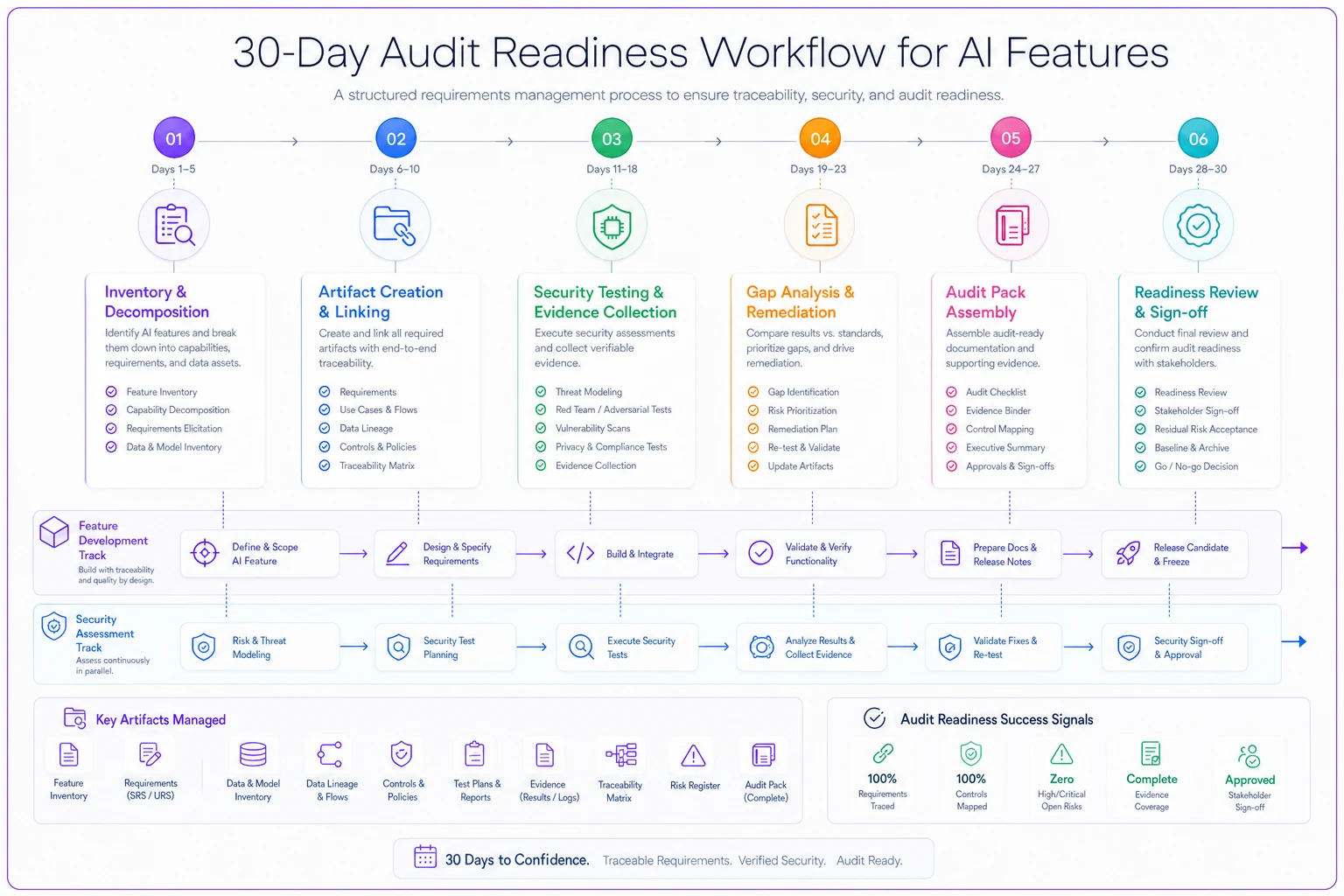
Capture all test artifacts and links in your traceability system so auditors can follow the chain from user story to security evidence without ad-hoc searches.
Operational changes that stick beyond compliance deadlines
Start treating AI models like code dependencies. When developers add a new library, they document the version, license, and security implications. Do the same for AI components. Requirements should explicitly state "uses Claude 3.5 Sonnet via Anthropic API v2.1"—not just "implements AI chat."
Build AI requirements traceability into your definition of done. No story involving AI components should close without:
-
Security artifact linked
-
Vendor documentation attached
-
Test evidence recorded
-
Decision rationale captured
-
Remediation items tracked
Create standing agenda items for AI governance. Every sprint review should include a quick check: which AI components changed, what new models were introduced, any security findings worth discussing. This prevents the scramble when audit requests arrive.
One pattern that works well: designate an "AI requirements champion" on each team. Not a full-time role—just someone who makes sure AI components get properly documented during sprint planning. They ask "does this story involve any ML models?" and "who's the vendor for this AI service?" That's it. Small habit, massive difference when an audit request lands.
Common pitfalls that destroy traceability
Retrofitting requirements after development. Teams build the AI feature first, then try to document requirements later. By then, decisions are forgotten, vendors have updated their models, and security context has changed. I've seen teams unable to explain why they chose a specific sentiment analysis model because the developer who made that call had left months earlier.
Treating AI as implementation details. Product managers write requirements like "improve search relevance" without specifying that it involves deploying a vector database and embedding model. When auditors ask about AI components, the team scrambles to reverse-engineer what was actually built.
Ignoring third-party updates. Your requirement says "GPT-3.5" but OpenAI deprecated that model and auto-upgraded production to GPT-4. Your audit trail shows testing on one model, production runs another. That gap kills traceability fast.
Mixing AI and non-AI requirements. A story titled "enhance user dashboard" includes both adding new charts (non-AI) and implementing predictive analytics (AI). When compliance reviews the AI components, they can't isolate what needs security assessment.
Making traceability sustainable with operational software
Manual tracking of AI requirements across sprints, tools, and teams eventually breaks down. The overhead becomes unsustainable when you're juggling multiple AI vendors, frequent model updates, and requirements that keep shifting as regulations evolve.
This connects directly to the broader challenge of building lightweight compliance-ready requirements traceability. The same principles apply, but AI components add layers of complexity that standard requirement management tools simply weren't built for.
AI-powered operational software can take a lot of that burden off teams. Instead of manually maintaining traceability matrices, the platform automatically links user stories to security assessments based on AI component tags. When a vendor updates their model, the system flags all dependent requirements for review. Security findings get tracked directly against the components they affect, rather than sitting in a separate spreadsheet someone updates when they remember to.
The key is choosing platforms that treat AI as a cross-cutting concern—not just another feature type—touching security, privacy, vendor management, and operational monitoring simultaneously. AI-assisted requirement management tools can scan your backlog for AI-related stories, suggest appropriate security criteria, and maintain living documentation that evolves with your product rather than falling behind it.
For teams managing 50+ AI components across multiple products, automated traceability stops being a nice-to-have. One team cut their audit preparation time from roughly three weeks down to a couple of days after implementing proper operational tooling—requirements, security assessments, and test evidence all in one searchable, versioned system.
The path forward: beyond the 60-day deadline
The executive order's timeline seems aggressive, but it's actually generous compared to what's already standard in other sectors. Financial services face stricter AI governance requirements. Healthcare providers must document algorithm bias testing. The automotive industry tracks AI decision-making in safety-critical systems as a baseline expectation.
Your AI features will face more scrutiny, not less. Teams that build solid requirements traceability now will handle future regulations with minor adjustments. Those that patch together temporary fixes will face this same panic in six months.
Start with the basics: decompose AI features into traceable components, link requirements to security artifacts, maintain evidence of testing and remediation. Build these practices into your sprint rhythm rather than treating them as compliance overhead that gets dumped on the team whenever a new regulation drops.
More importantly, recognize that AI requirement traceability isn't just about satisfying regulators. It's about understanding what you've actually built, why you made the decisions you did, and how you'll maintain it safely. When a customer asks "how does your AI make decisions about my data?" or a security researcher reports a vulnerability, you need answers quickly—not a three-day archaeology project through old Slack threads.
The clock is ticking on those 30-60 day deadlines. But start decomposing your AI features now and you'll find the audit trail isn't just compliance busywork—it's operational intelligence about how your product actually works.
The clock is ticking on those 30-60 day deadlines. But start decomposing your AI features now and you'll find the audit trail isn't just compliance busywork—it's operational intelligence about how your product actually works.
Ready to transform your product delivery?
Join 2,000+ teams using GoReqly to improve requirements accuracy, reduce rework, and accelerate time to market.