

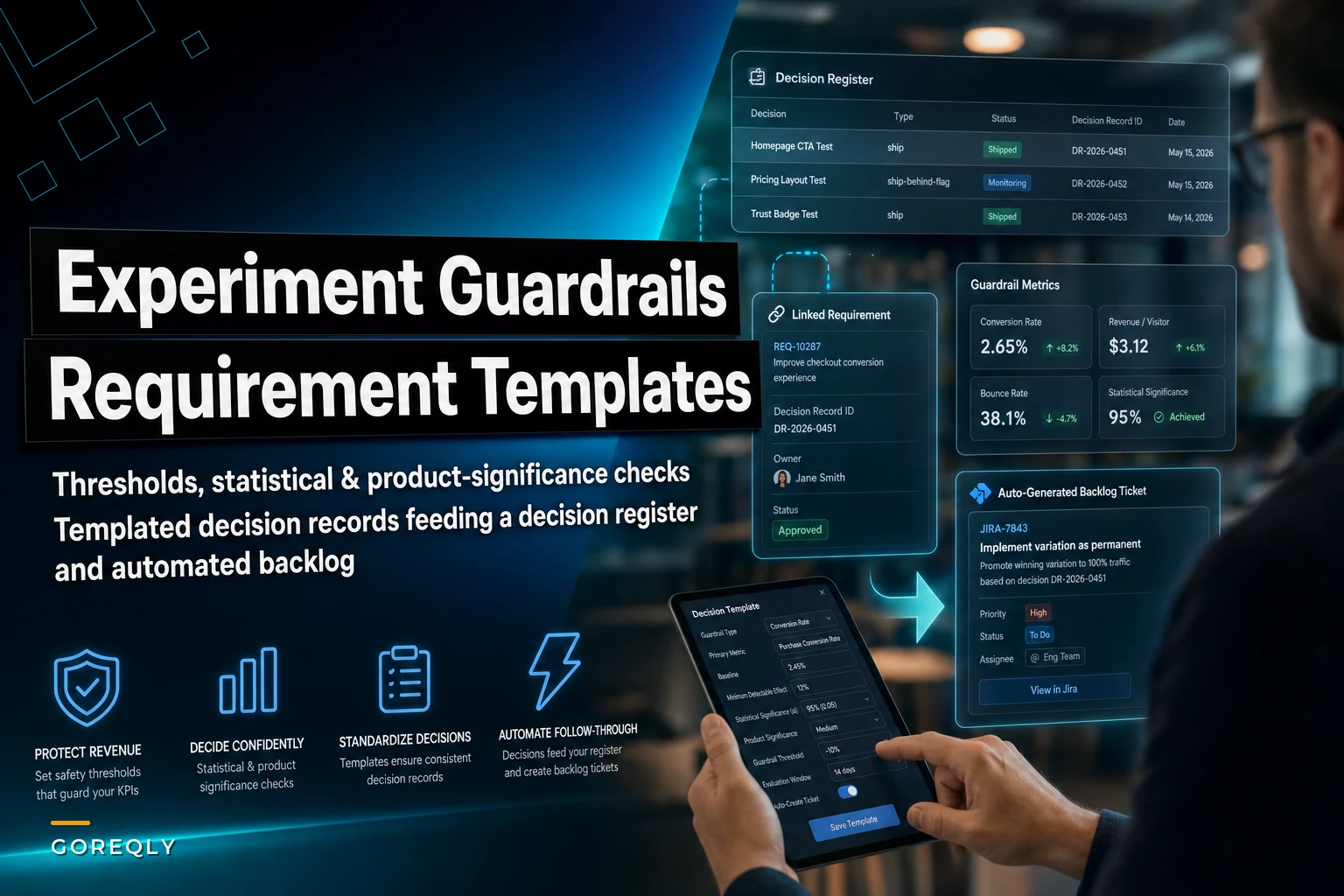

The gap where most product teams lose money isn't running the experiment. It's the handoff — the moment a winning variant becomes a requirement. That's where loose thresholds, gut-feel calls, and half-remembered Slack arguments sneak into the backlog and quietly become shipped product.
A variant lifts click-through by 1.8% with a p-value of 0.06 and 11 days of data. Someone says "close enough, let's ship it." Nobody writes down why close enough was acceptable this time. Three sprints later the feature underperforms, and the retro turns into archaeology — digging through dashboards, trying to reconstruct a decision that was never actually recorded.
This article covers one narrow thing: the guardrail layer between experiment result and committed requirement. Concrete thresholds. Statistical and product-significance checks. A templated decision record the backlog can actually consume. No broad experimentation theory, no "how to design a good A/B test." Just the boundary where results become commitments.
The two-gate problem: statistical significance is not product significance
The most common failure isn't teams ignoring statistics. It's teams treating statistical significance as the only gate.
A result can be rock-solid statistically and still be a terrible requirement. You run a test on a checkout tweak, get p < 0.01 with a massive sample, and the effect size is a 0.3% conversion lift. Real? Probably. Worth the engineering cost, the added code path, the ongoing maintenance, the cognitive load on every future PM who has to reason about that branch? Often not.
Two separate gates, checked independently:
-
Statistical gate — is the effect real, or is it noise?
-
Product gate — is the effect big enough to be worth building and maintaining?
A requirement should only clear the handoff when it passes both. Teams that collapse these into one number ship a lot of statistically-valid, operationally-pointless features.
Below is a threshold table that works well as a starting default. Adjust the numbers to your traffic and risk tolerance, but the structure is the point:
| Gate | Check | Default threshold | Hard stop if... |
|---|---|---|---|
| Statistical | p-value (or equivalent Bayesian prob) | p < 0.05 | p ≥ 0.10 → auto-reject |
| Statistical | Minimum sample / exposure | pre-registered N reached | under 80% of planned N |
| Statistical | Minimum runtime | ≥ 2 full business cycles (usually 14 days) | < 7 days regardless of significance |
| Product | Absolute effect size | ≥ your pre-set MDE | effect below MDE even if significant |
| Product | Guardrail metrics | no regression beyond tolerance | any guardrail breached |
| Product | Build-cost ratio | lift value > ~3× build+maintain cost | negative expected value |
The "hard stop" column matters more than the thresholds themselves. A hard stop removes the debate. When p ≥ 0.10, there's no meeting, no "but the trend looks promising" — it's auto-rejected and the conversation shifts to whether to re-run, not whether to ship.
The peeking problem nobody wants to admit to
The quietest killer here is early stopping. Someone checks the dashboard on day 4, sees the variant ahead, and the momentum to "just ship it" becomes irresistible. Every peek inflates your false-positive rate, and most teams peek constantly.
Make the earliest valid evaluation date an explicit, required field in the decision record so any early look is clearly labeled "monitoring only."
The fix isn't willpower. It's a rule written into the decision record itself: the earliest valid evaluation date is pre-registered before the experiment starts. If you want to look earlier, fine — but the template forces you to label that look as "monitoring only, not decision-eligible." Making that distinction explicit is what stops a day-4 glance from becoming a day-4 commitment.
What a decision record for an experiment actually needs to contain
A decision record isn't a lab report. It's the thing your backlog tool reads, your auditor trusts, and your future self searches when the feature underperforms. It has to be short enough that people actually fill it out and structured enough that it machine-reads cleanly.
Stop losing track of critical project requirements.
GoReqly helps you capture, organize, and track every requirement with precision and clarity.
- Centralized requirements repository
- Collaborative editing & commenting
- Traceability & version control
No credit card required
The minimum fields that make a record useful:
-
Experiment ID and hypothesis — one sentence, stated as a prediction, written before the test ran.
-
Pre-registered thresholds — the exact numbers from the table above, locked at start.
-
Observed result — effect size, confidence interval, p-value or posterior, actual sample, actual runtime.
-
Gate outcomes — explicit pass/fail on each gate, not a summary verdict.
-
Decision — ship / don't ship / re-run / ship-behind-flag, and who made the call.
-
Deviations — anything that didn't match the plan, and the justification.
-
Resulting requirement link — the backlog item ID this decision produced (or null).
Field 6 is the one people skip, and it's the one that saves you. Real experiments deviate. Traffic spikes, a bug corrupts three days of data, a holiday skews behavior. A record that pretends everything went to plan is a record nobody can trust. The deviation field is where honesty lives.
If you're already keeping decision records for product choices, this plugs straight into that practice — we've written separately about linking decision records to requirements as a living, searchable strategy, and experiment outcomes are just one more class of decision that belongs in that register.
Wiring the decision into the backlog so it doesn't evaporate
A decision record that lives in a Confluence page nobody reads might as well not exist. The value shows up when the record is wired — when the ship decision automatically creates (or blocks) a backlog item, and the backlog item carries the record's ID back as a link.
The wiring pattern that holds up in practice:
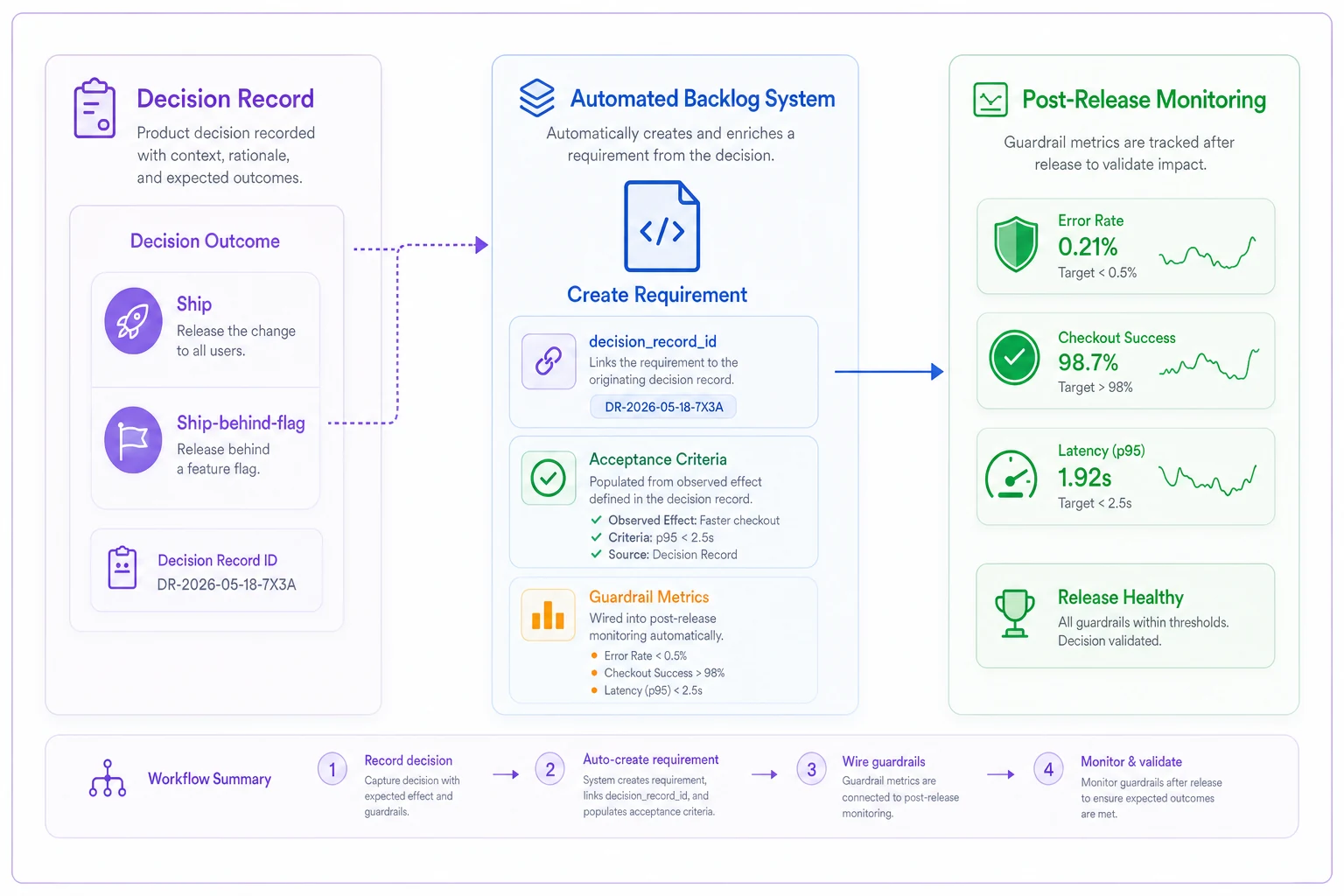
When a decision record is marked ship or ship-behind-flag:
-
A requirement/story is created in the backlog with the record ID in a custom field.
-
The acceptance criteria are pre-populated from the observed effect ("feature must preserve the measured +2.1% CTR within ±0.5% in production").
-
The guardrail metrics from the experiment become post-release monitoring criteria automatically.
When a decision record is marked don't ship or re-run:
-
No backlog item is created, but the record is tagged so the same hypothesis can't quietly get re-proposed without someone seeing the prior result.
That last point prevents one of the more expensive patterns teams fall into: re-litigating a dead experiment because nobody remembered it already failed. If the register is searchable by hypothesis, a quick check surfaces "we tried this in Q1, it failed the product gate" before anyone wastes a sprint.
A simple backlog-automation example
A mid-sized e-commerce team we looked at ran roughly 20–25 experiments a quarter. Before wiring, maybe 60% of winning experiments had a traceable path from result to shipped requirement. The rest were "we're pretty sure we built that" — unverifiable.
They set up a lightweight rule: no story could enter the "ready for dev" column if its source = experiment field was populated but the decisionrecordid field was empty. One validation rule. It forced every experiment-sourced requirement to carry its justification, or it simply couldn't move.
Here's a simple visualization of that wiring workflow.
Within two quarters, the traceable share climbed from that rough 60% into the high 90s. Nothing clever happened — the gate just refused to let undocumented experiment-features through. The discipline came from the backlog refusing to cooperate, not from people remembering to do the right thing.
A worked example, start to finish
Hypothesis (pre-registered): Adding a saved-cart reminder banner will increase return-checkout rate.
Pre-registered thresholds: p < 0.05, MDE = 1.5% absolute lift, minimum 14 days, guardrail = no increase in unsubscribe rate beyond 0.2%.
What happened: The test ran 16 days. Return-checkout rate rose 2.3% absolute, p = 0.03. Clears the statistical gate cleanly. Clears the product gate on effect size (2.3% > 1.5% MDE). But the guardrail metric — unsubscribe rate — rose 0.35%, past the 0.2% tolerance.
Under a one-gate system, this ships. The headline metric won, significantly, with a healthy effect. Under the two-gate-plus-guardrail system, it's a conditional reject: the decision record gets marked re-run with a note that banner frequency needs capping before the guardrail passes.
That guardrail breach is worth real money. A 0.35% unsubscribe bump on a large list is a durable loss of future reach, and it would've been invisible in a victory-lap retro six months later. The record captured it at the moment of decision — the only time it was cheap to catch.
The follow-up re-run capped banner frequency, landed a 1.9% lift with unsubscribe movement under tolerance, and that produced the shipped requirement — with both records linked, so the full rationale chain survived. Keeping that chain intact is the whole point. Once an experiment's reasoning is wired into the requirement it produced, you've built what we've described elsewhere as a discovery-to-requirements lifecycle that keeps the evidence usable long after the dashboard data has rolled off.
When this level of rigor makes sense — and when it's overkill
Not every experiment needs a seven-field record and a two-gate check. Forcing this on a team running two low-stakes copy tests a month will just get ignored.
When this actually makes sense:
-
You run enough experiments that undocumented decisions pile up (roughly one a week or more).
-
Experiment outcomes feed features that are expensive to build or costly to roll back.
-
You operate in a regulated or audited space where "why did you ship this" needs a real answer.
-
Multiple teams run experiments and re-litigate each other's dead hypotheses.
When it's a bad idea:
-
Early-stage product still searching for fit, where speed matters far more than traceability and you're changing direction weekly anyway.
-
Tiny teams where the person running the test is the same person shipping the code and the whole thing fits in one head.
Who should NOT bolt this on yet: teams that don't have a pre-registration habit at all. If you're not writing the hypothesis and thresholds before the experiment, adding a decision template at the end just creates post-hoc paperwork that rationalizes whatever you already decided. Fix the pre-registration first; the guardrails only work when the thresholds are locked before you see the data.
The pre-ship checklist
Before any experiment result becomes a committed requirement, run it against this:
-
[ ] Thresholds were pre-registered before the test started, not chosen after seeing results
-
[ ] Minimum runtime covered at least two full business cycles
-
[ ] Sample reached at least 80% of the planned N
-
[ ] Statistical gate passed (and wasn't the result of mid-test peeking)
-
[ ] Effect size cleared the pre-set MDE, not just statistical significance
-
[ ] Every guardrail metric stayed inside tolerance
-
[ ] Build-and-maintain cost was weighed against the measured lift
-
[ ] Deviations from plan were recorded honestly, with justification
-
[ ] A decision was logged — including "don't ship" decisions
-
[ ] The resulting backlog item carries the decision record ID (or the record is tagged as rejected)
If any box is unchecked, the result isn't ready to cross the line into a requirement. It needs another look first.
The real shift
The teams that get burned aren't the ones with bad experiments. They're the ones with good experiments and no boundary — where a promising result slides into the backlog on momentum and nobody can later explain the threshold it was supposed to clear.
Two gates instead of one. Thresholds locked before the data arrives. A short record that captures the pass, the fail, and the honest deviations. A backlog that refuses to accept experiment-sourced requirements without their rationale attached. None of this slows good decisions down — it just stops bad ones from traveling anonymously into your product, where they're expensive to find and even more expensive to unwind.
Two gates instead of one. Thresholds locked before the data arrives. A short record that captures the pass, the fail, and the honest deviations. A backlog that refuses to accept experiment-sourced requirements without their rationale attached. None of this slows good decisions down — it just stops bad ones from traveling anonymously into your product, where they're expensive to find and even more expensive to unwind.
Ready to transform your product delivery?
Join 2,000+ teams using GoReqly to improve requirements accuracy, reduce rework, and accelerate time to market.