

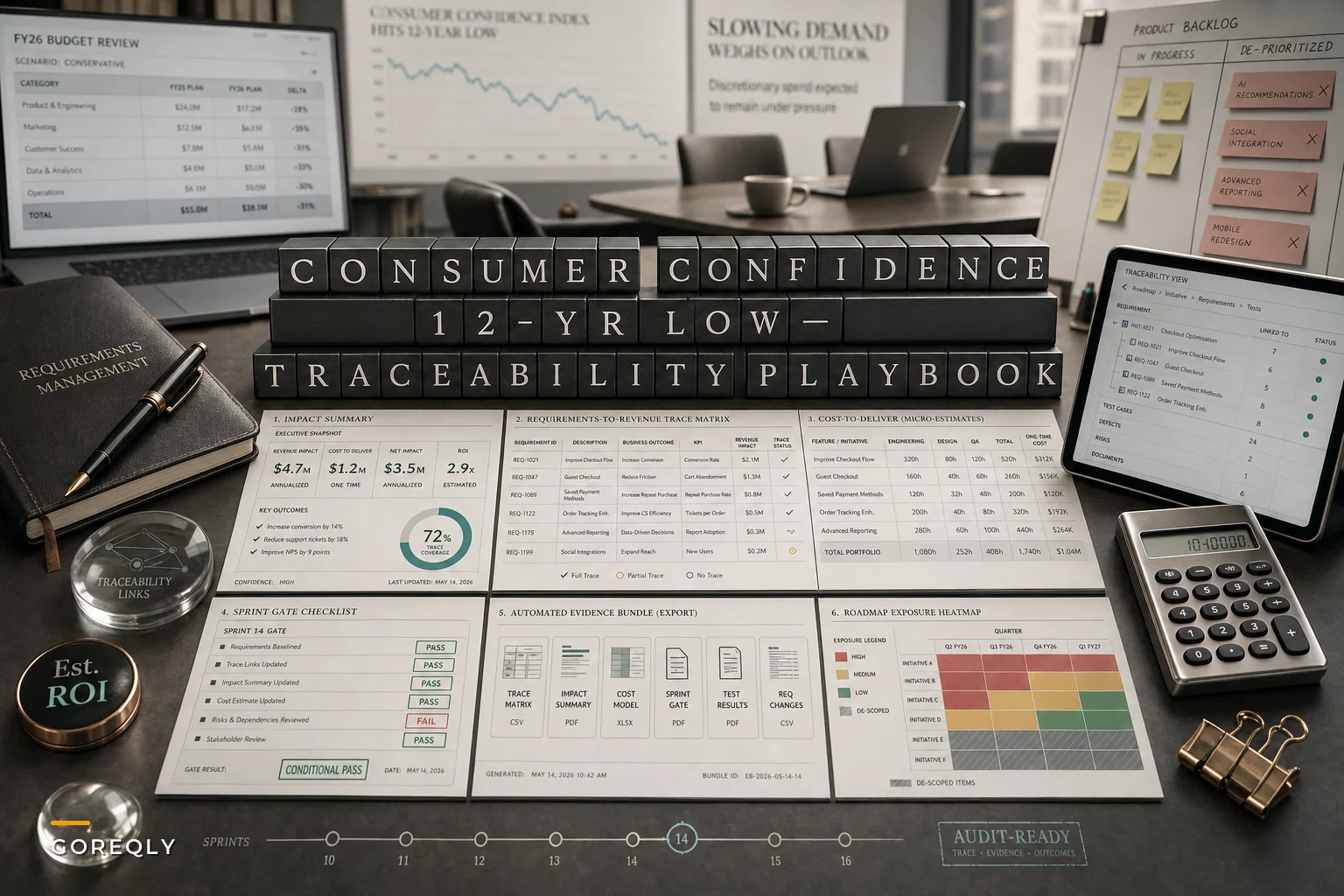

The Conference Board's September 2026 reading landed hard: the Consumer Confidence Index dropped 6.7 points to 81.9, the weakest reading since 2014. Reuters covered it as part of a broader labor-market softening story — you can read their breakdown of the September decline if you want the macro context.
If you're a PM or BA, the index number itself doesn't change your Tuesday. What changes your Tuesday is the email that lands two weeks later: "Finance is asking us to defend everything on the Q4 roadmap. Can you send over the business case for the three features we're building?"
That email is where careers and roadmaps quietly get decided. And most teams fumble it — not because their features are bad, but because they can't connect a requirement to a dollar fast enough to matter.
Why a confidence drop hits product teams before it hits revenue
There's a lag everyone forgets. Consumer confidence falling doesn't immediately dent your top line. What it does is change the psychology of the people who approve your budget.
A CFO reading the same Conference Board release starts running defensive math. Discretionary spend gets flagged. "Nice to have" becomes "prove it." Product roadmaps — which are basically a pile of bets on future value — become the easiest thing to question, because future value is inherently fuzzy.
What happens across a lot of orgs during tightening cycles is that the first casualty isn't the weakest feature. It's the feature nobody can explain quickly. A genuinely valuable initiative with no traceable link to revenue or cost reduction gets cut, while a mediocre one with a clean one-pager survives. The evidence trail wins, not the merit.
That's the uncomfortable part. Requirement traceability ROI stops being a governance nicety and becomes the thing that decides which of your work survives the quarter.
The real problem: most teams trace to tests, not to value
Most teams that think they have good traceability actually only have requirement-to-test coverage. They can prove a feature works. They cannot prove it was worth building.
Stop losing track of critical project requirements.
GoReqly helps you capture, organize, and track every requirement with precision and clarity.
- Centralized requirements repository
- Collaborative editing & commenting
- Traceability & version control
No credit card required
Those are completely different chains:
| Trace Chain | What it proves | Who cares when budgets tighten |
|---|---|---|
| Requirement → Test → Pass/Fail | The feature functions | QA, engineering |
| Requirement → Analytics Event → Usage | Someone uses it | Product |
| Requirement → Business Metric → $ Impact | It moved revenue or cut cost | Finance, execs, the people cutting budget |
Almost every team is strong on row one and weak on row three. When the "defend it" email arrives, row three is the only chain anyone asks about. You get a request framed in dollars and you answer in test pass rates. That mismatch is why good features die.
The deeper issue is that value traceability has to be built before you need it. You can't reverse-engineer the business case for a feature you shipped six months ago when nobody wrote down the hypothesis, the baseline metric, or the expected impact. The data's gone. The rationale lives in someone's memory, and that someone left in the last reorg.
A traceability chain that actually survives budget scrutiny
"Link requirements to revenue" is easy to say and annoying to operationalize. So here's what a value-oriented trace link actually looks like in practice.
-
Requirement carries an explicit hypothesis
annual-plan abandonment is ~22%, we believe a simplified payment step cuts it by 4–6 points.
-
Baseline metric is captured and dated before the work starts, not estimated afterward.
-
Analytics events are specified as part of the requirement — the exact events that will prove or disprove the hypothesis.
-
Business metric link ties those events to a revenue line
5 points of abandonment on annual plans is worth roughly $40k–$55k a quarter at your current traffic.
-
Decision record states what happens if it works and what happens if it doesn't.
When finance asks, you're not scrambling. You hand over a chain that goes requirement → hypothesis → baseline → live usage → dollar impact, with a decision already attached. That's a defensible roadmap item. The feature two desks over that has none of this is the one that gets cut.
The order matters. The baseline has to be captured before work begins. Teams that skip step two are the ones who later say "we think it helped" — which, in a tightening quarter, reads to finance as "we have no idea."
When this level of rigor makes sense — and when it doesn't
Not every requirement deserves a full value-trace chain. Trying to attach a revenue model to a bug fix or an internal tooling tweak is how you burn your BAs out and make the whole practice feel like theater.
Build the full value chain when:
-
The feature represents real engineering investment (multiple sprints)
-
It's customer-facing and tied to acquisition, retention, or conversion
-
It's the kind of thing a CFO would recognize by name
-
You'd struggle to defend it in a 15-minute budget review
Keep it lightweight when:
-
It's compliance or security work where the "why" is non-negotiable anyway
-
It's a small fix with obvious, bounded value
-
The cost of measuring exceeds the cost of just doing it
Who should NOT go all-in on this right now: early-stage teams still searching for product-market fit. If you're pre-fit, forcing a revenue trace on every requirement slows discovery and gives you false precision on numbers that don't mean much yet. Rough directional evidence is fine at that stage. The heavy machinery is for teams defending established roadmaps under scrutiny — which is exactly who gets squeezed when confidence indices slide.
A fast triage playbook for the "defend it" email
When the budget-pressure request lands, you usually have days, not weeks. A compressed workflow that holds up under time pressure:
-
Pull the roadmap list and tag each item
has value trace / partial / none.
-
Triage by exposure — which items are most likely to be questioned first? Usually the expensive, customer-facing ones.
-
For items with full traces, assemble the one-pager
hypothesis, baseline, current data, projected impact, decision rule.
-
For partial-trace items, backfill the fastest available evidence — usage data beats nothing, even if you can't get to dollars.
-
For no-trace items, make an honest call
either rapidly construct a defensible case or voluntarily flag them for review before finance does it for you.
-
Bundle everything into a consistent format so reviewers aren't decoding five different layouts.
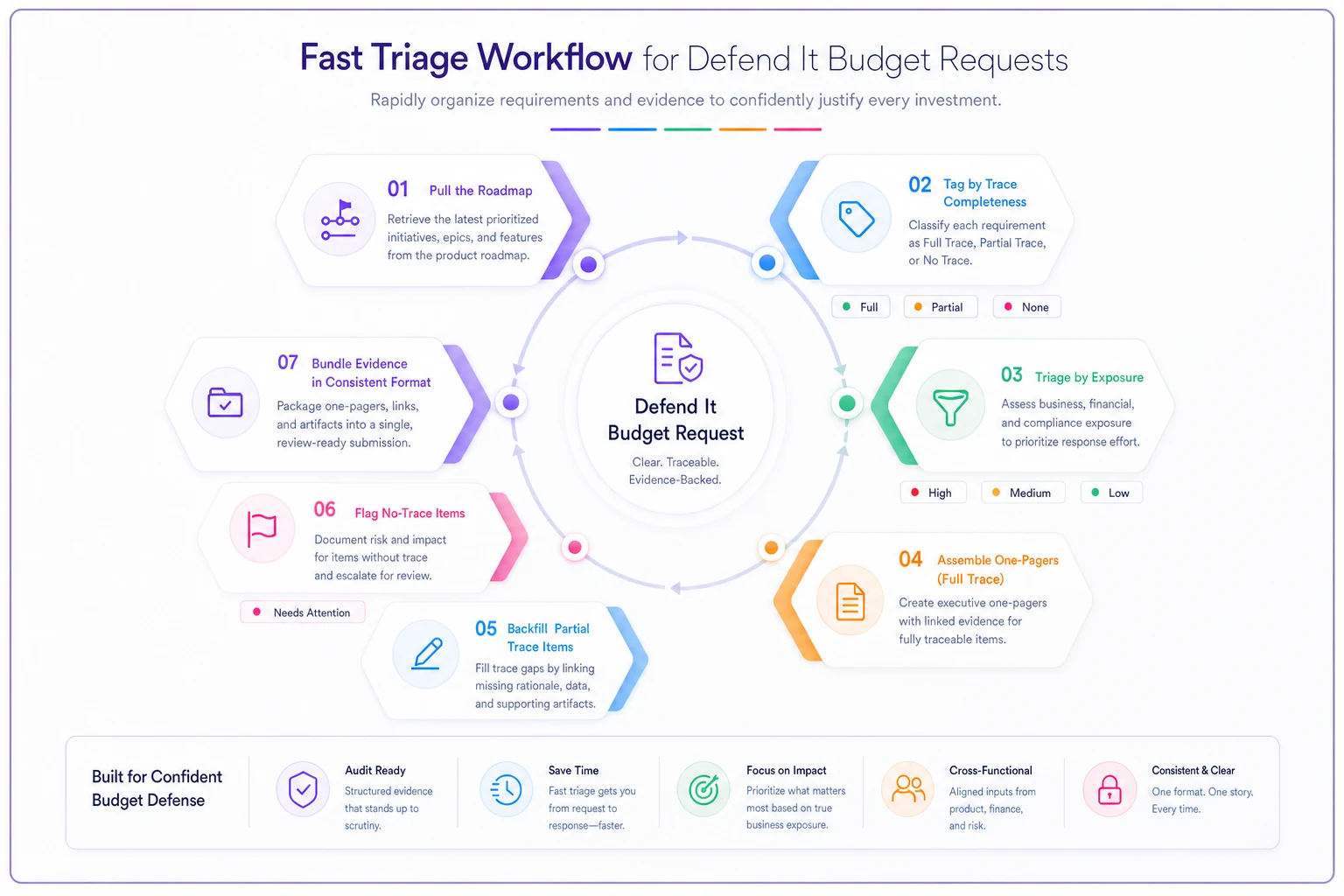
That last point is underrated. When every feature's evidence looks different, reviewers default to cutting, because inconsistency reads as weakness. A uniform evidence format signals a team that has its act together, and that perception alone saves features.
A real scenario
A product team at a roughly 60-person B2B software company went into Q4 2026 with eight roadmap items and a finance team suddenly asking for justification on all of them after the confidence numbers hit the news.
Four of the eight had been built the normal way — good test coverage, no value traceability. The other four had hypotheses, baselines, and analytics links attached from the start because the lead BA had insisted on it earlier that year.
The four traceable items were defended in a single 40-minute meeting. The other four took nearly three weeks of back-and-forth, two got deferred to 2027, and one was cut outright. The deferred features weren't worse — one was arguably the strongest idea in the batch. It just couldn't be defended fast enough.
The team's own retro noted that the cut feature's projected impact was probably somewhere in the $30k–$50k range, lost largely because nobody had written down a baseline eight weeks earlier. The lesson they took away wasn't "measure everything." It was: the evidence has to exist before the pressure arrives.
Where this connects to governance
Doing this per-feature, per-crisis is exhausting and doesn't scale. The teams that handle budget pressure calmly are the ones who wired value evidence into their investment process ahead of time — so a feature can't even reach the roadmap without a basic hypothesis and a metric attached.
That's less about any single trace link and more about how your portfolio gates are designed. If you want the structural version — tying funding decisions to requirement evidence so that defensibility is built in rather than bolted on under duress — the approach in portfolio requirements governance that ties investment gates to requirement evidence covers how to make evidence a condition of investment rather than an afterthought.
The gate does the hard work up front so you're not doing it reactively when the macro headlines turn.
Tooling, briefly and honestly
You can run a lot of this in whatever you already use. A spreadsheet of hypotheses and baselines beats nothing, and plenty of teams start there. The friction shows up when traces live in five disconnected places: the requirement in one tool, the baseline in a spreadsheet, the analytics in a dashboard, the decision in a Slack thread nobody can find.
A spreadsheet of hypotheses and baselines beats nothing.
That's where an operational platform that keeps requirements, their linked analytics events, and decision records in one connected chain earns its keep — not because it's fancy, but because when the email lands, you pull one view instead of reconstructing a story from six sources. AI-assisted tooling can help by flagging which requirements are missing baselines or value links before a quarter goes sideways, so gaps surface during planning rather than during an audit. The point isn't the automation. It's that the evidence is already assembled when you need it.
The takeaway
A falling confidence index — the official framing is in the Conference Board's own consumer confidence release — isn't really the story for product teams. It's the trigger that turns a slow-burning weakness into an urgent one.
The weakness is that most roadmaps are built on value that was never written down, measured, or linked to a dollar. The teams that come through tightening quarters intact aren't the ones with the best features. They're the ones who can connect a requirement to an outcome in minutes, with evidence that was captured before anyone asked. Build that chain now, while nobody's forcing you to, and the next defensive-budget email becomes a 40-minute meeting instead of a three-week fight over which of your work gets to live.
A falling confidence index — the official framing is in the Conference Board's own consumer confidence release — isn't really the story for product teams. It's the trigger that turns a slow-burning weakness into an urgent one.
The weakness is that most roadmaps are built on value that was never written down, measured, or linked to a dollar. The teams that come through tightening quarters intact aren't the ones with the best features. They're the ones who can connect a requirement to an outcome in minutes, with evidence that was captured before anyone asked. Build that chain now, while nobody's forcing you to, and the next defensive-budget email becomes a 40-minute meeting instead of a three-week fight over which of your work gets to live.
Ready to transform your product delivery?
Join 2,000+ teams using GoReqly to improve requirements accuracy, reduce rework, and accelerate time to market.