

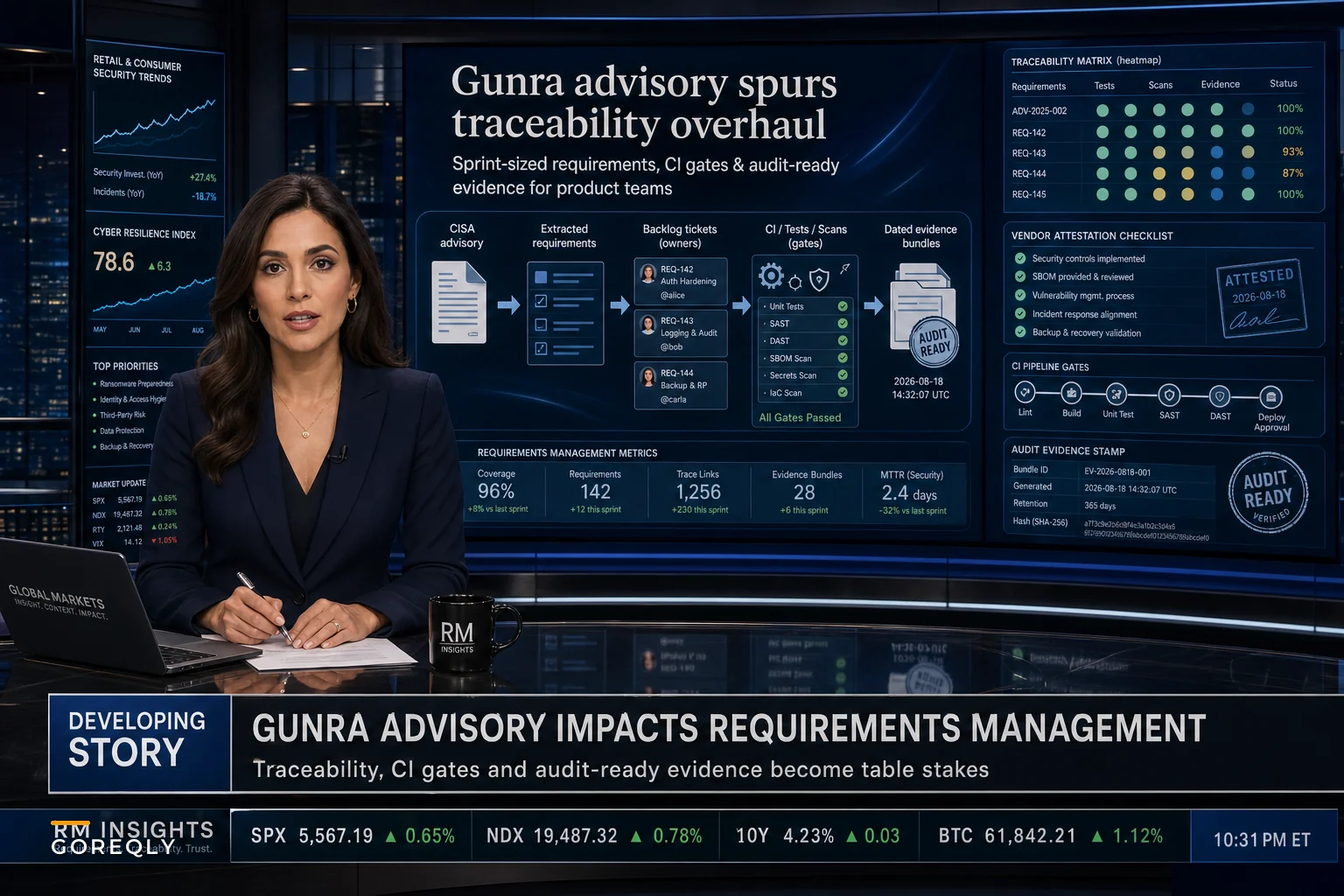

When CISA and the FBI pushed out their joint advisory on the Gunra ransomware strain on August 10, you could almost hear procurement teams across the country scrambling to re-open vendor risk questionnaires. A few days earlier, Reuters had already flagged a broader surge in AI-driven attacks against U.S. companies, and the Gunra advisory itself laid out indicators of compromise and mitigation steps in the usual dense, technical format.
The problem most product and BA teams run into: an advisory like this lands, security forwards it to engineering, engineering skims it, and then nothing traceable happens. Controls get discussed in a Slack thread, maybe a ticket or two gets filed, and three months later when a customer's security team asks "show me how you responded to Gunra," nobody can produce a clean line from advisory → requirement → test → evidence.
That gap — between "we're aware of the threat" and "we can prove what we did about it" — is the real subject of this piece. Not the malware. The traceability.
Why an advisory is actually a requirements event (not a security event)
Most teams treat a ransomware advisory as something that lives entirely inside the security org. That's the first mistake. An advisory is a change trigger. It introduces new expectations about how your product behaves, how your vendors attest, and how fast you can recover. Those are requirements — mostly non-functional ones — and they need owners, acceptance criteria, and evidence like anything else in your backlog.
The pattern you see in teams that handle this badly: the advisory gets absorbed as tribal knowledge. Someone senior reads it, mentally maps it to "yeah, we already have MFA and backups," and moves on. No artifact gets created. When the same threat resurfaces in a customer audit or a regulator's questionnaire six months later, the team is reconstructing their response from memory and old Jira comments.
| Response style | What gets produced | What happens at audit time |
|---|---|---|
| Advisory-as-security-event | Slack discussion, ad-hoc tickets, mental notes | Reconstruct response from memory, scramble for evidence |
| Advisory-as-requirements-event | Linked requirements, acceptance criteria, test/scan evidence | Pull a pre-built trace from control to proof in minutes |
The second column is the whole game. Ransomware traceability isn't about having more security controls — it's about being able to prove, on demand, that a specific threat drove a specific requirement, which drove a specific test and a specific piece of evidence.
The underlying problem: security requirements live outside your requirement system
Here's what actually breaks. Functional requirements live in your backlog. Security controls live in a spreadsheet, a GRC tool, or a policy document that hasn't been touched since the last SOC 2 cycle. These two worlds don't share IDs, owners, or lifecycle events.
Stop losing track of critical project requirements.
GoReqly helps you capture, organize, and track every requirement with precision and clarity.
- Centralized requirements repository
- Collaborative editing & commenting
- Traceability & version control
No credit card required
So when Gunra drops and you decide "we need to validate our backup restoration path and confirm we can detect lateral movement," those decisions get logged in the security world. Meanwhile, the actual engineering work — the ticket that implements backup integrity checks, the test that validates restore time — lives in the product world. The link between them is a human who remembers both.
In practice, this breaks down at exactly the wrong moment: during an actual incident or an urgent customer review, when the person who held the connection in their head is on PTO or has left the company.
-
A control is marked "implemented" in the GRC tool, but the corresponding code was reverted two sprints later and nobody updated the control status.
-
A vendor attestation exists, but there's no link showing which of your requirements depends on that vendor meeting it.
-
An incident response runbook references detection capabilities that were never actually tested against a realistic scenario.
Each of these is a traceability gap, and each one turns into hours of manual archaeology when scrutiny hits.
Turning the Gunra advisory into sprint-ready requirements
Here's a workable process for converting an advisory into traceable, sprint-sized work. This isn't theoretical — it's the sequence that separates teams who respond cleanly from teams who panic.
-
Extract control-relevant statements from the advisory. Gunra's advisory, like most, lists mitigations: things like phishing-resistant MFA, network segmentation, tested backups, and monitoring for specific behaviors. Pull each mitigation out as a candidate requirement. Don't editorialize yet — just extract.
-
Map each candidate against what you already have. For each one, mark it as already covered and evidenced, claimed but unverified, or gap. The middle category is where most teams get burned — you think you have it, but you can't prove it.
-
Write the "unverified" and "gap" items as NFRs with acceptance criteria. "Backups exist" is not a requirement. "Production database can be restored to a point within the last 4 hours, validated by a quarterly restore drill with logged results" is. The acceptance criteria must be testable and produce evidence.
-
Assign owners and link to the source. Every new requirement gets a trace link back to the advisory that triggered it. This is the step everyone skips, and it's the one that makes the audit trivial later.
-
Wire each requirement to a test or scan. MFA enforcement → an automated check. Segmentation → a network scan result. Restore capability → a drill log. If a requirement can't be tied to something runnable or repeatable, it's aspirational, not real.
-
Close the loop on remediation. When a scan fails or a drill misses its target, the remediation ticket links back to the requirement, which links back to the advisory. Now the whole chain is navigable in both directions.
The output of this process isn't a document. It's a set of connected artifacts where you can start from "Gunra" and walk forward to a passing test result, or start from a failing scan and walk backward to understand which threat it originally addressed.
Include the advisory URL and the advisory date in the requirement so the trace link is unambiguous.
A quick visual can make it obvious to non-security folks how the pieces connect.
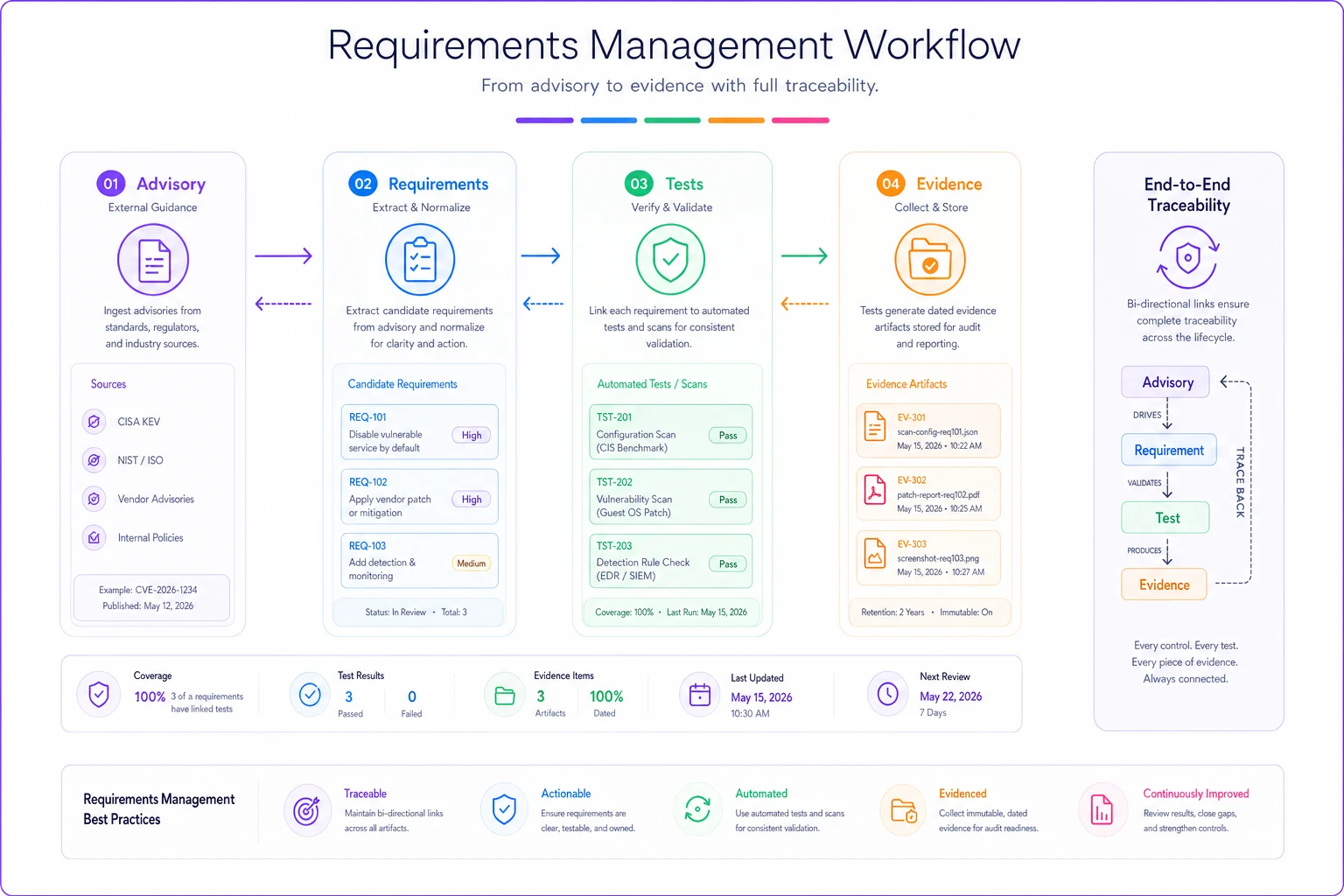
The output of this process isn't a document. It's a set of connected artifacts where you can start from "Gunra" and walk forward to a passing test result, or start from a failing scan and walk backward to understand which threat it originally addressed.
A real scenario: the mid-size SaaS vendor mid-audit
Consider a B2B SaaS company — maybe 40 engineers, selling into healthcare-adjacent customers. When the ransomware surge hit the news, two of their enterprise customers sent emergency security questionnaires within a week. The kind with a 10-business-day turnaround and roughly 120 questions each.
Before they'd fixed their traceability, this situation would have eaten a senior engineer and a PM for the better part of two weeks. Their previous questionnaire response took somewhere around 60–70 hours of scattered effort, and about a third of the answers were "we believe we do this" hedges because nobody could locate proof quickly.
The difference the second time around came down to linkage. Because they'd started tying security requirements to actual test and scan evidence, roughly 70% of the questionnaire answers could be sourced directly — "here's the requirement, here's the control, here's the last passing scan dated within the quarter." The response effort dropped to something closer to 20 hours, and the hedge-answers mostly disappeared. One of the two customers specifically noted the speed and specificity of the evidence in their vendor review.
Nothing magical happened. They didn't buy more security tools. They just made the connection between requirement and evidence durable instead of leaving it in someone's head.
The evidence layer is where most teams underinvest
Requirements are easy to write. Evidence is the hard part, because evidence has a shelf life. A passing scan from eight months ago tells an auditor almost nothing. Teams that do this well treat evidence as a living stream tied to the requirement — not a one-time attachment.
This is the muscle we covered in more depth in the piece on building a lightweight compliance-ready requirements traceability model — the core idea being that traceability only pays off if the links stay fresh as the system changes. A ransomware advisory just raises the stakes on that same principle, because the questions arrive faster and the tolerance for hedging is lower.
Where AI-assisted operational tooling genuinely helps — and this deserves only a brief mention because it's not the point of the article — is in the tedious upkeep. Watching for stale evidence, flagging when a control's linked scan hasn't run in the last quarter, drafting the first pass of requirements from an advisory's mitigation list. That's the kind of grunt work that quietly rots when left to manual effort, and it's where automation actually earns its keep rather than just adding noise.
A quick checklist before your next advisory lands
You don't want to be building this muscle during an incident. Run through this while things are calm:
-
[ ] Every security control has a stable ID that your requirement artifacts can reference.
-
[ ] Each control links to at least one piece of dated evidence (scan, test, drill log, attestation).
-
[ ] You can navigate from a threat/advisory to the requirements it triggered, and back.
-
[ ] Vendor attestations are linked to the specific requirements that depend on them.
-
[ ] Someone other than the original author can find and interpret the evidence.
-
[ ] Stale evidence gets flagged automatically, not discovered during an audit.
If you can't check off at least the first four, your next questionnaire or audit will cost you far more time than it should.
When this level of rigor makes sense — and when it doesn't
Not every team needs to industrialize this. A two-person startup with three customers and no compliance obligations should not be building formal advisory-to-requirement traceability — they should be patching things and moving on. The overhead would outweigh the benefit.
This work starts paying off when you have real customer scrutiny, regulatory exposure, or you've grown past the point where one person can hold the whole security posture in their head. That's usually somewhere around 20–30 engineers, or the first serious enterprise contract, whichever comes first.
Worth saying clearly: this is not for teams that would use "we need better traceability" as an excuse to stall shipping. The goal is faster, more confident responses to scrutiny — not a bureaucratic layer that slows delivery. If your traceability process is generating more meetings than evidence, you've built the wrong thing.
Where to start Monday
Pick the last advisory or security questionnaire that hit your team and reverse-engineer it. For each thing you claimed you did, ask: could I produce dated evidence in under five minutes? Wherever the answer is no, you've found your first traceability gap.
The threat landscape isn't slowing down, and advisories like Gunra are going to keep landing with tighter response windows and less patience for hand-waving. The teams that come out of this well aren't the ones with the most security tools — they're the ones who treated each advisory as a requirements event, wired their controls to living evidence, and made the whole chain something anyone on the team could walk through without a tour guide.
The threat landscape isn't slowing down, and advisories like Gunra are going to keep landing with tighter response windows and less patience for hand-waving. The teams that come out of this well aren't the ones with the most security tools — they're the ones who treated each advisory as a requirements event, wired their controls to living evidence, and made the whole chain something anyone on the team could walk through without a tour guide.
Ready to transform your product delivery?
Join 2,000+ teams using GoReqly to improve requirements accuracy, reduce rework, and accelerate time to market.