



Your microservices look clean on the architecture diagram. Each service has clear boundaries, defined responsibilities, and a dedicated team. The product requirements flow in, stories get written, development starts. Three sprints later, integration testing reveals a mess — services expecting different data formats, conflicting ownership assumptions, and acceptance criteria that passed individually but fail together.
The problem isn't your architecture. It's that your requirement patterns don't match your service topology.
Teams write requirements the same way they did for monoliths — one big pool of user stories with acceptance criteria focused on end-to-end functionality. Meanwhile, the actual software architecture demands service-specific requirements with explicit contracts between boundaries.
The disconnect creates operational chaos that compounds over time.
Service boundaries need requirement boundaries
Most product teams still write requirements like they're building a single application. A typical user story might read: "As a customer, I want to update my shipping address so my orders arrive at the correct location."
Seems straightforward. The acceptance criteria probably includes validation rules, UI behavior, and confirmation messages. Development assigns it to the customer service team. They build it, test it, mark it done.
In a microservice architecture, that single story actually touches:
-
Customer service (profile management)
-
Order service (shipping destination)
-
Notification service (confirmation emails)
-
Inventory service (warehouse routing)
-
Payment service (fraud check on address changes)
Each service team interprets the requirement through their own lens. Customer service thinks they own the address. Order service believes they maintain shipping data. Nobody explicitly defined the contracts between services, so each team makes reasonable but incompatible assumptions.
The integration tests fail. Teams point fingers. Rework begins.
Contract-test patterns that prevent integration disasters
Traditional acceptance criteria focus on behavior: "When the user clicks save, the address updates and a confirmation appears." That works for monoliths. Microservices need contract-focused acceptance criteria that define the exact data flowing between services.
Stop losing track of critical project requirements.
GoReqly helps you capture, organize, and track every requirement with precision and clarity.
- Centralized requirements repository
- Collaborative editing & commenting
- Traceability & version control
No credit card required
Standard acceptance criteria:
-
User enters valid address
-
System validates format
-
Address saves successfully
-
Confirmation message appears
Contract-focused acceptance criteria:
``
Customer Service publishes AddressUpdated event:
{
  customerId: string (UUID),
  timestamp: ISO-8601,
  address: {
    line1: string (max 100 chars),
    line2: string (optional, max 100 chars),
    city: string (max 50 chars),
    state: string (2-char code),
    postal: string (regex: ^\d{5}(-\d{4})?$)
  },
  changeType: enum ["billing", "shipping", "both"]
}

Order Service consumes and responds within 500ms
Payment Service validates within 2 seconds
Notification Service acknowledges receipt
``
The contract-focused approach forces teams to agree on data structures before writing code. It makes integration testing deterministic. It eliminates the "but it works on my service" arguments.
Ownership rules that scale with team growth
Service ownership gets messy fast. A medium-sized e-commerce platform might have 30-40 microservices. Each needs an owner, but ownership means different things to different teams.
Some teams think ownership means they control everything about their service. Others believe it means they're responsible when things break. Neither interpretation works at scale.
Data ownership pattern: The service that creates data owns its canonical form. Other services can cache or transform it, but the source service defines the structure and validation rules. Customer service owns customer profiles. Order service can store customer names for display, but any validation or format requirements come from customer service's contract.
Process ownership pattern: The service that initiates a workflow owns its completion criteria. Participating services own their step-specific requirements. Order service owns the checkout process. Payment service owns payment validation requirements. Inventory service owns stock verification rules. Order service defines when the overall process succeeds or fails.
Event ownership pattern: The service that publishes an event owns its schema. Consuming services own their reaction requirements. Inventory service publishes StockDepleted events. The event structure belongs to inventory. How order service responds (blocking new orders, notifying customers) belongs to order service. These patterns eliminate around 70% of integration conflicts before they happen.
Integration acceptance criteria that actually integrate
Standard acceptance criteria verify that features work. Integration acceptance criteria verify that services work together. Most teams skip this distinction and pay for it during deployment.
Consider a product search feature. Traditional acceptance criteria might specify search accuracy, response time, and result formatting. But in a microservice architecture, you need integration-specific criteria:
Service interaction criteria:
-
Search service calls product service with max 3 retries
-
Product service responds within 200ms for 95% of requests
-
Cache service updates within 5 seconds of product changes
-
If product service fails, search returns cached results with "possibly outdated" flag
Data consistency criteria:
-
Product updates propagate to search index within 30 seconds
-
Inventory changes reflect in search filters within 10 seconds
-
Price updates sync across all services within 5 seconds
-
Partial updates don't create inconsistent states
Failure handling criteria:
-
Each service degrades gracefully when dependencies fail
-
Error messages include service correlation IDs
-
Timeouts trigger before user-facing delays
-
Circuit breakers activate after 5 consecutive failures
These criteria turn vague "services should work together" requirements into testable specifications.
Real patterns from production deployments
A financial services platform struggled with requirement misalignment across 12 microservices. Their monolithic legacy system had 3,000+ requirements documented in traditional format. The microservice migration stalled repeatedly due to integration failures.
They implemented three specific patterns:
1. Requirement decomposition matrix
| Business Requirement | Services Involved | Contract Owner | Integration Points |
|---|---|---|---|
| Calculate loan eligibility | Credit Service, Income Service, Risk Service | Risk Service | Credit score API, Income verification webhook, Risk decision event |
| Process payment | Payment Service, Ledger Service, Notification Service | Payment Service | Payment initiation, Transaction recording, Confirmation dispatch |
| Generate statements | Account Service, Transaction Service, Document Service | Document Service | Account details API, Transaction history query, PDF generation |
2. Service boundary checklist
-
Which service owns the primary data?
-
Which services consume the data?
-
What's the canonical data format?
-
Who defines validation rules?
-
What happens when services disagree?
-
How do updates propagate?
-
What's the failure recovery path?
3. Cross-service acceptance template
``
Given: [Service A state]
When: [Service B action]
Then: [Service A response]
And: [Service C side effect]
Within: [Time constraint]
Unless: [Failure condition]
``
After implementing these patterns, their integration test failures dropped from around 60% to under 15%. More importantly, when integration issues did occur, teams could trace them to specific requirement gaps rather than arguing about interpretations.
Common requirement antipatterns in microservices
Certain requirement styles consistently create problems in distributed architectures:
The monolithic story: "As a user, I want to complete my entire purchase process smoothly." This requirement spans multiple services but doesn't acknowledge it. Teams implement their piece without considering service interactions.
The assumption-heavy criteria: "System should validate all inputs appropriately." Each service team defines "appropriate" differently. Customer service allows international addresses. Payment service doesn't. Integration fails.
The performance hand-wave: "Response time should be fast." In microservices, you need specific latency budgets per service. "Fast" means nothing when you're coordinating six services in a single user action.
The silent dependency: "Order status updates when payment completes." Sounds simple until you realize order service doesn't know when payment service finishes processing. Nobody specified the event or API contract.
Building contract-first requirement workflows
The most successful microservice teams flip their requirement process. Instead of starting with user stories and decomposing to services, they start with service contracts and build up to user stories.
Workflow that actually scales:
-
Define service capabilities
Each service team documents what data they own and what operations they support. This becomes the service's "requirement interface."
-
Map user journeys to services
Product managers identify which services participate in each user journey. They don't write requirements yet — just map the flow.
-
Specify contracts
For each service interaction, teams define the exact contract — request format, response format, error conditions, timing constraints.
-
Write bounded requirements
Only now do teams write user stories. Each story explicitly states which services it affects and references the relevant contracts.
-
Create integration tests first
Before implementing features, teams write integration tests based on the contracts. This catches requirement gaps before development starts.
Start with contracts for high-risk flows first to minimize upfront work.
A logistics platform used this approach for their delivery tracking feature. Instead of a vague "customers can track packages" requirement, they produced:
-
4 service capability documents
-
7 inter-service contracts
-
12 service-specific user stories
-
23 contract tests
-
0 integration failures at deployment
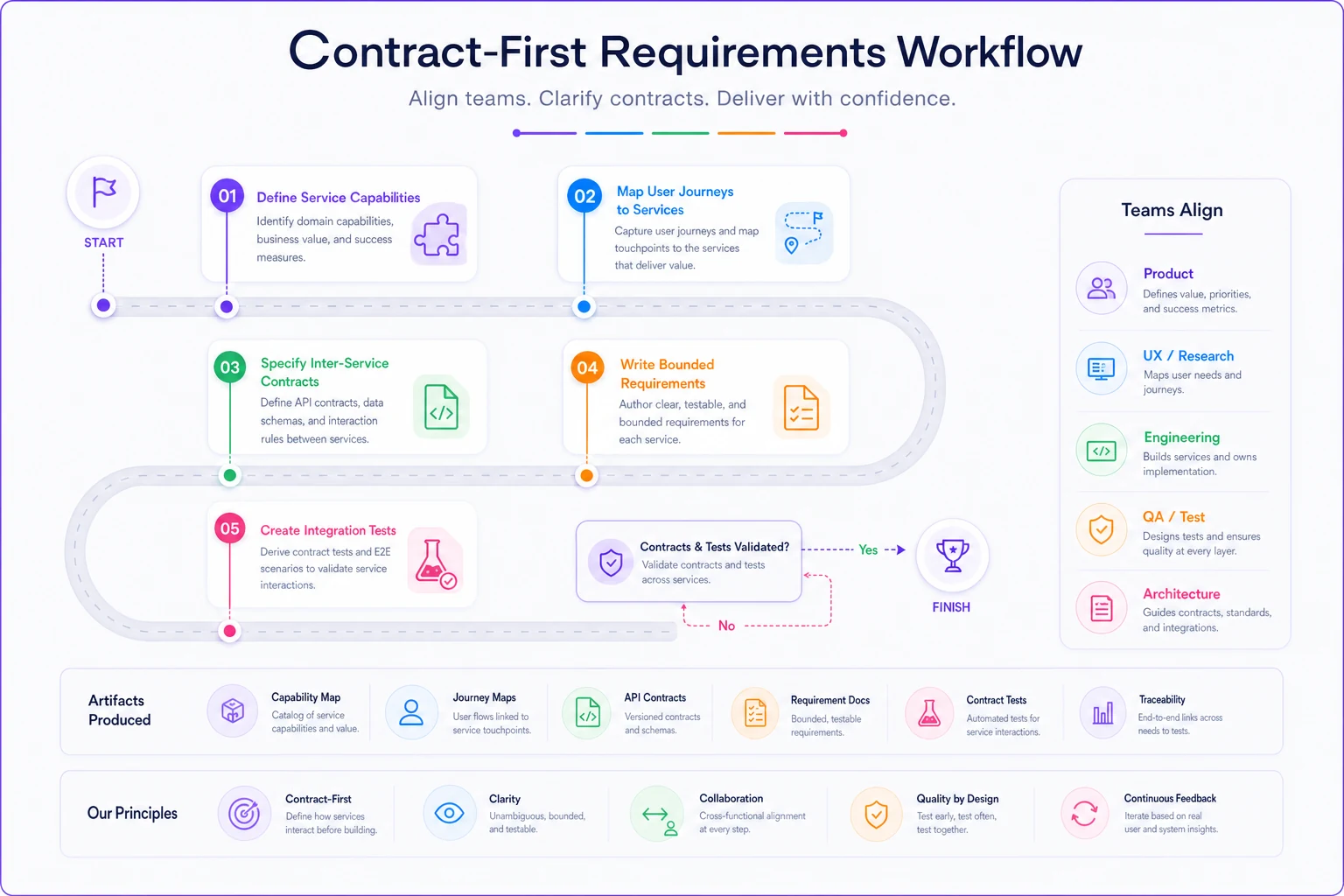
The diagram visualizes the contract-first workflow.
The upfront specification work took an extra week. It saved them roughly six weeks of integration debugging and rework.
When to break the patterns
Not every requirement needs military-grade specification. Some situations benefit from flexibility:
Experimental features: When you're testing market fit, strict contracts slow iteration. Use loose contracts with version tags, plan to solidify them once the feature proves valuable.
Internal tools: Services used only by internal teams can tolerate more ambiguity. Document the happy path, handle edge cases as they emerge.
Read-only operations: Services that only query data need less rigorous contracts than those modifying state. Focus contract efforts on write operations.
Single-team services: If one team owns all services in a flow, they can coordinate informally. Still document contracts, but skip the formal review cycles.
The key is conscious deviation. Break patterns deliberately, not accidentally.
Acceptance criteria templates for service boundaries
Generic acceptance criteria templates don't work for microservices. You need templates that acknowledge distributed system realities:
``
Given: Service A has state X
When: Event Y occurs
Then: Service B reaches state Z
Within: [time limit]
Verified by: [specific check]
``
``
Given: Service A fails
When: Service B attempts operation
Then: Service B [fallback behavior]
And: User sees [degraded experience]
But: No data corruption occurs
``
``
Given: Update to Service A
Eventually: Service B reflects change
Within: [consistency window]
Unless: [failure condition]
Recovery: [reconciliation process]
``
The compound cost of misaligned requirements
Poor requirement patterns in microservices create compound costs:
Immediate costs:
-
Integration test failures (around 3-5 hours per incident)
-
Debugging service interactions (2-3 days per major issue)
-
Requirement clarification meetings (6-8 hours per sprint)
Accumulated costs:
-
Service coupling from workarounds
-
Technical debt from quick fixes
-
Team friction from repeated conflicts
-
Slower feature velocity over time
A mid-sized SaaS platform tracked these costs over six months. Teams spending less than 10% of their time on requirement alignment spent 35% on integration issues. Teams investing 15-20% in upfront requirement patterns spent under 10% on integration problems. The math is clear: proper requirement patterns pay for themselves within two sprints.
Modern tooling for microservice requirements
Managing distributed requirements manually becomes impossible beyond a handful of services. Modern platforms help teams maintain requirement patterns at scale.
AI-powered operational software can map requirements to service boundaries automatically, flag potential contract conflicts before development starts, and generate integration test scenarios from requirement patterns. These platforms understand microservice architectures and enforce consistent requirement patterns across teams.
The automation handles routine contract validation while teams focus on business logic. It's particularly valuable for organizations migrating from monoliths — the software can decompose existing requirements into service-appropriate patterns, saving months of manual analysis.
These tools maintain living documentation. As services evolve, the requirement patterns update automatically. Contract changes trigger impact analysis. Integration criteria stay synchronized with actual service behavior.
Microservice requirements need microservice thinking
The shift from monolithic to microservice architecture demands an equal shift in requirement thinking. You can't decompose a monolith into services while keeping monolithic requirement patterns.
Success requires service-bounded requirements from the start, explicit contracts in acceptance criteria, clear ownership rules that scale, integration-first testing approaches, templates that acknowledge distribution, and tools that enforce patterns consistently.
Teams that nail these patterns spend roughly 80% less time on integration issues. They deploy faster, with more confidence, and less finger-pointing when things go wrong.
The investment in proper requirement patterns feels heavy upfront. The alternative — endless integration debugging, service coupling, and team friction — costs far more in the long run. Your microservices architecture is only as clean as the requirements that define it. Get the patterns right, and the services follow. Get them wrong, and no amount of architectural elegance will save you from integration chaos.
Ready to transform your product delivery?
Join 2,000+ teams using GoReqly to improve requirements accuracy, reduce rework, and accelerate time to market.