

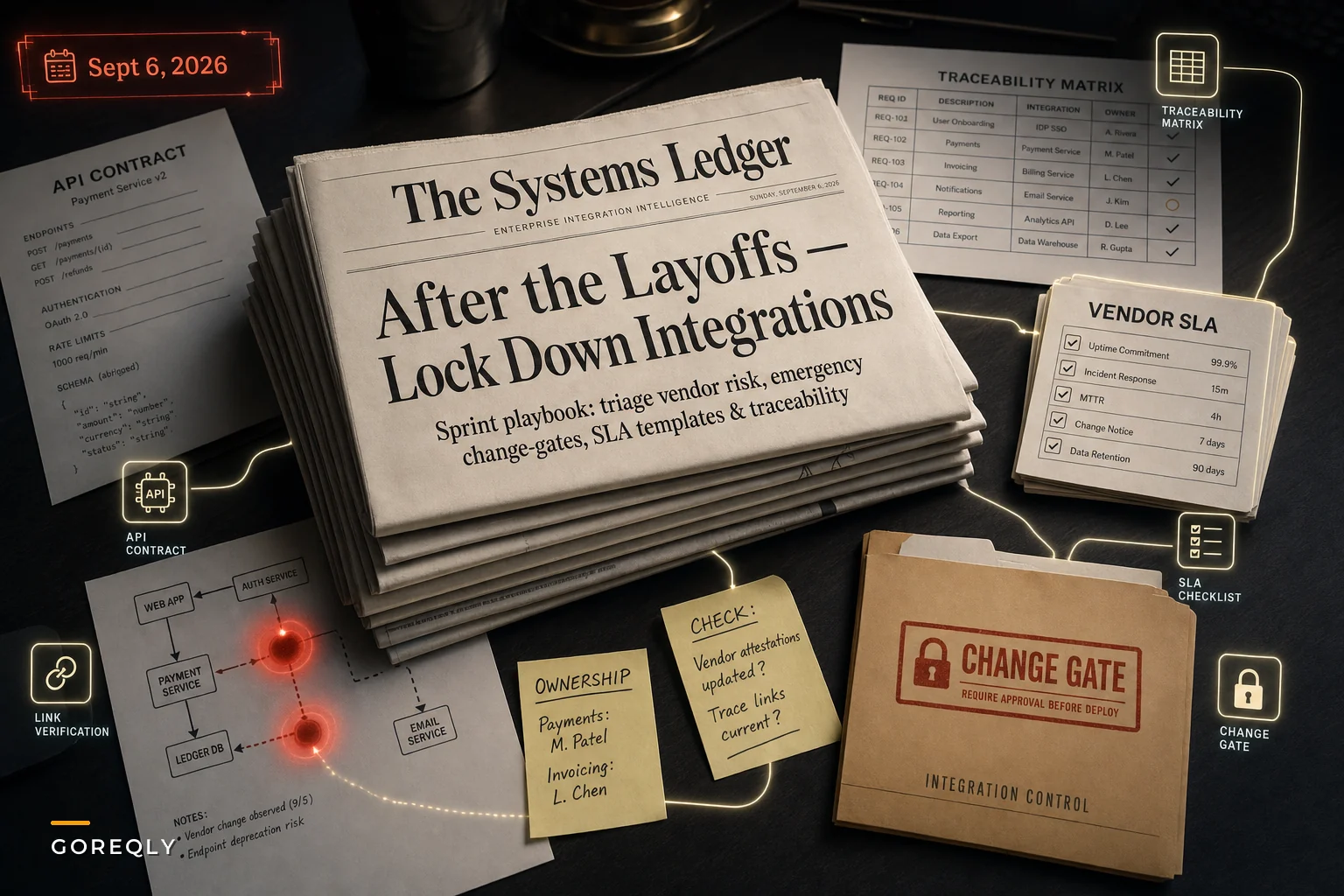

When Uber announced it was cutting roughly 3,300 roles — about 10% of staff — in its biggest restructuring since the pandemic, most of the coverage focused on the internal management-layer story. Reuters reported it as a flattening exercise. Fair enough. But if you run product or work as a BA inside a company that depends on a big platform's APIs, partner integrations, or engineering support, the interesting part isn't the headline. It's the quiet stuff that happens three months later.
Support response times drift. The engineer who understood that one weird webhook edge case is gone. A deprecation notice that used to come with six months of runway now shows up with six weeks. Nobody sends you an email saying "the team maintaining your integration got reorganized." You find out when something breaks and there's no one on the other end who remembers why it was built that way.
That's the actual risk large layoffs create for product teams. Not the vendor disappearing — that's rare. It's the slow erosion of knowledge, responsiveness, and continuity you were quietly depending on. And the teams that survive this well are almost always the ones who had their traceability and change-control discipline in place before the churn started.
The gap that layoffs expose
Vendor instability doesn't create integration problems. It exposes the ones you already had.
Most integration knowledge lives in three places: the vendor's engineers, your engineers, and a handful of Slack threads nobody can find anymore. When both sides are fully staffed and things are stable, that informality works fine. You can always ask someone. The knowledge gap is invisible because it never gets tested.
Then a restructuring hits — either theirs or yours — and suddenly the informal channel is gone. The Bloomberg account of the Uber cuts framed it as reducing management layers, which sounds harmless enough. But management layers are often where institutional memory and cross-team coordination actually live. When those get thinned out, the people who could answer "why does this integration behave this way" become harder to reach on both sides of the relationship.
This is where vendor churn traceability stops being a compliance nicety and becomes an operational survival tool. If you can't trace which requirements depend on which vendor endpoints, which acceptance criteria validated those endpoints, and who currently owns that dependency, you're flying blind the moment the vendor relationship gets shaky.
What actually breaks — a realistic walkthrough
The failure is rarely dramatic. It's a sequence of small things.
Stop losing track of critical project requirements.
GoReqly helps you capture, organize, and track every requirement with precision and clarity.
- Centralized requirements repository
- Collaborative editing & commenting
- Traceability & version control
No credit card required
A mid-size logistics SaaS depends on a mapping and routing provider for ETA calculations. The integration was built two years ago by an engineer who has since moved to another team. It works. Nobody touches it. The provider goes through a restructuring. Three months later, they push a minor API change — a field that used to return null now returns an empty array. Not a breaking change on paper. Their reduced docs team updated the changelog but not the migration guide. The logistics team's ETA feature starts silently producing bad numbers on roughly 4% of routes. No error, no alert — just wrong data. Support tickets trickle in slowly, phrased as "ETAs seem off lately." It takes the team about three weeks to trace it back to the API change, because:
-
The original requirement for that feature didn't link to the specific vendor endpoint
-
There was no owner listed for the integration after the original engineer left
-
The acceptance criteria tested "ETA displays" but not "ETA accuracy against known routes"
-
Nobody was watching the provider's changelog because the person who used to do that got reassigned during their own company's headcount review
None of these are exotic problems. Every one of them is a traceability gap that was survivable during stability and expensive during churn.
The knowledge that walks out the door
There's a specific kind of loss that happens with layoffs, and it's worth naming precisely because it's the hardest to recover from.
When a person leaves, you lose their tickets and their code — but you can recover most of that. What you can't recover is the reasoning. Why was this integration built with a retry loop instead of a queue? Why does this vendor call happen synchronously when it probably shouldn't? Why did we accept that weird rate limit?
Those decisions were rational at the time. But if the rationale only ever lived in someone's head, it leaves when they do. The next person inherits a system full of choices they can't explain, which means they can't safely change it. That's how integrations calcify — nobody dares touch the parts they don't understand.
The teams that handle churn well treat decision rationale as an artifact, not a memory. When you can look at an integration and see a linked decision record explaining why it works the way it does, a departure becomes an inconvenience instead of a crisis.
A triage sequence for the first two weeks after a provider shakeup
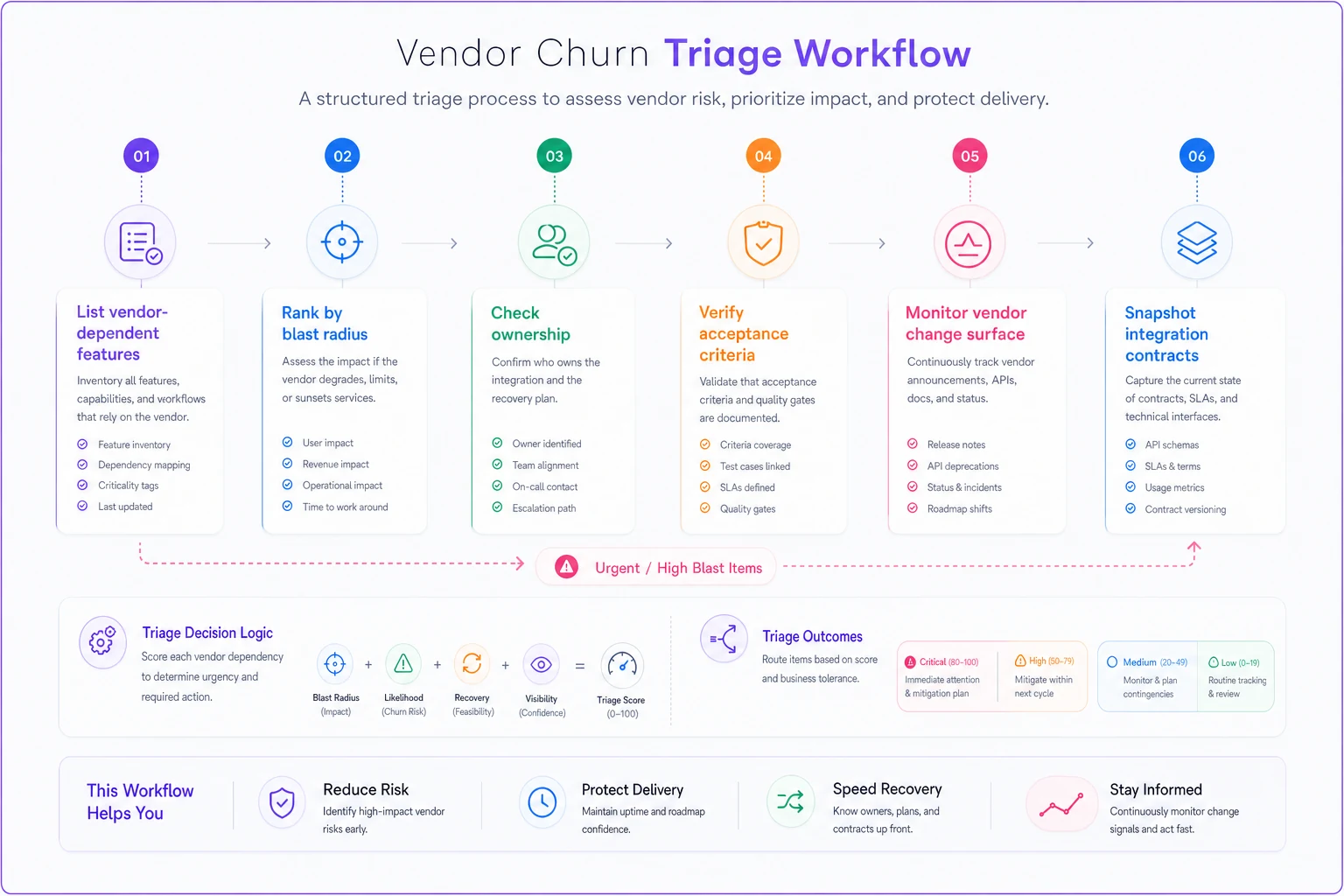
When you hear that a key vendor is restructuring — or when your own team takes cuts — don't try to fix everything at once. Triage. Here's a sequence that works under real time pressure:
-
List your vendor-dependent features. Not vendors — features. What breaks for the customer if this provider degrades? That's your prioritization lens.
-
Rank by blast radius, not by vendor size. A small provider handling your payment reconciliation matters more than a large one handling a cosmetic feature.
-
Check ownership for each dependency. For every high-blast-radius integration, is there a named, currently-employed human who owns it? Half the time, there isn't. Fix that first.
-
Verify your acceptance criteria test behavior, not just presence. "The field displays" is not the same as "the field is correct." Churn-era bugs hide in accuracy, not availability.
-
Confirm you're monitoring the vendor's change surface. Changelogs, deprecation notices, status pages. Assign a human to watch each one, even if it's a five-minute weekly check.
-
Snapshot your current integration contracts. Capture the exact request/response shapes you depend on today so you can detect drift later.
A simple triage workflow looks like this.
Notice what's not on this list: rewriting integrations, switching vendors, or building abstraction layers. Those are big projects. In the first two weeks, you're just trying to know what you have and who's responsible for it.
Change-control gates matter more when the other side is understaffed
During stable periods, you can afford to be relaxed about vendor change control because the vendor is being careful for you. Well-staffed teams give long deprecation windows, thorough migration guides, responsive support. That safety net thins during restructuring.
So the gate you enforce on your side has to get stricter to compensate. This is exactly the kind of discipline covered in more depth in this breakdown of specifying third-party integrations with vendor change-control gates — but the short version is that every external dependency should pass through a defined checkpoint before it hits production, and that checkpoint should get tighter the less you trust the vendor's stability.
| Control point | Stable vendor | Post-layoff / churn risk |
|---|---|---|
| Deprecation response window | Match vendor's timeline | Assume half the stated window |
| Changelog monitoring | Monthly review | Weekly, with named owner |
| Contract snapshots | On major version change | On every release you ship |
| Fallback behavior | Nice to have | Required for high-blast features |
| Acceptance criteria depth | Presence checks OK | Accuracy + behavior checks required |
| Ownership documentation | Team-level | Named individual, verified quarterly |
Assume half the stated window.
The point isn't to become paranoid about every vendor. It's to recognize that the implicit safety you were getting from a well-staffed provider is now something you have to build explicitly on your own side.
Where automation genuinely helps — and where it doesn't
There's a real limit to how much of this you can do manually across dozens of integrations. Manually checking whether every vendor-dependent requirement has a current owner, up-to-date acceptance criteria, and a fresh contract snapshot is the kind of task that gets skipped the moment things get busy — which is exactly when churn hits.
A traceability platform that maintains live links between requirements, vendor endpoints, tests, and owners earns its place not because it's clever, but because it keeps the boring maintenance from silently rotting. When a requirement links to a vendor endpoint and that link carries an owner and a last-verified date, you can pull a report answering "which of our integrations have gone stale or lost their owner" in seconds rather than a two-week manual audit. AI-assisted checks can flag drift — a contract snapshot that no longer matches the live response, an acceptance criterion that hasn't been validated since the vendor's last change — before it becomes a customer-facing bug.
What automation can't do is decide blast radius, negotiate with a vendor, or reconstruct the reasoning behind a decision nobody wrote down. Tooling maintains the trace; humans still own the judgment. Teams that expect software to replace that judgment usually end up with a very tidy record of a system they still don't understand.
When to invest heavily in this — and when not to
Not every team needs to go all-in on hardened vendor traceability.
This makes sense when:
-
A single vendor failure could cause customer-facing outages or bad data
-
You have more than a handful of third-party integrations
-
Your integrations were built by people who've since left
-
You operate in a space where a wrong number — billing, medical, logistics — causes real harm
This is overkill when:
-
Your integrations are cosmetic or easily bypassed
-
You have one or two vendors and everyone who built them is still around
-
Manual weekly checks genuinely cover your surface area
A small team with two stable integrations and no signs of vendor instability should not be sinking time into this right now. Building elaborate change-control gates for low-blast-radius dependencies is governance for its own sake, and over-governing is its own failure mode.
A real scenario: the payments integration that survived a provider's restructuring
A B2B invoicing product — small team, around 12 people — depended on a payments provider that went through a significant staff reduction. Before the churn, their integration traceability was typical: requirements existed, but links to specific endpoints were spotty and ownership was "whoever's around."
They spent about two weeks running through the triage sequence above. Nothing fancy. They mapped their five payment-related features to specific vendor endpoints, assigned a named owner to each, tightened acceptance criteria to check reconciliation accuracy rather than just "payment succeeded," and set up a weekly changelog check.
Roughly four months later, the provider deprecated an endpoint with a much shorter window than they'd historically given — about five weeks instead of the usual six months. Because the invoicing team had a live link between that endpoint and the two features that used it, plus a named owner watching the changelog, they caught it on day two. Migration took a focused sprint. No customer impact, no scramble, no bad reconciliation data leaking into invoices.
The comparison that matters: a similar team without that traceability would likely have found out when reconciliation started failing, spent a week or two tracing the root cause, and shipped the fix under emergency pressure. The difference wasn't smarter engineers. It was knowing what depended on what, and who owned it, before it mattered.
The underlying lesson
Layoffs at big platforms — Uber's included — are a reminder that the stability you're building on is borrowed, not permanent. The vendor's staffing, responsiveness, and institutional memory are all things you're implicitly depending on, and none of them show up in your architecture diagrams.
The teams that ride out vendor churn aren't the ones with the best vendors. They're the ones who assumed the safety net could thin at any time and built their own traceability, ownership, and change-control discipline accordingly. When the provider's team gets smaller, your discipline has to get sharper. Build it before the churn, and a restructuring on the other side becomes something you manage. Build it after, and it becomes something that manages you.
The teams that ride out vendor churn aren't the ones with the best vendors. They're the ones who assumed the safety net could thin at any time and built their own traceability, ownership, and change-control discipline accordingly. When the provider's team gets smaller, your discipline has to get sharper. Build it before the churn, and a restructuring on the other side becomes something you manage. Build it after, and it becomes something that manages you.
Ready to transform your product delivery?
Join 2,000+ teams using GoReqly to improve requirements accuracy, reduce rework, and accelerate time to market.