

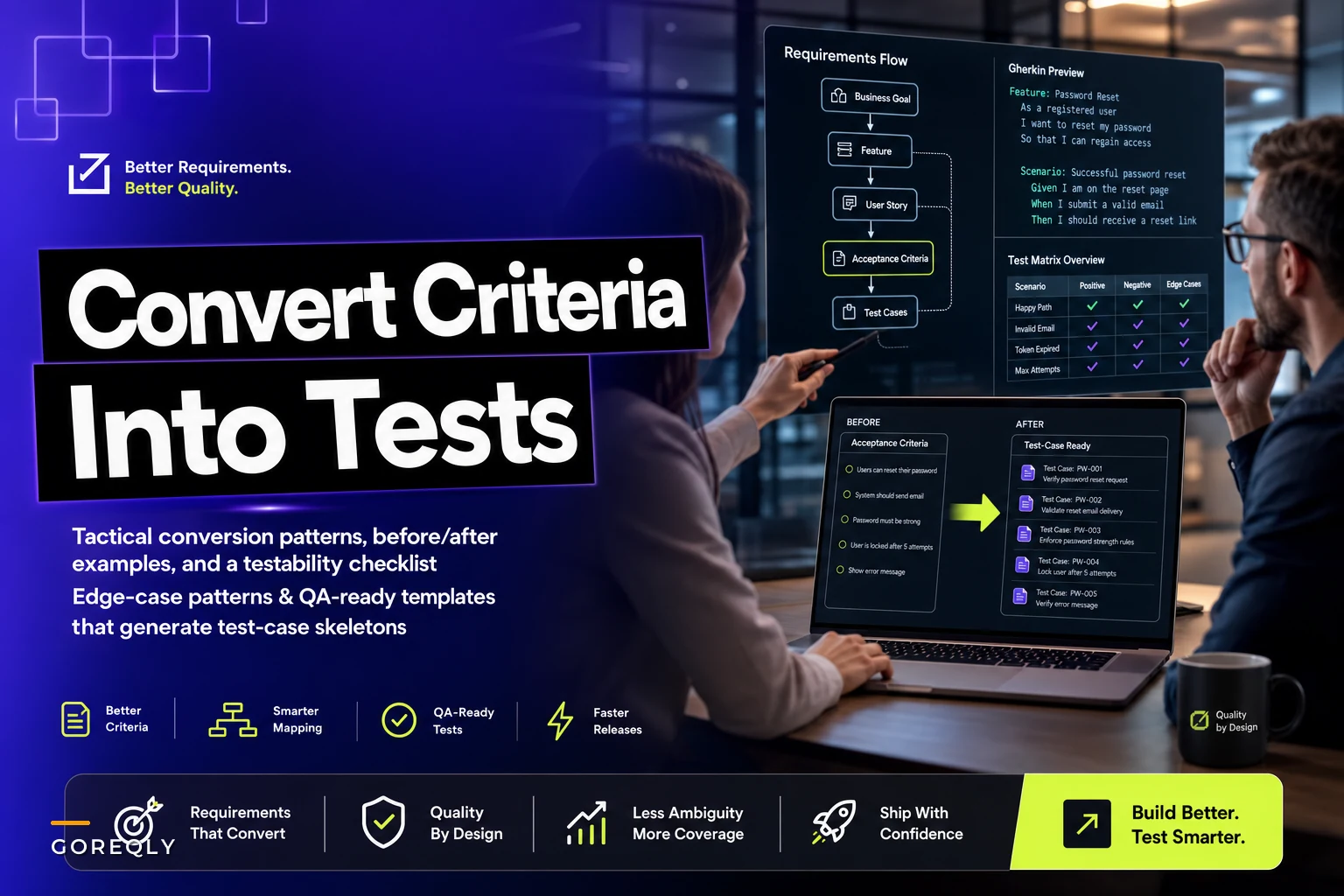

Your product team writes acceptance criteria that reads "Users should be able to filter products efficiently." The developer builds a filter that works. QA writes 47 test cases covering everything from SQL injection to Unicode characters. Three weeks later, a customer complains the filter doesn't save their preferences—something nobody tested because the original criteria never mentioned persistence.
The hidden translation problem between product definition and quality verification
This disconnect happens all the time. Not because people are incompetent, but because acceptance criteria and test cases operate in completely different languages.
One describes intent. The other verifies execution. The gap between them creates testing blind spots that only surface when real customers start using your product.
Why acceptance criteria fail the testability check
Most acceptance criteria get written to get stakeholder approval, not to guide test execution. They answer "what should this do?" instead of "how do we prove this actually works?"
Stop losing track of critical project requirements.
GoReqly helps you capture, organize, and track every requirement with precision and clarity.
- Centralized requirements repository
- Collaborative editing & commenting
- Traceability & version control
No credit card required
Here's criteria I saw from a logistics platform last month:
-
No definition of how distance gets calculated (straight line? actual roads?)
-
Weight boundaries completely undefined
-
Zero handling for edge cases like negative weights
-
No plan for when external mapping services fail
-
Calculation precision requirements missing
The QA engineer wrote 23 test cases based on educated guesses. Half got rejected during review because they tested behaviors the product owner never actually wanted.
This keeps happening because acceptance criteria and test cases optimize for different things. Criteria need stakeholder buy-in. Test cases need executable precision.
Tactical conversion patterns that work
Stop leaving criteria at the intention level. Expand each one into testable scenarios:
Pattern 1: The Given-When-Then expansion
Before: "Users can export their transaction history" After: GIVEN a user with 150 transactions across 3 months WHEN they select export with date range 01/01-01/31 THEN system generates CSV with 42 transactions AND file includes columns: date, amount, description, category AND amounts match database values to 2 decimal places
Pattern 2: The boundary definition template
Before: "System handles bulk uploads" After: Minimum case: 1 record upload completes in <2 seconds Standard case: 100 records upload completes in <30 seconds Maximum case: 10,000 records upload completes in <5 minutes Boundary case: 10,001 records shows error "Upload limit exceeded" Zero case: Empty file shows error "No records found"
Pattern 3: The state transition map
State: PENDING → Action: Cancel → Result: CANCELLED (refund triggered) State: PROCESSING → Action: Cancel → Result: CANCEL_REQUESTED (requires approval) State: SHIPPED → Action: Cancel → Result: ERROR "Cannot cancel shipped orders" State: DELIVERED → Action: Cancel → Result: ERROR "Cannot cancel delivered orders" State: CANCELLED → Action: Cancel → Result: ERROR "Order already cancelled"
Visualizing the conversion steps helps teams spot gaps.
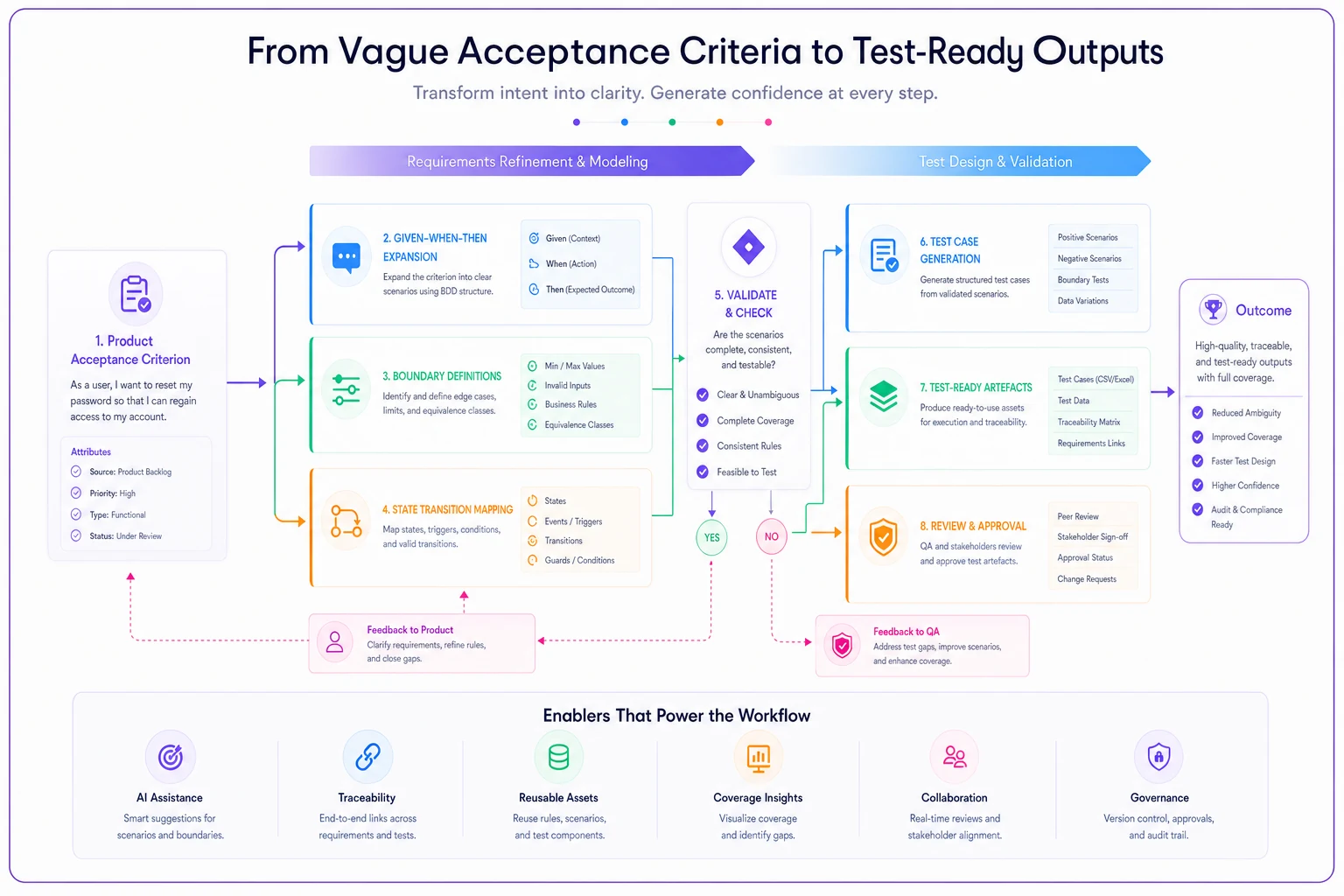
This forces you to be specific. You can't write "THEN file is generated correctly"—you need measurable outcomes that someone can actually verify.
Real-world transformation example
Here's an actual transformation from a restaurant ordering platform:
Original criteria:
"Restaurant staff should be able to modify orders before kitchen preparation begins"
What QA discovered:
-
"Modify" undefined—add items? remove? change quantity? substitute?
-
"Before preparation" unclear—what signals preparation started?
-
No mention of permission requirements
-
No price recalculation logic specified
-
No customer notification requirements
Converted test-ready version:
Test Scenario Set 1: Modification Types
GIVEN order #4521 with status "RECEIVED" containing 2 items WHEN staff adds item "Extra Rice" ($3.50) THEN order total increases by $3.50 AND order version increments to 2 AND modification logged with timestamp and staff ID
Test Scenario Set 2: Status Boundaries
GIVEN order status = "RECEIVED" WHEN modification attempted THEN modification succeeds AND status remains "RECEIVED" GIVEN order status = "PREPARING" WHEN modification attempted THEN modification fails AND error shows "Order already in preparation"
Test Scenario Set 3: Permission Matrix
Role: SERVER → Can modify own tables only Role: MANAGER → Can modify any order Role: KITCHEN → Cannot modify, view only Role: HOST → Cannot access order modification
The testability checklist
Before criteria leave refinement, verify these elements:
-
Inputs defined? - [ ] All user inputs have format specified - [ ] Acceptable ranges documented - [ ] Invalid input handling defined - [ ] Empty/null cases addressed
-
Outputs measurable? - [ ] Expected results quantified - [ ] Success indicators specified - [ ] Error messages documented - [ ] Response times defined
-
States mapped? - [ ] Initial state described - [ ] End state described - [ ] Transition triggers identified - [ ] Parallel states considered
-
Boundaries explicit? - [ ] Minimum values set - [ ] Maximum values set - [ ] Edge cases listed - [ ] Overflow behavior defined
-
Dependencies called out? - [ ] External service behaviors documented - [ ] Fallback scenarios defined - [ ] Timeout handling specified - [ ] Data availability assumptions stated
Before criteria leave refinement, verify these elements:
Edge cases most teams miss
Concurrent modification trap
Two users modify the same record simultaneously. Most criteria never specify which change wins or how conflicts resolve. This creates intermittent production bugs that are nearly impossible to reproduce.
USER A loads order #823 at 10:15:30 USER B loads order #823 at 10:15:31 USER A adds item at 10:15:45 USER B removes item at 10:15:46 EXPECTED: Last write wins OR optimistic locking error
Timezone assumption gap
Server timezone: EST User timezone: PST Restaurant timezone: CST Order placed at 4 PM PST (7 PM EST, 6 PM CST) VERIFY: Which timezone determines "after 5 PM"
Permission degradation scenario
What happens when permissions change mid-session? User starts editing with admin rights, gets demoted to viewer while form is open, then tries to save.
-
User opens edit form with EDITOR role
-
Admin changes user to VIEWER role
-
User attempts save
-
Expected
Graceful failure with "Permissions changed" message
Expected: Graceful failure with "Permissions changed" message
QA-ready templates
Template 1: CRUD operation matrix
| Operation | Valid Case | Boundary Case | Invalid Case | Error Message |
|---|---|---|---|---|
| CREATE | New record with all required fields | Maximum field lengths | Duplicate key | "Record already exists" |
| READ | Single record by ID | 1000 records with pagination | Non-existent ID | "Record not found" |
| UPDATE | Change single field | Update all fields | Update deleted record | "Cannot modify deleted record" |
| DELETE | Soft delete active record | Delete already deleted | Delete with dependencies | "Cannot delete: active references exist" |
Template 2: State machine verification
STATE: [Current State] TRIGGER: [Action/Event] GUARD: [Condition that must be true] OUTCOME: [New State] SIDE EFFECT: [What else happens] TEST: [How to verify] Example: STATE: PENDINGPAYMENT TRIGGER: Payment received webhook GUARD: Amount >= order total OUTCOME: PAYMENTCONFIRMED SIDE EFFECT: Email sent, inventory reserved TEST: Check state change, verify email queue, confirm inventory decrement
Template 3: Integration point checklist
External Service: [Name] Success Case: [Expected response and handling] Timeout Case: [Behavior after X seconds] Error Case: [Behavior on 4xx/5xx] Unavailable Case: [Behavior when service down] Data Format Mismatch: [Behavior on unexpected response structure] Rate Limit: [Behavior when throttled]
How operational software helps
Converting acceptance criteria to test cases doesn't have to be entirely manual. AI-powered operational platforms can spot testability gaps during criteria creation.
These systems analyze criteria as teams write them, flagging ambiguous phrases like "quickly" or "efficiently" and suggesting specific metrics. When someone writes "users can upload files," it prompts for file size limits, format restrictions, and error handling specifications.
One e-commerce team using this approach reduced their criteria-to-test translation time from 4 hours to about 45 minutes per feature. Their test coverage improved too—catching 3x more edge cases before code review.
The automation doesn't replace human judgment. It surfaces the questions QA would ask later, but during planning when fixes cost less.
When to skip this approach
This level of criteria detail doesn't fit every team. Skip this if:
-
You're prototyping or in early MVP stage where features change daily
-
Your QA team is already embedded in product planning
-
You have dedicated QA automation engineers writing tests during development
-
Your product is internal-only with forgiving users
The overhead only pays off when the cost of production bugs exceeds upfront specification costs.
Making it stick operationally
Getting teams to write test-ready criteria requires operational changes, not just templates.
Have QA review criteria before sprint planning, not after development starts.
Have QA review criteria before sprint planning, not after development starts. This happens in roughly 30% of teams, but QA spots testability issues while they're still cheap to fix.
Create a shared glossary of testable terms. "Fast" becomes "<3 seconds". "Large" becomes ">10MB". "Many" becomes "50-100". This removes ambiguity without lengthy documents.
Track test cases rejected during review due to assumption mismatches. When this number drops, criteria quality improves. One team went from 40% rejected test cases to under 8% in two months using these patterns.
Developers start thinking in test cases during implementation when criteria make edge cases obvious. QA finds fewer bugs because developers handle the scenarios QA would test anyway.
The gap between acceptance criteria and test cases isn't a communication problem—it's a translation problem. Product teams write for stakeholder understanding. QA teams need execution precision. These patterns create that bridge without overwhelming documentation or slowing delivery.
Ready to transform your product delivery?
Join 2,000+ teams using GoReqly to improve requirements accuracy, reduce rework, and accelerate time to market.